


Cuts to Renewable Energy Research in Energy Department’s Budget Irk Senate Democrats
Although the department’s overall budget will increase in 2027, the amounts dedicated to environmental management, research and renewable energy infrastructure face significant hits.
Democrats on the Senate Energy and Natural Resources Committee have challenged the Department of Energy’s proposal that would divert funds from solar and wind while keeping fossil fuel plants online past their retirement dates.
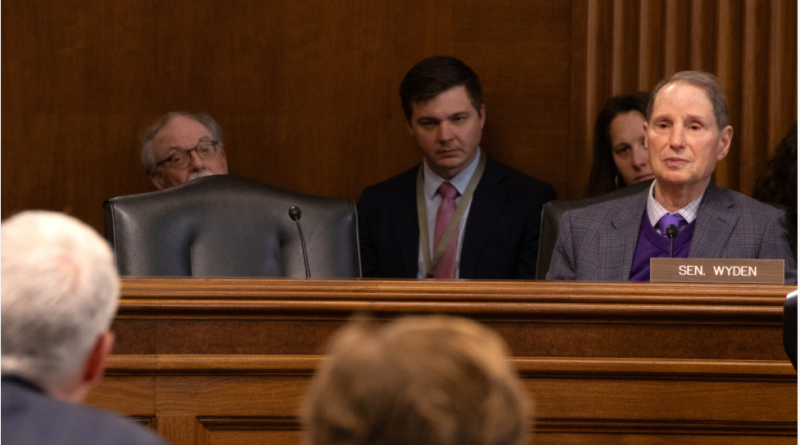
At an April 21 hearing on the fiscal year 2027 budget, Sen. Ron Wyden (D-Ore.) was strident in his disapproval of Secretary Chris Wright’s prioritization of fossil fuel plants over cleaner technologies.
“We have a role [for wind and solar power], the clean energy tax credit, and the private sectors loved the fact that they were technologically neutral,” Wyden said. “They were voluntary, there were no mandates, and you all pulled it out by the roots, over the opposition of people in natural gas—of all industries—who said, ‘Look, we love gas, but we also need renewable clean energy to hold it up.’”
While Congressional Democrats have defended a transition to renewable sources, some Republicans have argued those sources are not as reliable as fossil fuels. The conflict in Iran has raised fuel prices and disabled key energy infrastructure, making the issue more pressing.
Since last May the department has issued a series of emergency orders requiring multiple coal-fired power plants in the continental U.S. and Puerto Rico to remain operational despite plans for retirement.
Those federal actions are having ripple effects throughout the country’s utilities. Southern Company said it would continue operating coal-fired plants in Mississippi and Georgia, and North Carolina’s legislature passed the “The Power Bill Reduction Act,” allowing Duke Energy to backslide on its legally mandated carbon emissions reductions.
At the hearing, Wright defended his proposal to subsidize fossil fuel generation as a way to “restore grid reliability.” He said his department separated extra funding for those plants after an internal outage risk analysis showed the odds could increase up to 100-fold by 2030 due to supply shortage.
But the investment in coal power might be less appealing for investors than renewables, as the country’s coal plants are older and more costly to operate.
“The market doesn’t seem to agree with you,” Sen. Angus King (I-Maine) told Wright. “This year, according to the Energy Information Administration, we’re talking about increases in capacity … That’s the market telling us these technologies work.”
“There were a lot of distortions in that data,” Wright replied.
He added that the buildup of wind and solar energy over the past year was a result of the federal subsidies under the Biden administration, not market forces. “If you look at where the capital is going … You’ll see natural gas is by far in the lead,” he said.
The committee’s Republican members celebrated Wright’s budget proposal. Some applauded the secretary’s decisions on refocusing research and delivering reliable and predictable energy. “The U.S. Department of Energy is set to be in progress in getting our country back in the right direction when it comes to energy,” Chairman Sen. Mike Lee ( R-Utah) said.
The rising oil prices as a result of the Iran War were also discussed.
On Sunday, Wright said in an interview with CNN that gasoline prices in the United States could remain elevated for months, contradicting his early March statement that the average gas price in the nation would fall below $3 a gallon within “weeks” of the initial airstrikes against Iran in late February. The statement also contradicted President Trump’s earlier claim that high fuel prices would be “short-term.”
At the hearing, Wright said he did not know the future of energy prices. “I would say gasoline prices, it looks like they peaked about a week or so ago,” he said.
Sen. Maria Cantwell (D-Wash.) also questioned Wright’s decision to cut programs she described as “the future” for solving the fuel crisis, like the Hydrogen Program, which conducts research and development for hydrogen storage and fuel cells for transportation, as well as the tax credit for sustainable aviation fuel, which was eliminated in the One Big Beautiful Bill Act. “You’re really crippling the next generation of jet fuel,” she said. Wright assured Cantwell those prices will get “cheaper as time goes forward.”
A Big Increase for Nuclear—and Big Cuts for Science and Renewables
The Trump administration requested a $53.9 billion budget for the Energy Department in FY 2027, a 10 percent increase from FY 2026. But the entire increase would be devoted to the National Nuclear Security Administration and its defense-related programs like counterterrorism and managing and modernizing the nation’s nuclear weapons stockpile. The portion of the budget not related to defense would be reduced 16.5 percent, to $12.5 billion, with major cuts to funding for renewable energy research.
About 15 percent of the budget is dedicated to environmental management—cleaning up of nuclear waste from legacy government research and weapons sites across the country, and soil and groundwater remediation. Its funding is set to decrease by 5 percent, with a noteworthy cut to river protection efforts.
Wright has also proposed two entirely new programs: Baseload Power and Artificial Intelligence and Quantum.
The Baseload Power program would devote $3.5 billion to subsidizing upgrades and modernization of power plants that are slated for retirement by 2030—most of them coal plants—as well as construction of new “baseload” facilities and pipelines. The investment also includes funds for nuclear power and hydropower plant upgrades.
The Trump administration has maintained that even though the amount of new generation planned to come online by 2030 is more than double the amount that is retiring in terms of gigawatt capacity, it will not be an adequate replacement. Most of the new generation in the project pipeline is wind, solar and battery storage projects, which Wright and his team have maintained are not as reliable as so-called “baseload” power that runs at a constant rate and can be dispatched at any time of day.
According to the budget proposal, the nation will be unable to meet projected demand for manufacturing, re-industrialization and data centers unless it addresses “the accelerated retirement of existing generation capacity and the insufficient pace of firm, dispatchable generation additions.”
An additional $1.2 billion investment was allocated for Artificial Intelligence and Quantum. The new appropriation intends to support multiple AI supercomputers at the Argonne and the Oak Ridge national laboratories. The fund is also set for the oversight of the Genesis Mission—described as a national initiative to build the world’s most powerful AI-generated scientific platform to “accelerate discovery, strengthen national security and drive energy innovation.”
In contrast, science appropriations will see the largest decrease in absolute terms, of about $1.1 billion. The budget for Biological and Environmental Research faces a 54 percent decrease. The budget also cancels over $15 billion in grants for renewable energy infrastructure.
Addressing Wright at a House budget hearing on April 16, Rep. Frank Pallone Jr. (D-N.J.) said the Trump administration’s energy policies have been an “absolute disaster” and condemned the current conflict in Iran that has increased energy prices for Americans.
“Rather than trying to soften the blow for Americans, the Department of Energy, under your leadership, has only made things worse,” he said. “DOE has attacked energy efficiency standards, cancelled or delayed clean energy projects, and slowed down important cost-saving programs.”
The House and Senate will now incorporate the Energy Department’s requests—and their own priorities—in their appropriations bills.
Cover photo: Sen. Ron Wyden (D-Ore.) said President Trump “took a wrecking ball to solar and wind energy projects.” Credit: Gabriel Matias Castilho/Inside Clean Energy