

As the UN Global Climate Talks Lose Momentum, a Smaller Coalition Eyes a Fossil Fuel Exit
More than 50 countries will gather in Colombia to try to develop real-world timetables to phase out oil and gas amid global energy shocks and petrostate stalling.
In an overheated and fractured world that’s lurching from one crisis to the next to feed its oil and gas addiction, collaboration toward an energy transition may seem unrealistic or even radical.
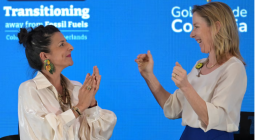
But more than 50 nations are gathering in Santa Marta, Colombia, today to start mapping out specific plans to phase out fossil fuels, going beyond the conditional global consensus on “transitioning away from fossil fuels in energy systems” reached at COP28 in Dubai. A lack of progress toward that goal spurred Colombia and the Netherlands to build a coalition of countries willing to move faster and farther.
Attending countries span a spectrum from influential fossil fuel producers like Australia, Norway, Brazil, Nigeria and Mexico to climate-vulnerable island nations including Fiji, Tuvalu and the Maldives, as well as Denmark, Spain and France and the European Union. Notably absent are the United States, Russia, China and major Gulf petrostates such as Saudi Arabia and the United Arab Emirates.
Offering a perspective from The Elders, a group of former independent world leaders that acts as a moral and ethical voice on issues of peace, justice and climate, former President of Ireland Mary Robinson described the conference as “a new multilateral space for a committee of doers … those who want to collaborate and usher out fossil fuels.”
At a webinar just days before the conference, Robinson put the conference squarely into the context of current events. “It’s such a serious moment,” she said. “The United States and Israel have waged an illegal war against Iran and the consequences have been felt worldwide.”
She said the erosion of international law and the global economic impacts caused by the Iran war shows why a just transition into renewables is now “a security imperative.” The second major energy shock in just four years isn’t just a wakeup call, she added, but “a clear signal that our energy systems need urgent structural change.”
Instead of trying to drag every reluctant petro‑state along at once, Colombia and the Netherlands are hoping to build a modular coalition of countries to develop practical timetables and mechanisms for protecting people, communities and ecosystems while electrifying transport and industry and boosting conservation and efficiency to displace fossil fuels.
She said Spain, with plenty of solar and windpower, has been able to keep power prices lower than in countries still more dependent on fossil fuels, adding that the people-led solar revolution in Pakistan has already helped the country avoid more than $12 billion in fossil fuel imports.
The organizers planned the conference with the belief that the faster-moving subset of states can pilot practical ideas now and later incorporate them into the slower-moving climate policy formulations of the United Nations Framework Convention on Climate Change.
Compared to the biggest UN climate summits that draw more than 50,000 participants, and where countries can haggle for days over commas in legal text, the Santa Marta conference is designed to be accessible to a broader audience, with more open sessions and livestreaming.
Rather than treating civil society as an afterthought, the conference in Santa Marta will include a People’s Summit of community groups, unions, Indigenous leaders and public-interest advocates, called civil society, in the formal process. Organizers hope that a successful meeting could reinvigorate climate activism in participating countries, helping build momentum to ditch fossil fuels as soon as possible.
Holding the conference in troubled times, when “some bullies are even trying to force countries to stay dependent on fossil fuel” is an achievement in itself, Robinson said, showing that much of the world wants to speed up the transition from fossil fuels despite political headwinds.
She noted that last year’s advisory opinion on climate change from the International Court of Justice in The Hague clarified that “breaking free from fossil fuels is no longer just a political obligation,” she said, adding that the court said states need to take appropriate action to protect the climate.
Santa Marta should be seen as the start of a new process, not a place “to expect a big, grand declaration,” said Natalie Jones, a senior policy advisor with the International Institute of Sustainable Development, a nonprofit group that closely monitors and analyzes international environmental talks.
Jones said it’s a rolling process, not a make-or-break meeting, and because the conference supports ongoing work by the Brazilian COP30 presidency, she said whatever comes out of Santa Marta will inform a series of climate meetings during the coming months, perhaps spurring further momentum toward the transition at COP31 in Antalya, Turkey, in November.
Any step to accelerate the transition away from fossil fuels helps, not just for climate reasons, “but also for energy security and affordable energy for households and businesses,” she said.
The current global energy system is uncertain and chaotic, with price spikes and shortages that always hits the most vulnerable people first and hardest. What’s needed, she said, is a “stable and credible policy environment” to create conditions for a faster fossil fuel phaseout. The roadmaps envisioned as the conference starts, she added “are how governments give investors, workers and communities a clearer sense of direction.”
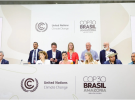
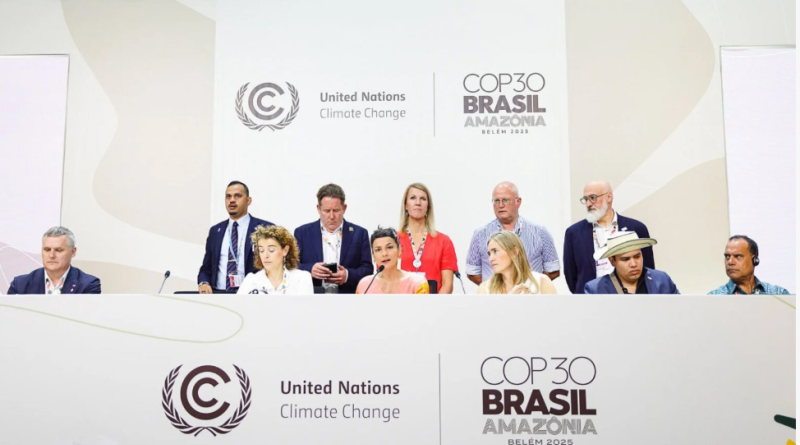
Cover photo: A panel announces the First Conference on Transitioning Away from Fossil Fuels during the COP30 in Belém, Brazil, on Nov. 21, 2025. Credit: First Conference on Transitioning Away from Fossil Fuels