

‘Carpe Digital’: Africa must seize climate tech moment – AGES 2026
Climate data must be embedded within mainstream digital infrastructure planning
Africa must “seize the digital” to unlock its climate ambitions, Africa’s Green Economy Summit 2026 (AGES) heard, as investors, policymakers and technologists discussed how the continent’s data boom can accelerate—rather than derail—the green transition.
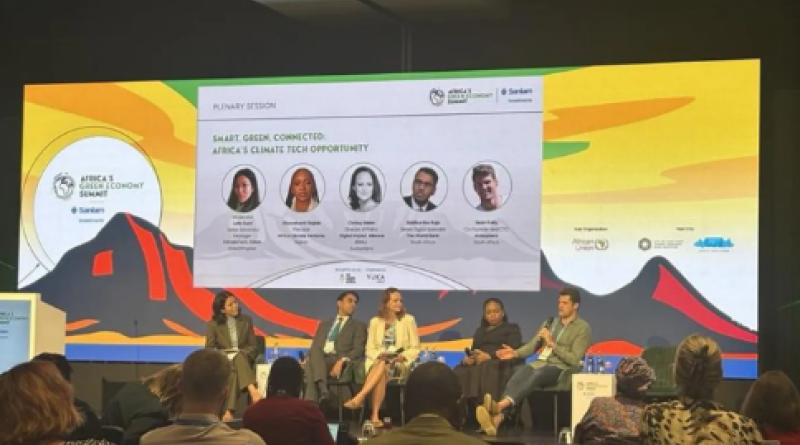
The session, titled Smart, Green, Connected: Africa’s Climate Tech Opportunity, examined the fast-converging digital and climate agendas.
With data centre investment surging and artificial intelligence (AI) adoption gathering pace, speakers argued that the right policy frameworks and data governance systems could turn digital infrastructure into a powerful climate enabler.
Moderated by Leila Guici of the GSMA, the panel brought together representatives from the World Bank, Digital Impact Alliance, Africa Climate Ventures and South African tech start-up Anisoptera.
Data centres as green anchors
Siddhartha Raja, Senior Digital Specialist at the World Bank, said digital infrastructure investments must be shaped by long-term policy thinking to ensure they deliver both climate and development gains.
He argued that large-scale assets such as data centres and telecommunications networks could serve as “anchor loads” within national power systems, helping to crowd in renewable energy generation.
“Are we able to leverage that into investments, for example, in renewable energy that are being made by the energy suppliers and the generators?” Raja asked.
Without relevant local data, AI-driven climate tools risk missing the realities of African communities.
He pointed to the potential for hybrid telecoms and data centre projects to stimulate clean energy deployment but he cautioned that climate resilience must be embedded at design stage.
From flood-proofing facilities to improving day-to-day operational efficiency, small interventions can yield significant gains. Even seemingly minor oversights, such as leaving cardboard packaging inside server rooms, can reduce energy efficiency by disrupting airflow, he noted.
Raja also highlighted the often-overlooked issue of e-waste. The rapid expansion of digital infrastructure will generate millions of dollars’ worth of end-of-life equipment, creating both an environmental risk and a commercial opportunity.
“In some cases, [this is] triggering the creation of e-waste systems that didn’t exist before,” he said.
Raja suggested policy can catalyse entirely new recycling industries.
Beyond the infrastructure itself, Raja stressed that improved connectivity enhances access to information and service delivery, enabling businesses and citizens to make better climate-related decisions.
Climate data gaps constrain cities
Chrissy Meier, Director of Policy at the Digital Impact Alliance, shifted the focus to data governance and digital public infrastructure.
While most African cities now have climate action plans, she said many lack the granular, accessible datasets required to implement them effectively.
“Climate resilience, climate adaptation, climate action… these are key things that are now affecting daily lives. But the data to make informed decisions often doesn’t exist,” Meier explained.
She argued that digital public infrastructure conversations remain overly concentrated on payments, digital ID and data exchange, while neglecting geospatial and climate-relevant data.
Hyper-local datasets are essential, she said, whether mapping urban heat islands or tracking tree-planting campaigns to reduce temperatures in vulnerable communities. Yet such data often needs to be gathered by citizens, standardised and made interoperable across platforms.
Caution needed over AI models that lack Africa context
Meier also warned against over-reliance on AI models trained predominantly on non-African datasets. Without relevant local data, AI-driven climate tools risk missing the realities of African communities.
To unlock data sharing, she advocated for “data trusts” and governance frameworks that provide clarity on access rights and safeguards, helping governments and private firms feel more comfortable sharing sensitive information.
However, financing remains a critical bottleneck. Many climate-tech data solution providers struggle to access patient, blended capital to build viable markets.
“The cities know they need data. The solution providers are starting to innovate. But the financing simply isn’t there,” she said.
Policy as a risk-pricing tool
From an investor’s perspective, OluwaKemi Olajide, Principal at Africa Climate Ventures, said policy can be either a powerful enabler or a significant barrier.
For policy to catalyse investment, she argued, it must align with infrastructure time horizons and fundamentally reshape how risk is priced.
“It needs to give comfort and certainty around expected revenues… and support the frameworks in which companies operate,” she said.
Encouragingly, she pointed to progress in African carbon markets, where emerging regulatory frameworks, guarantees and first-loss facilities are helping to de-risk projects for commercial investors.
Yet fragmentation across jurisdictions remains a challenge. Misaligned national policies can complicate continent-wide investment strategies, limiting scale.
Overall, Olajide described the climate-tech convergence as “here to stay”, urging closer collaboration between governments and private capital providers to craft durable, harmonised frameworks.
Access to data fuels innovation
Sean Kelly, Co-Founder and CTO of Anisoptera, underscored the commercial dimension of open data access.
He noted that AI models trained on the same datasets tend to reach similar performance benchmarks, suggesting that access to quality data, rather than proprietary algorithms alone, is the true competitive differentiator.
Greater data accessibility would stimulate entrepreneurship and enable more climate-tech businesses to emerge, he noted.
At the same time, he cautioned that intellectual property disputes around AI training data are likely to intensify, raising complex regulatory questions for emerging markets.
‘Seize the digital’
In closing remarks, the panel coalesced around a simple message: Africa must treat climate data as core infrastructure, not an afterthought.
Meier called for climate data to be embedded within mainstream digital infrastructure planning, ensuring interoperability and accessibility for decision-making, not just monitoring.
Raja summed up the mood with a reworking of the Latin maxim carpe diem. “I would change it to Carpe Digital. Seize the digital. There’s a massive opportunity to use all of these technologies to change how economies operate… to make them more efficient, more inclusive, greener,” he said. ESI
Cover photo: Panellists at Africa’s Green Economy Summit 2026 discussed the topic Smart, Green, Connected: Africa’s Climate Tech Opportunity. Source: ESI Africa