

Ireland Tells Data Center Developers To Bring Their Own Clean Energy
Ireland boasts more data centers than almost any other country in Europe. Those data centers create lots of tax revenue and jobs that are vital to the financial health of the nation. Most new data centers would like to be located near Dublin. That’s where the people are with the education and experience to operate those data centers. It is also where most of the digital links to the internet within Ireland are located.
There is a problem, however. Way back in 2021, the grid operator in the Dublin area warned it could not supply the enormous amounts of electricity needed to power new data centers without creating a danger of widespread rolling blackouts. As a result, no new data centers have been built in or around Dublin for the past four years.
In December, the Commission for Regulation of Utilities announced a new policy that said any data center wanting a grid connection must install on-site generation or battery systems capable of meeting its full electricity demand. In addition, data center operators will be required to provide power back to the national grid when needed.
The new guidelines also require at least 80% of the electricity needed to operate a new data center must come from new renewable energy sources. Utilities also have new obligations under the new rules. They will be required to publish regular updates on their capacity to accommodate new connections and submit annual reports on their renewable-energy use and carbon emissions.
According to Bloomberg, Ireland is one of Europe’s largest data center hubs. Collectively, they consume about a quarter of the country’s electricity. That’s more than all the urban households in the country and up five-fold from just a decade ago.
The moratorium on new connections was a concern for industry groups, who argued that Ireland was missing out on global capital during a boom in infrastructure construction to support artificial intelligence applications. Investment in new Irish sites had largely dried up.
Some will ask why we need to spend so much time and money on an industry that focuses on pornography and helping school children avoid doing their own homework. Those are the same Luddites who question why taxpayers should have to build roads to access new sports stadiums owned by billionaires.
A LEAP Forward
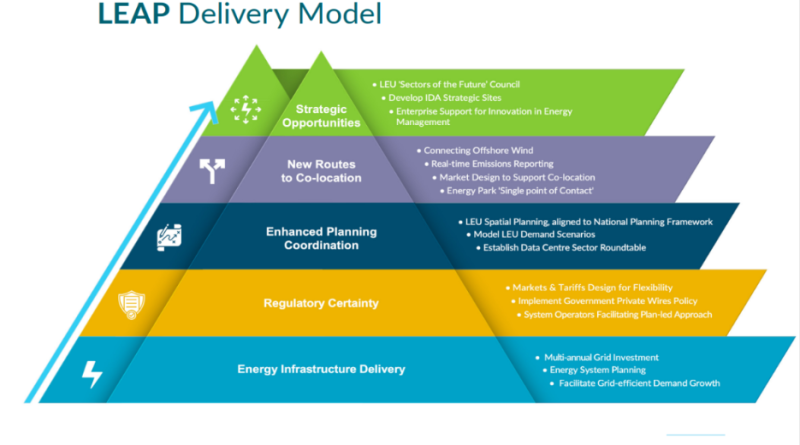
On January 13, 2026, the Irish government unveiled a new Large Energy User Action Plan that calls for establishing special business parks where large consumers of electricity will have easy access to clean power. The so-called Green Energy Parks will be located close to renewable energy sources such as offshore wind installations.
In the Executive Summary, the plan says, “This Large Energy-User Action Plan (LEAP) sets out the Government’s approach to planning for sustainable new energy intensive industrial developments. It prepares for a plan-led approach to the location of very large energy user (LEU) sectors, especially in the period beyond 2030, including through identifying green energy park locations. This will facilitate co-locating the most energy intensive industrial developments with indigenous renewable energy supply.”
The plan provides “additional certainty for the sector to ensure that we can bring more jobs in, bring more investment in,” Energy Minister Darragh O’Brien told the press. It “addresses existing barriers on energy intensive industrial developments,” he said.
Finding A Balance
Bloomberg says Ireland is trying to balance energy security for households “with a need to stay competitive as a location for foreign direct investment, which is hugely important to the country. It drives a large portion of the economy and generates huge tax revenues for the state, making Ireland one of the few European countries running a budget surplus.”
The changes in policy may lead to other changes in how electricity is generated and distributed in Ireland. At the present time, only the grid operator can own a line that carries electricity from a generator to a customer, but legislation to change that is under consideration. It’s all part of a re-imagining of the electrical grid from a place with a single point source to one that has multiple inputs that allow neighbors to share electricity with each other.
US Ignores Renewables
Sharp-eyed CleanTechnica readers (that may be redundant) will note that the US has no similar plan. In fact, American politicians are falling all over themselves to promote new thermal and nuclear generating capacity for data centers that will spew millions of tons of planet heating emissions into the atmosphere.
At the same time, there is a sense of near panic that these data centers must be built as quickly as possible so more people can get their daily porn fix faster. Let’s reactivate Three Mile Island that has been closed for three decades! What could possibly go wrong? There is even an idea to use the nuclear reactors in Navy vessels to generate the electricity the tech bros so desperately want.
Perhaps we could grow more corn to turn into ethanol to burn? The farmers would like that. Of maybe some thick Venezuelan crude would come in handy for powering those behemoths, or we could use more “portable” methane generators like Elon Musk is using to poison the air over Memphis because he can’t wait for the local grid to supply the electrons xAI needs. No one in the US dares mention the dreaded words “renewable energy” for fear of angering the glowering tyrant in the White Man’s House — what’s left of it.
We need more electricity because of all the wondrous things artificial intelligence can do. Yet we ignore the one source of electricity that can get installed the fastest and is cheaper than virtually any other source of electrons. All this twisting ourselves into knots because one man hates renewable energy with such a fierce passion that the entire nation must be made to suffer.
Everyone is so giddy about AI that no one is giving a thought to the environmental harm that will follow in its wake just as surely as night follows day. How refreshing it would be if there was more actual intelligence evident in the US today.
Cover photo: Government of Ireland