

Talking About Energy Dominance? Solar Would Like to Have a Word.
We are in the solar-powered century, although some are taking their time to figure this out.
There’s a lot happening right now in U.S. energy and policy and it’s easy to lose track of the larger picture. I’m going to ask you to turn your attention, at least for a few minutes, to something bigger that’s also happening:
Solar power is moving toward dominance of the global energy system.
The trend lines for solar deployment, panel prices and efficiency all point to a future in which energy is cleaner, cheaper and more accessible than today.
A recent paper in Nature Energy summarizes where we’re likely heading. It lists more than 60 co-authors from some of the world’s leading research institutions, including the National Laboratory of the Rockies (which was the National Renewable Energy Laboratory before a recent name change), the Fraunhofer Institute for Solar Energy Systems in Germany and the National Institute of Advanced Industrial Science and Technology in Japan.
“The global growth of photovoltaics for electricity generation has been remarkable, outpacing other energy technologies across history in rates of the expansion of manufacturing capacity and reduction in price,” said the paper.
As this continues, some of the main technological and policy challenges will involve designing an energy system that can operate with high levels of solar. Planners will need to develop a variety of power plants and energy-storage technologies to support the grid at night and during periods of low solar generation.
I spoke with Sarah Kurtz, an electrical engineering professor at the University of California, Merced and a co-author of the paper. She explained that the success of solar energy largely depends on the fact that the fuel—the sun—is free and plentiful.
“In one hour, the Earth receives enough light from the sun to power the world for the whole year,” she said.
She is a prolific researcher who has focused on improving solar panel performance, work she has focused on since the mid-1980s.
Andreas Bett, director of the Fraunhofer Institute and a co-author of the paper, said the growth of solar power has profound implications for making energy affordable and accessible. Solar is already the least expensive energy source in most of the world.
“There is no fundamental limit or resource problem for photovoltaic technology,” he said in an email. “It is a technology that will advance the prosperity of the entire global community. Nevertheless, it is important to continue developing the technology in order to ultimately achieve higher efficiency levels and thus reduce material consumption.”
The paper draws on discussions at the Terawatt Workshop, a gathering of solar researchers hosted in California in June 2024.
It begins by noting that the world now has 2 terawatts of solar photovoltaic generating capacity installed, which includes utility-scale and smaller systems. That’s a huge number, more than double what it was in 2022, according to the International Energy Agency.
Based on current manufacturing capacity and growth forecasts, the world is on track to install about 75 terawatts of solar by 2050, the paper said. This indicates growth on a transformational scale.
Solar power would expand because of a combination of declining panel prices and increasing efficiency. Today, a highly efficient panel can convert about 30 percent of the solar radiation striking it into electricity. The paper identifies technological improvements that could increase efficiency to 35 percent by mid-century.
As panels become more efficient, projects require fewer of them to generate the same amount of electricity, which saves land and materials.
To understand where we’re heading, it’s helpful to understand where we are. As of 2024, renewable energy sources produced 32 percent of the world’s electricity and were on the verge of overtaking coal as the global leader, according to the IEA.
Hydropower was the world’s leading source of renewable electricity in 2024, followed by wind and then solar. But solar, which was 7 percent of global electricity generation, is growing the fastest and is on track to become the largest source.
For governments and businesses, success in the energy economy of the future will depend on maximizing the benefits of solar and adapting to a grid dominated by solar.
Much of the world seems to understand this, but the United States under President Donald Trump is heading in the opposite direction with policies that favor fossil fuels and eliminate tax incentives for solar. The Trump administration often talks about this as a desire to achieve “energy dominance” through increasing production of coal, oil and natural gas.
“(M)y energy policy is defined by maximum production, maximum prosperity, and maximum power,” Trump said in an Oct. 17 proclamation designating “National Energy Dominance Month.”
I asked Bett what he makes of recent energy decisions by U.S. leadership.
“In my personal opinion, it is a mistake for the U.S. government to cut subsidies for photovoltaics,” he said. “It is the technology of the future and will be implemented worldwide. Developments will now progress outside the U.S.—especially in China, which will be able to establish itself as the sole global market leader. It is a shame that a high-tech nation like the U.S. is turning its back on a high-tech development.”
Kurtz said it’s shortsighted for the United States to not try to be a leader in solar.
“Solar is such a strong technology that the U.S. not supporting it will not be able to stop it,” she said. “The U.S. may get left behind.”
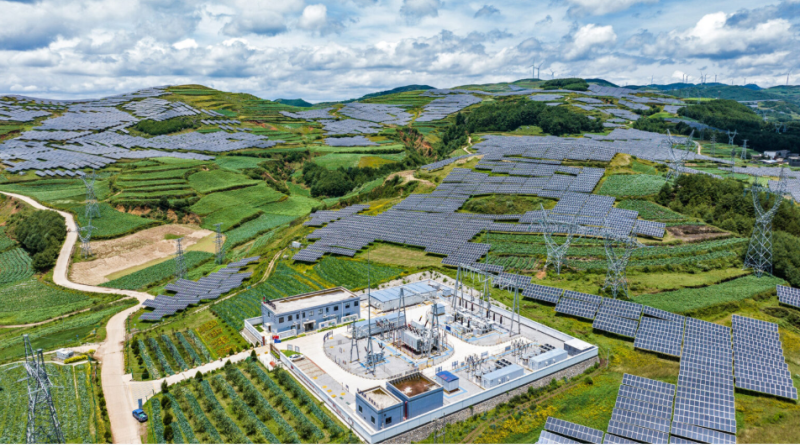
Cover photo: Solar panels line the hills of Weining, China. Credit: Tao Liang/Xinhua via Getty Images