

COP30 and G20: A victory for rhetoric, a failure for value
From the Seventh United Nations Environment Assembly, which unfolded in Nairobi last week, to global leaders crisscrossing from the climate halls of COP30 in Belém to the G20 in Johannesburg, this year’s climate talks have resulted in a starkly uneven balance sheet for these summits.
The headline success of COP30 is undoubtedly the operationalisation of the Just Transition Work Programme through the new Belém Action Mechanism (BAM). For years, “just transition” was a floating signifier, a buzzword used to pacify labour unions and developing nations. The BAM changes this by establishing a formal institutional home under the UNFCCC, with a mandate to link national climate plans to social protections, rights, and decent work.
While the inclusion of the BAM marks a historic institutional victory for the “Just Transition,” the glaring omission of binding commitments on critical minerals value chains threatens to render that transition economically hollow. The world has handed Africa a mechanism for “justice” without the material engine to fund it.
For African negotiators, who have championed this since the “Africa COP” in Egypt, this is a diplomatic triumph. The mechanism finally acknowledges that decarbonisation cannot simply be a technocratic switch from coal to solar; it must be a social contract that protects workers and communities.
However, a mechanism for justice that is detached from economic structural change is a car without an engine. The BAM provides the governance for a transition but remains silent on the finance and industrial strategy required to execute it. This is where the silence on critical minerals becomes deafening.
Critical minerals failure
Despite the intense pre-summit advocacy for the Africa Green Minerals Strategy, the outcomes of COP30 failed to anchor critical minerals value chains within the binding climate architecture. The logic proposed by African leaders was simple: if the world wants a green transition, it needs Africa’s minerals (cobalt, lithium, copper). Therefore, the “Just Transition” should structurally guarantee that Africa captures the value of these minerals through local processing, rather than just exporting raw ore. Unfortunately, this argument was sidelined at COP30.
Instead of binding targets for domestic processing (such as the proposed 70% value-addition mandate by 2035), the dialogue on minerals was largely relegated to the G20 in South Africa. While the G20’s adoption of a “Critical Minerals Framework” is a positive political signal, it remains a voluntary, non-binding set of principles. It lacks the teeth of international law and, crucially, is divorced from the UNFCCC’s climate finance mechanisms.
This bifurcation is dangerous. By keeping “minerals” in the G20 (trade/economics) and “justice” in COP (climate/rights), the Global North, and specifically China who was very vocal against the inclusion of minerals in the COP outcome, has effectively firewalled the profits of the green transition from its social costs.
Justice, but no equity
In a nutshell, African countries are being offered “justice” aid while their request for “industrial” equity is ignored. Without a binding link between climate finance and mineral beneficiation, Africa risks remaining the primary extraction pit for the Global North’s green industrial revolution, receiving “transition support” funds while shipping out the raw wealth that powers the global economy.
The outcomes of November 2025 leave Africa in a precarious position. The Lobito and TAZARA corridors are expanding, effectively turning the continent into a dual-exit export chute, one facing the Atlantic for the West, the other the Indian Ocean for China. Without the value-addition safeguards Africa demanded at COP30, these corridors risk accelerating “green colonialism”. The situation where infrastructure is built solely to extract resources faster, rather than to construct regional industrial hubs.
If the “Just Transition” is funded only by concessional aid through the BAM, rather than by the revenue of refined copper and battery precursors, Africa’s ability to finance its own resilience will remain dependent on donor whims. To be sure, true justice requires fiscal sovereignty, and fiscal sovereignty in the 21st century lies in the smelter, not the mine shaft.
The climate agenda for African countries must see our diplomats refuse to let the “environment” agenda be separated from the “economic” agenda. We must, in all engagements in 2026, insist on redefining “Sustainable Mineral Value Chains” not just as an economic preference, but as an environmental imperative. Surely, it is common sense that local processing on the continent, powered by its abundant hydro and solar potential, is the low-carbon solution the planet needs.
The outcomes of COP30 and the G20 have given Africa a framework for justice but denied it the tools for prosperity. We eagerly await the outcomes of UNEA-7, the final opportunity of 2025, recognising that we cannot have a “resilient planet” while hollowing out the continent that holds the keys to its survival. Whatever the outcome, the message from African countries in 2026 must be clear: There is no Just Transition without Value Addition. ESI
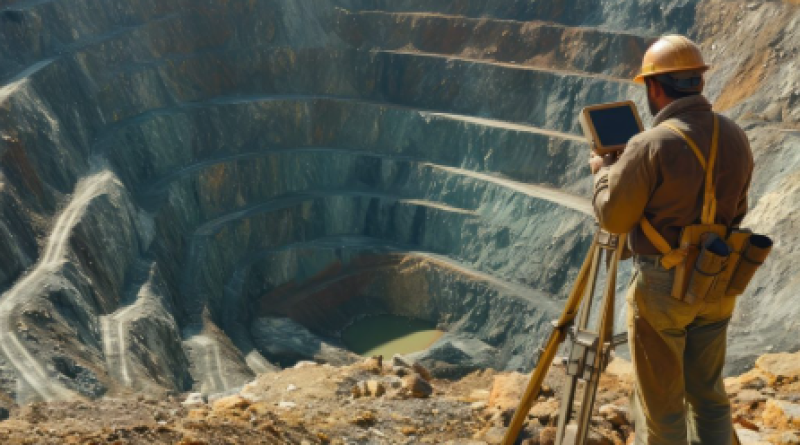
Cover photo: Surveying at an open pit copper mine. Source: buraratn©123rf