

During a fierce storm I could hear the panicked screams of children in tents outside. This is Christmas in Gaza
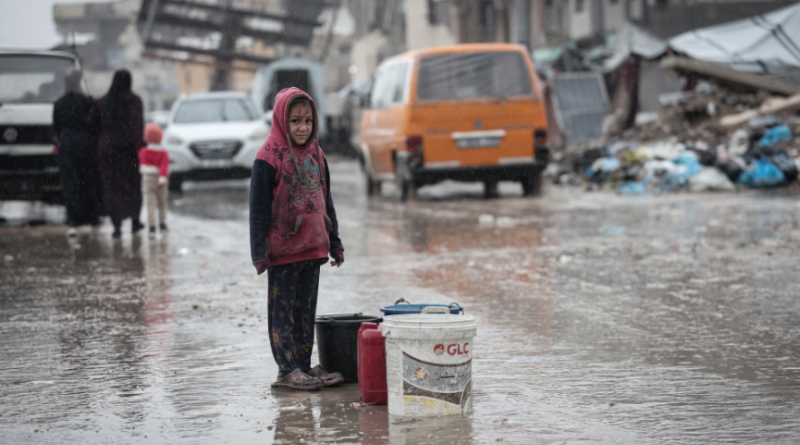
This time of year is the true beginning of winter: the 40 coldest and harshest days of the season. One resident of Gaza City describes the reality for Palestinians living with little shelter and no electricity or heating
It was about 8.30pm on a Thursday when I headed back home in Gaza City. It was windy, and I couldn’t stay out any longer, so I had to walk. At first it was only a light drizzle, but after about 200 metres the rain suddenly grew heavier. That wasn’t surprising. I stopped near a tent to take shelter, rubbing my palms together to draw some warmth. A young boy was sitting outside selling homemade cookies. We exchanged a few words while I stood there, though he didn’t seem interested in talking. I noticed the cookies were loosely wrapped in plastic, already soggy from the drizzle, and I wondered if he’d have enough to sell before the night ended. The cold seeped into everything.
As I walked along al-Wehda Street in Gaza City, tents lined both sides of the road. There were no voices coming from inside them, only the sound of rain pouring down and the whistle of the wind. As I hurried on, trying to dodge the rain, I switched on the torch of my mobile phone to see the road ahead. My thoughts kept returning to those sheltering inside: What are they doing now? What are they thinking? How do they feel? It was bitterly cold. I imagined children curled under wet blankets, parents shifting constantly to keep them warm.
When I opened the door to my apartment, the freezing handle served as a subtle yet haunting reminder of the hardships endured across Gaza in these harsh winter conditions. I stepped inside my apartment and couldn’t shake the guilt of having a roof when so many were exposed to the storm.
In the middle of the night, the storm intensified. Outside, plastic sheeting on shattered windows sagged and flapped violently, while corrugated metal tore loose and crashed to the ground. Above it all came the sharp, panicked screams of children, cutting through the darkness. I felt completely helpless.
Over the past two weeks, the rain has been relentless. Cold, heavy, and driven by strong winds, it has soaked tents, flooded makeshift camps and turned open ground into mud. Elsewhere, this might be called “bad weather”. In Gaza, it is lived with exposure and abandonment.
Palestinians know this time of year as al-Arba’iniya; the 40 coldest and harshest days of winter, beginning in late December and lasting until the end of January. It is the true beginning of winter, the moment when the season reveals its full force. Normally, it is endured with preparation and shelter. This year, Gaza has neither. The cold bites through homes, streets are empty and people simply endure.
But the danger of winter is no longer abstract. Early on the Sunday before Christmas, the civil defence agency recovered the bodies of two children after the roof of a war-damaged building collapsed in northern Gaza, rescuing five others, including a child and two women. Two people remain missing. Such collapses are not new attacks, but the result of homes weakened by months of bombardment and finally undone by winter rain. Earlier this month, Rahaf Abu Jazar, an eight-month-old baby girl in Khan Younis, died of exposure to the cold.
Walking past the camp nearest my home, I saw the consequences up close. Thin plastic sheets sagged under the weight of water, mattresses floated and clothes hung damply, never fully drying. Each step reminded me how fragile these shelters were and how close the rain and cold came to claiming life and health for hundreds of thousands living in tents and overcrowded shelters.
Most of these people have already been displaced, many several times over. Homes are gone. Neighbourhoods flattened. Winter has arrived in Gaza, but protection from it has not. It has come without proper shelter, without electricity, without heating.
As a university lecturer in Gaza, this weather weighs heavily on me. My students are not figures in a report or faces in a photograph. They are young people I speak to regularly; intelligent, determined, but profoundly exhausted. Most attend online classes from tents; others from overcrowded shelters where privacy is impossible and connectivity unreliable. Many of my students have already lost family members. Most have lost their homes. Yet they still try to study. Their resilience is extraordinary, but it should not be required in this way.
In Gaza, what would normally count as routine academic practices, assignments, deadlines, resubmissions, and extensions, turn into moral negotiations, shaped each day by uncertainty about students’ safety, warmth and access to shelter.
During nights like these, I find myself thinking about them constantly. Are they dry? Are they warm? Did the wind tear through their shelter while they were trying to sleep? For those still living in apartments in Gaza, or what remains of them, there is no heating. With electricity largely unavailable and fuel scarce, warmth comes mainly from wearing multiple layers of clothing and using whatever blankets are left, after many have already given their extra blankets to people who lost their homes and belongings entirely. Even so, cold nights are unbearable. What, then, of those living in tents?
Humanitarian agencies report that more than a million people in Gaza live in shelters. Aid supplies, including insulated tents, blankets, warm clothing and heating fuel, have been insufficient. During the recent storm, Shelter Cluster partners reported reaching more than 8,800 families across Gaza City, Deir al-Balah and Khan Younis with tarpaulins, tents and bedding. On the ground, however, this assistance was widely experienced as uneven and inadequate, limited to short-term fixes that did little to protect families from prolonged exposure to cold, wind and rain. Tents collapse. Respiratory illnesses, hypothermia, and infections linked to damp conditions are rising.
This is not an unforeseen disaster. Winter comes every year. People in Gaza understand this failure not as misfortune, but as abandonment. People speak of how tarpaulins, timber, insulation materials and prefabricated shelter units are restricted or delayed, while attempts to repair damaged homes or reinforce tents are repeatedly obstructed. Local initiatives and humanitarian actors have tried to improvise, to distribute plastic sheeting, strengthen shelters, or provide winterisation kits, yet they remain limited by what is allowed to enter. The failure is political and humanitarian. Solutions exist, but are kept out.
What makes this suffering especially painful is how preventable it is. No one should have to study, raise children, or fight illness standing ankle-deep in cold water inside a tent. No student should fear the rain ruining their last notebook or phone. Rain exposes just how fragile life has become. It tests bodies worn down by stress, exhaustion, and grief.
This winter coincides with the Christmas season that, for millions around the world, symbolises warmth, refuge and care for the most vulnerable. In Palestine, that symbolism is tied to the memory of a birth marked by displacement and lack of refuge in Bethlehem. In Gaza today, that symbolism is painfully literal: families are once again seeking safety in the cold and the rain.
If there is any urgency left in international concern for Gaza, winter should make it impossible to look away. People need proper shelter now, prefabricated homes delivered immediately. Not statements, not promises, but materials, access and action. My students deserve at least that much.
Cover photo: This time of year is known in Palestine as the true beginning of winter: the 40 coldest and harshest days of the season. Photograph: Abdalhkem Abu Riash/Anadolu/Getty Images