America’s Leaking Nuclear Coffin Is a Climate Time Bomb
The Cold War left many inglorious legacies. The Runit dome is a good example.
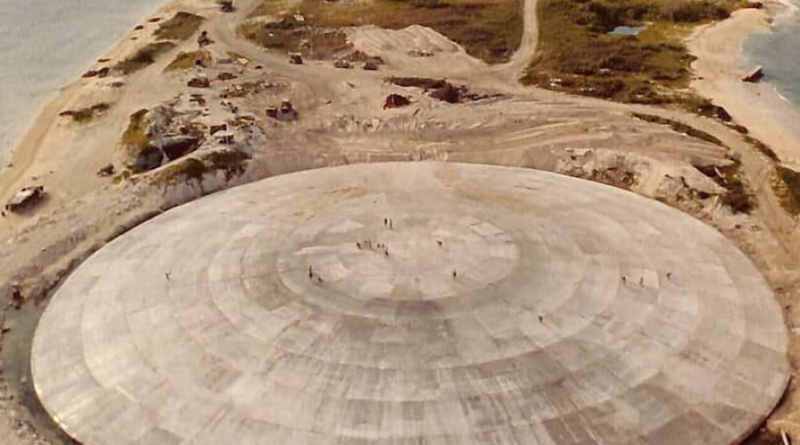
From the outside, it looks almost too unassuming: a perfect concrete disk, 377 feet (115) meters) wide, rising from the white sand. Locals from the Marshall Islands call it “The Tomb.” In fact, it’s a sarcophagus.
Beneath the concrete cap there are more than 111,000 cubic yards of radioactive soil and debris. It’s lethal fallout from America’s Cold War nuclear testing program. Lethal amounts of plutonium-239, an isotope so toxic a speck can kill you and with a half-life of 24,100 years. The Tomb was America’s hasty solution to a permanent problem. It was built cheap, built fast, and built to fail.
Now, it’s failing.
Seawater is seeping into its unlined base, soaking the radioactive waste with the daily rise and fall of the tide. The concrete cap is cracking. And a warming planet is raising the ocean that surrounds it, promising a future where storms will tear it apart and unleash its contents into the Pacific.
Bomb the Islands
The story of the Tomb begins with a betrayal. After World War II, the United States took control of the Marshall Islands as a “strategic trust territory” under the United Nations. The U.S. had a fiduciary duty to “protect the inhabitants”.
Instead, it kind of bombed them.
Seeking a remote “proving ground” for its new atomic arsenal, the U.S. evacuated the people of Bikini and Enewetak atolls. In 1946, a U.S. Navy commodore famously told the Bikini islanders their sacrifice would be “for the good of mankind and to end all world wars“.
What followed was 12 years of atmospheric terror. The U.S. detonated 67 nuclear weapons in the Marshall Islands. The combined yield was staggering, equivalent to 1.6 Hiroshima-sized bombs exploding every single day for the entire 12-year period.
Most of those tests (44) were carried out at Enewetak Atoll, the future home of the Tomb. Islands were vaporized. The 1954 “Castle Bravo” test, a 15-megaton hydrogen bomb, was a 1,000-times-more-powerful-than-Hiroshima miscalculation that showered radioactive fallout on the inhabited atolls of Rongelap and Utrik. Declassified documents confirm U.S. officials knew the winds were blowing toward the islanders but proceeded anyway. Children played in the “ashy snowflakes”. This was followed by a secretive U.S. medical study, Project 4.1, that studied the exposed islanders.
It appears that at the time, cleaning up wasn’t a big priority. But that changed a bit in the 1970s.
The Messy Cleanup
By the 1970s, the U.S. was preparing to grant the Marshall Islands independence and faced pressure to clean up the “mess”. The solution was the 1977-1980 Enewetak cleanup. They framed it as a moral commitment. Approximately 6,000 Veterans participated in the cleanup project, which ran from May 1977 through May 1980. But in some ways the project was a cynical, cost-cutting operation.
Veterans weren’t supposed to be in charge of the project. The initial plan was to use nuclear experts, but Congress slashed the budget, so the U.S. had to send its own troops. You’d imagine people in hazmats and protective suits, but photos and testimonies from the era are damning. Some men worked in cutoff shorts, boots, and floppy sun hats. They handled plutonium-laced debris with their bare hands. They breathed in radioactive dust with no respirators.
Leaders of the cleanup publicly assured troops the radiation was as harmless as a dental X-ray, while privately worrying about “plutonium problems”. In one propaganda exercise, an Air Force radiation technician was filmed in a new, full-body safety suit. After the cameras left, he was ordered to return the gear. “I never saw one of those suits again,” he later said. Hundreds of these veterans have since suffered from cancers, degenerative bone diseases, and tumors on their ribs, spines, and skulls.
The radioactive soil these men scraped up amounted to over 111,000 cubic yards. This was dumped into the 350-foot-wide crater left by the 1958 “Cactus” nuclear test on Runit Island.
This, already, was the first mistake.
The Leaky Tomb
This is the Tomb’s original sin. The crater was chosen for convenience, not in the best possible geological spot. The Tomb’s geology makes it a sieve. It sits in porous, permeable coral, rock that was already highly fractured by three other nearby nuclear blasts. It is below sea level at high tide.
The U.S. Environmental Protection Agency objected to the plan. Contractors warned that dumping the waste there would “not remove this material from environmental interaction, since direct ocean water connections into the crater exist”. The idea of lining the bottom with concrete was explicitly rejected because it was too expensive and time-consuming.
Ultimately, the poisoned soil was mixed with cement, then poured into the porous hole. It was then capped with an 18-inch concrete dome. This compromise was lacking from day one, but with current sea level rise and climate change, seawater washes over the dome’s edges during storms.
Through the years, maintenance has also been lacking. The concrete cap is visibly cracking and spalling.
The nightmare scenario is a major typhoon, strengthened by warmer waters, making a direct hit. Such a storm could breach the cap and disperse its plutonium-laden contents across the Pacific.
The Dilution Defense and the Coming Storm
You’d expect that a big chunk of leaky, radioactive material would be a priority. But no one seems in any rush to take care of it.
In 1986, the U.S. and the Republic of the Marshall Islands (RMI) signed the Compact of Free Association, granting the nation independence. The U.S. argues this compact was a “full settlement of all claims” and that since the dome is on sovereign Marshallese land, it is the RMI’s responsibility.
The Marshallese government is furious. “I’m like, how can it be ours?” former RMI President Hilda Heine has said. “We don’t want it. We didn’t build it. The garbage inside is not ours. It’s theirs“.
The RMI argues the compact is invalid because the U.S. withheld critical information during negotiations — namely, the dome’s flawed design and the true extent of the remaining contamination. This includes the stunning fact, revealed decades later, that the Tomb holds only one percent of the total plutonium dumped on the atoll. The other 99 percent remains where it settled: in the sediments of the Enewetak lagoon.
The response of the US is basically “the area is poisoned already.”
The Department of Energy (DOE) admits the dome is leaking. It admits that radioactive groundwater beneath the structure “rises and falls with the ocean tide,” flushing contaminants into the lagoon. But, the DOE argues, this leakage is insignificant.
The lagoon is already a toxic soup, the dilution argument goes. So, who cares about a little more poison?
DOE released a new report in July 2024 modeling this very threat. Its conclusion was that the dilution argument still holds. The study, by Pacific Northwest National Laboratory, simulated a complete, catastrophic failure of the dome in the year 2090. It found the resulting increase in radiation dose to residents would be “negligible” (less than 0.2 mrem/year). The report summary states there is “no potential for increased health risks”.
No Fix in Sight
For the people and ecosystems in the region, the nuclear pollution is a reality of day to day life. People living in the area receive higher doses and are subject to greater cancer risks. Furthermore, modeling studies are useful, but there’s no real insight into the effect of this radiation on the local population.
As the RMI’s Foreign Minister pointedly asked the U.S. Congress, “What are the health risks of living on the shores of a lagoon with a larger amount of radioactive material than the infamous Runit Dome?”.
For the Marshallese, those risks are a daily reality. They suffer from elevated cancer rates and generations of birth defects. Their traditional food sources are poisoned. This has forced them to rely on imported processed foods, fueling a secondary epidemic of diabetes and obesity.
And now, the planet is amplifying the threat. Climate change is an existential crisis for the low-lying Marshall Islands, but it is a direct, physical threat to the Tomb. The dome was built at sea level, with no consideration for rising oceans.
There are only two real long-term solutions, and the U.S. has rejected both. The first is to build a massive, truly impermeable containment structure over the existing dome. The second is even more intensive: excavate the 111,000 cubic yards of radioactive slurry and ship it to a secure repository .
None of them are currently being considered practically.
And so, the Tomb sits, unmarked and unguarded, a monument to American apathy. It is a sarcophagus built on porous coral, a hasty fix for a 24,100-year problem, waiting for the ocean to rise and reclaim it.
Cover photo: Aerial view of the Runit Dome. The dome is placed in the crater created by the “Cactus” nuclear weapons test in 1958. Image via Wikipedia.