
NYC Congestion Pricing Is Improving Air Quality, but Trump Pushback Threatens Its Future
A toll program in New York City has resulted in environmental gains across all five boroughs. The Trump administration is seeking to end it.
Just over a year ago, New York City implemented a first-in-the-nation “congestion pricing” program to reduce traffic, fund public transit work and improve air quality by raising tolls for drivers coming into Manhattan’s major hubs.
Now some of the early results are in—and experts are giving it top marks. Research shows that air quality has improved across the city and parts of New Jersey. Traffic levels and fatal car accidents are down while subway and bus ridership is up.
Despite these gains, congestion pricing is still getting major pushback from President Donald Trump, who tried to halt the program before it could get off the ground but was thwarted by a federal judge. Since then, Trump has continued his assault on congestion pricing in the courts. The latest battle played out last week, with his administration on one side and New York transit officials and local advocacy groups on the other.
A Win for Air Quality: New York is not the first city to hike tolls in pursuit of smoother commutes. In 2024, I reported from across the pond on London’s congestion pricing program, in place for more than two decades. Other cities such as Singapore and Stockholm also have their own versions.
Now, I’m reporting to you from New York City, which saw a surprisingly large air-quality improvement in the program’s first six months, according to a recent study led by Cornell University. Pulling particulate matter data from 42 air monitors across the metropolitan area, a team of researchers used a model that estimated how congestion pricing impacted air pollution from January to June 2025.
After accounting for many of the other potential influences on air quality, such as temperature, humidity and daily and monthly factors such as the presence of wildfires, the model revealed that congestion pricing alone was responsible for driving down a key pollutant in the toll zone by 22 percent, compared with the estimated average if the program was not in place. The toxic particles they studied are known as PM2.5, around 30 times smaller than a human hair and a significant cause of premature death.
“It’s happy news,” the study’s lead author, Cornell computational social scientist Timothy Fraser, told me. “If we had seen a 5 percent drop, all the congestion pricing enthusiasts would have been thrilled, but to see that we actually saw better improvements than in European cities—wow.”
Perhaps more surprisingly, according to Fraser, the toll also improved air quality outside the area across the five boroughs and the slightly broader region. Particulate matter even decreased in the South Bronx, an area local residents feared more drivers would cut through to skirt the zone on their way to Manhattan.
Fraser said these gains could be for a number of reasons, including more drivers opting for public transit or fewer large trucks on the road at the same time.
“This is a solid paper,” Jonathan Buonocore, an assistant professor of environmental health at Boston University, told me. “Within the first six months … concentrations declined by like 3 micrograms per cubic meter [in the toll zone]. That’s a pretty big deal in terms of air quality.”
Other positive trends are showing up in the data since congestion pricing kicked in. According to the Metropolitan Transportation Authority, roughly 27 million fewer vehicles entered the toll zone in 2025, an 11 percent decrease in traffic compared to the previous year.
The city also saw the fewest number of traffic deaths in recorded history last year, but no formal studies have determined congestion pricing’s influence on this. Even suburban drivers are reporting quicker commutes to places outside the toll zone entirely, Bloomberg reports.
Toll Limbo: London saw similar gains in its first year of congestion pricing, but not all of them lasted. As the toll expanded to include more zones and higher prices in the following decades, congestion returned to roughly the same levels as before.
Buonocore noted that the Cornell-led air quality study just covers the first six months of the program. To determine the effectiveness of congestion pricing in NYC, researchers need long-term data, which won’t be possible if the Trump administration gets its way in court.
Last February, Transportation Secretary Sean Duffy ordered New York Gov. Kathy Hochul to halt the congestion pricing plan, but a federal judge issued a temporary injunction. Since then, Duffy has threatened to withhold federal approval and funding from New York highway and transit initiatives if the toll is not ended, The New York Times reports. Trump has also renewed his calls for the program’s demise.
“Congestion Pricing in Manhattan is a DISASTER for New York. It’s got to be ended, IMMEDIATELY!” Trump posted on Truth Social in January. “It’s never worked before, and it will never work now. I love New York, and hate to see it being destroyed so rapidly with such obviously foolish ‘policy.’”
Grassroots advocacy groups and the Metropolitan Transportation Authority are challenging the White House’s attempts to squash the effort.
“This is a really important program, and it’s disappointing to see the federal government try to stop it when it’s been successful in every measure,” Dror Ladin, a senior attorney at the nonprofit Earthjustice, told me. He represents the advocacy groups supporting congestion pricing in court.
Last Wednesday, both sides made their cases to the same federal judge that issued the temporary injunction stopping the Trump administration from blocking congestion pricing. Judge Lewis J. Liman will decide whether the injunction will become permanent.
Asked why the administration is working to halt the program, a Transportation Department spokesperson directed me to an April statement from Duffy.
“The federal government sends billions to New York—but we won’t foot the bill if Governor Hochul continues to implement an illegal toll to backfill the budget of New York’s failing transit system,” he said in the statement. “We are giving New York one last chance to turn back or prove their actions are not illegal.”
On the other end of the spectrum, many activists, New York politicians such as New York Mayor Zohran Mamdani and a majority of residents in recent polls have supported the program.
“We are also celebrating something that feels too rare in our politics these days,” Mamdani said at a January press conference. “That is the change that can come when government dares to do big things.”
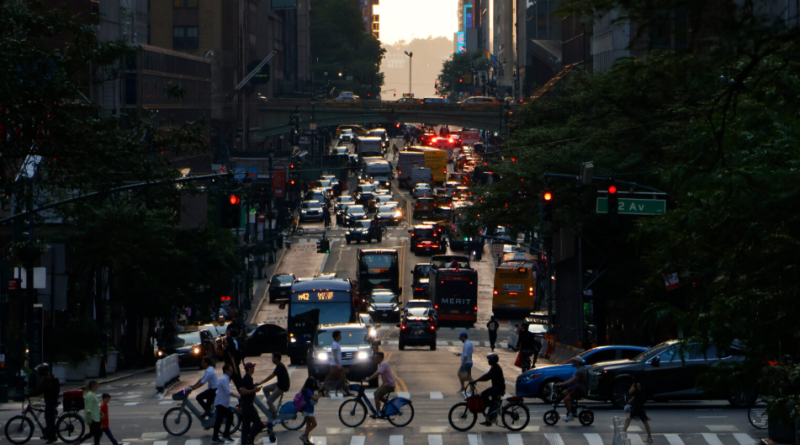
Cover photo: Cyclists and pedestrians cross busy 42nd Street in New York City. Credit: Gary Hershorn via Getty Images