

40% Of Bolt’s Motorcycle Fleet Is Now Electric, Making It Nairobi’s Largest EV Ride-Hailing Provider
Kenya’s electric motorcycle ecosystem is now starting to flourish thanks to the hard work and vision of several innovators over the past 8 years which saw a tremendous opportunity to transform one of the key pillars of the county’s transport landscape. The share of electric motorcycles in new motorcycle registrations reached 7% in Kenya in 2024. In terms of the adoption of technologies, the 5% threshold is generally considered the point where things start to accelerate in these kinds of transitions, and therefore the motorcycle sector market share being at 7% in 2024 was already exciting. Given the lower total cost of ownership associated with electric motorcycles compared to their equivalents, this could be a key moment for electric motorcycles in Kenya. Well, 2025 is even better, and so far, new motorcycle registrations in Kenya show that the penetration of electric motorcycles is now around 10%.
The overall motorcycle sales market in Kenya is starting to recover after a rough couple of years post-COVID 19. The overall motorcycle market in Kenya had been going through a rough patch where sales of new motorcycles in Kenya dropped from a peak of 285,203 in 2021 to just 68,804 in 2024. The latest KNBS Leading Economic Indicators Report for August 2025 shows that for the period from January 2025 to August 2025, 97,299 motorcycles were sold in Kenya. That means 28,495 more motorcycles were sold in the first 8 months of the year compared to the whole of 2024! With 39% of CO2 emissions in Kenya coming from the transport sector and ICE motorcycles making up over 50% of vehicles in Kenya, accelerating the adoption of electric motorcycles can make a huge difference. For example, if electric motorcycle sales in Kenya grow to about 100,000, a fleet of 100,000 can save 85,092 tonnes of CO2 emissions annually.
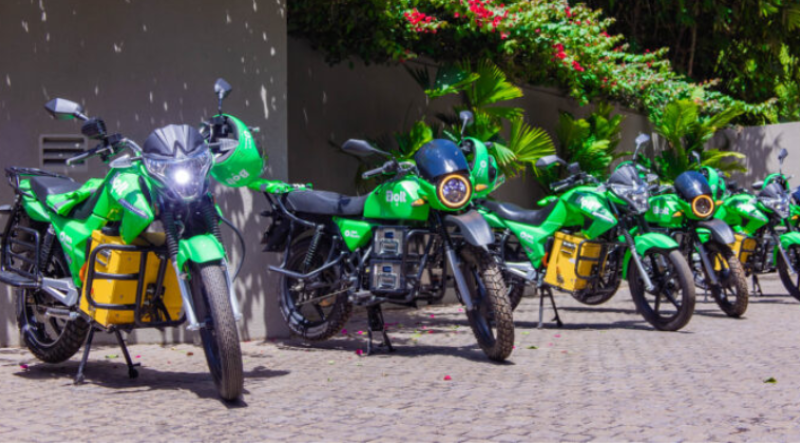
Although B2C applications targeting the 2.5 million ICE motorcycle boda boda riders presents a large addressable market, B2B partnerships with fleet operators, financiers, and shared mobility platform operators such as ride-hailing companies are also a key enabler of the ecosystem. We have some good news from one of the major players in the ride-hailing and shared mobility sector. Bolt, a provider of shared mobility services company with operations in over 50 countries and 600 cities through its on-demand mobility platform, recently announced a major milestone in Kenya’s transition to greener urban mobility. Bolt says electric motorbikes now make up over 40% of its motorbike fleet, making it the largest supplier of electric bikes in the ride-hailing industry countrywide. Several other shared mobility services companies are also increasingly adopting electric motorcycles, which is great and goes to show the growing confidence major companies are now having in Kenya’s electric motorcycle sector.
Bolt also confirmed that it has successfully onboarded over 1,700 M-KOPA-financed riders, reaching its 2025 target ahead of schedule and accelerating the availability of affordable electric mobility for riders across the country. This great milestone is another testimony for Kenya’s burgeoning electric motorcycle ecosystem that is supported by Kenya’s innovative financing landscape. Recently, another financier, Watu, reported that the company wants to build on the momentum from 2024, when Watu financed over 2,193 EVs, supported by a growing network of battery swapping stations across all major markets.
Watu’s 2025 financing plans and targets financing for Kenya and beyond are as follows:
- 4,850 motorcycles in Kenya, with 2,000 of them being electric. That’s a massive 41% electric share!
- 27,300 motorcycles in Uganda, with 3,600 of them being electric. That’s 13% electric.
- 26,128 motorcycles in Tanzania, with 300 of them being electric. That’s 1.1%.
Back to Bolt. Bolt says the expanded adoption of electric bikes is part of Bolt’s broader strategy to reduce emissions, lower operating costs for riders, and contribute to Kenya’s clean transport ambitions. Bolt adds that the partnership with M-KOPA has enabled riders to access electric bikes through flexible financing models, improving earnings by significantly reducing fuel and maintenance expenses.
Watu’s 2025 financing plans and targets financing for Kenya and beyond are as follows:
- 4,850 motorcycles in Kenya, with 2,000 of them being electric. That’s a massive 41% electric share!
- 27,300 motorcycles in Uganda, with 3,600 of them being electric. That’s 13% electric.
- 26,128 motorcycles in Tanzania, with 300 of them being electric. That’s 1.1%.
Back to Bolt. Bolt says the expanded adoption of electric bikes is part of Bolt’s broader strategy to reduce emissions, lower operating costs for riders, and contribute to Kenya’s clean transport ambitions. Bolt adds that the partnership with M-KOPA has enabled riders to access electric bikes through flexible financing models, improving earnings by significantly reducing fuel and maintenance expenses.
Dimmy Kanyankole, Senior General Manager, East Africa, said: “Kenya is at the forefront of clean mobility in Africa, and today’s announcement marks a pivotal step in scaling practical, affordable and sustainable transport solutions. By reaching over 40% electric bike penetration and onboarding 1,700 M-KOPA-supported riders, we are demonstrating that sustainability and improved rider livelihoods can go hand in hand.”
The shift to electric bikes offers riders daily cost savings compared to petrol motorbikes, while also lowering carbon emissions in densely populated urban centres. With transport representing one of the fastest-growing sources of emissions, EV adoption in the ride-hailing sector is seen as a critical lever for national climate and air quality goals.
Nena Sanderson, Chief Product Officer and Managing Director, M-KOPA Mobility, noted: “Our partnership with Bolt is proving that when financing barriers are removed, riders are eager to adopt cleaner and cheaper electric alternatives. Reaching 1,700 riders is just the beginning, we are committed to scaling this impact even further.”
Bolt says its end-of-year data indicates that Kenya continues to demonstrate strong and accelerating electrification potential, with riders increasingly embracing sustainable mobility options. Bolt’s platform recorded an impressive 4.8 million EV rides over the past year, highlighting the growing local demand for cleaner transport, and making Kenya the continent’s biggest e-mobility milestone. Bolt says it aims to continue expanding its electric bike fleet over the next year through new financing partnerships, rider support programs, and strategic collaborations with manufacturers and charging network providers.
I am really excited about this because companies like Bolt are key partners and enablers of the ecosystem, and to see them having confidence in electric motorcycles, all mostly developed and assembled in Kenya, is a key milestone. As more companies that are active in Kenya’s electric motorcycle sector start to seriously ramp up production of their electric motorcycles as well as increase the footprint of their battery swapping and charging networks, we expect to see the sector starting to really make inroads to displace those ICE motorcycle sales.
It’s great to see all this progress. The transition to electric in key transport segments in places like Kenya is happening faster than most people thought. This is because locally based companies and their international partners are putting in all the work to address the key pain points and concerns consumers face.
Cover photo: Ampersand electric motorcycles on Bolt platform. Image courtesy of Bolt