What can the EU and Nato do to stop Trump from trying to claim Greenland?
The territory and the European bloc are trying to see off the US president, who has said control of Greenland is essential to national security
The Trump administration has said repeatedly that the US needs to gain control of Greenland, justifying its claim from “the standpoint of national security” and warning that it will “do something” about the territory “whether they like it or not”.
This puts the EU and Nato in a difficult spot. Greenland, a largely self-governing part of Denmark, is not a member of the bloc but Denmark is; while the Arctic island is covered by the defence alliance’s guarantees through Denmark’s membership.
European leaders have strongly defended sovereignty, territorial integrity and the right of Greenland and Denmark to decide on matters concerning them, but there is as yet no clear strategy on how to deter Trump – or respond if he does make a move.
Here are some of the options.
Diplomacy, and Arctic security
The US secretary of state, Marco Rubio, is due to meet the Danish and Greenlandic foreign ministers on Wednesday but Denmark’s ambassador to the US, Jesper Møller Sørensen, and Greenland’s envoy, Jacob Isbosethsen, have already begun lobbying US lawmakers.
Diplomatic overtures will aim in part to address US security concerns, first by stressing that an existing US-Danish defence treaty from 1951, updated in 2004, already allows for massive expansion of the American military presence on the island, including new bases.
In a message aimed squarely at Republicans beyond Trump’s Maga circle, they will also underline that, as Denmark’s prime minister, Mette Frederiksen, put it, a US attack on Greenland, in effect one member turning against another, would mean “the end of Nato”.
More concretely, Nato ambassadors reportedly agreed in Brussels last week that the transatlantic alliance should move to boost military spending in the Arctic, deploying more equipment and holding more and bigger exercises to help allay US security concerns.
Although Trump’s claims that Greenland “is full of Chinese and Russian ships everywhere” are plainly exaggerated, diplomats believe some kind of concerted western move to strengthen Greenland’s external security could be the least painful way out of the crisis.
EU officials have said this could be modelled on Baltic Sentry, a Nato operation launched last year to secure infrastructure in the Baltic Sea, and Eastern Sentry, which expanded the concept to more broadly protect Europe’s eastern flank from drones and other threats.
Economic sanctions
In theory, the EU – a market of 450 million people – has considerable economic leverage over the US and could threaten retaliatory measures ranging from shutting down US military bases in Europe to banning European purchases of US government bonds.
The most widely touted sanction is the EU’s anti-coercion instrument or “trade bazooka”, which gives the European Commission the power to bar US goods and services from the EU market, apply tariffs, strip their intellectual property rights and block their investments.
But that would require the bloc’s national governments to agree to use it, which – unwilling to inflict economic harm on the bloc, and eager to keep the US onboard over Ukraine – they have seemed unlikely to do even when faced with Trump’s threatened trade tariffs.
Europe relies on US tech companies in all manner of areas, noted Jean-Marie Guéhenno, a former top UN official: “Whether it is data protection, artificial intelligence or software updates, including for defence, Europe remains at the mercy of American goodwill.”
For any threat of economic sanctions to be effective, moreover, Trump would have to believe it was real – which, so far at least, it all too clearly is not.
Invest in Greenland
Greenland’s economy relies heavily on annual subsidies from Denmark, totalling about DKK4bn (about €530m) last year, which cover roughly half of the vast territory’s public spending budget and represent about 20% of its GDP.
Trump’s promises to “invest billions” could be matched by the EU in an effort to keep the island – which, at some stage in the not too distant future, is thought likely to vote in favour of independence from Denmark – out of the economic clutches of the US.
A draft Commission proposal from September suggests the EU could double its commitments to Greenland to match the annual Danish grant, while the island could also apply for up to €44m of EU funding for remote EU-associated territories.
While Washington may have billions more to offer than Brussels, Greenlanders may, once they have won their independence, be wary of laying themselves open to rapacious US corporations and reluctant to lose their Nordic-style social security system.
Commit troops
All the above would take time. Moreover, it is not clear that Trump’s Greenland ambitions would be satisfied by treaties or enhanced Arctic security: US “ownership” of the island was “psychologically needed for success”, the US president told the New York Times.
In a paper for the influential Bruegel thinktank, Moreno Bertoldi and Marco Buti argued that EU governments should “proactively protect Greenland from US expansionism”, adding: “The EU has a rapid deployment capacity and it should be activated.”
In agreement with Copenhagen and Nuuk, they said, European troops should be deployed on the island “as a signal of Europe’s commitment to Greenland’s territorial integrity”. While that would not prevent US annexation, it would render it far more complicated.
“While there would be no need for an armed confrontation, the spectacle of the US taking prisoner the troops of its closest allies would ruin US credibility, tarnish its international reputation and strongly influence the US public and Congress,” they argued.
A German government spokesperson said last week that Berlin was working on a plan “including European deterrence” for if the US tried to take Greenland, while France’s foreign minister, Jean-Noël Barrot, last year floated the prospect of deploying a French military contingent.
The EU’s rapid deployment capacity is a framework for quickly deploying up to 5,000 troops from several different member states, under EU command, for crisis response outside the bloc. It could change US calculations, experts and some politicians believe.
“No one believes a war between the US and the EU is desirable or winnable,” said Sergey Lagodinsky, a German Green MEP. “But a US military move against the EU would have devastating consequences for defence cooperation, markets, and global trust in the US.”
That may make Trump think twice.
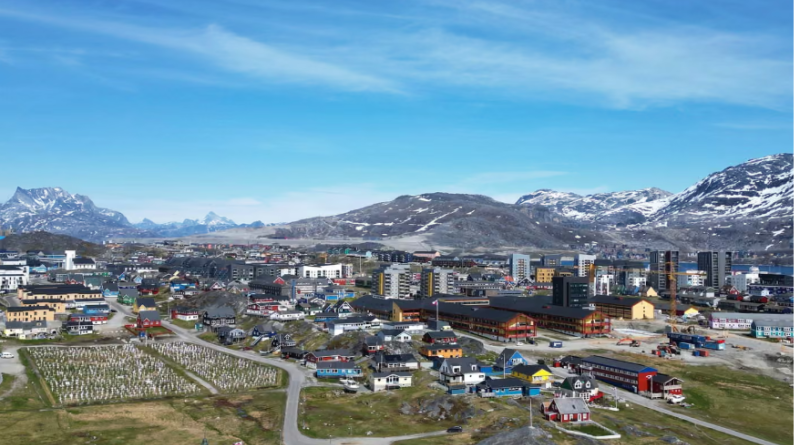
Cover photo: Nuuk, Greenland’s capital. Photograph: Kwiyeon Ha/AP