

As Zambia Pushes New Mining, a Legacy of Pollution Looms
Zambia is expanding development of its rich deposits of critical minerals, which are needed for the global shift to renewables. But poisoning from past mining and a huge toxic spill at a mine site are raising fears that new wealth will come at a high cost for people and the environment.
avid Mwape has spent 24 years working as a teacher in Kabwe, in central Zambia, where his students grow up in one of the planet’s most polluted cities, exposed to a neurotoxin that can permanently damage their mental development and physical health.
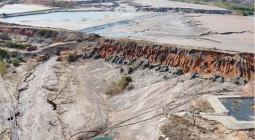
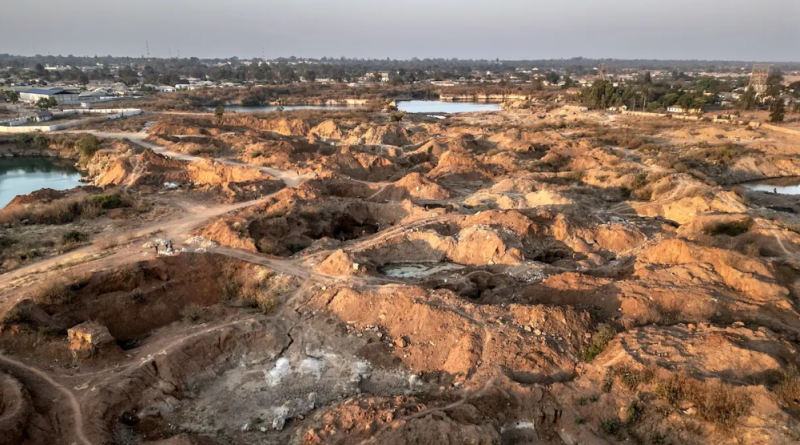
On the playground, children in bright red uniforms shout, hula-hoop, and climb on a rusted slide less than half a mile from what was once one of the world’s largest lead and zinc mines. The Broken Hill mine and smelter opened in 1906 and shut down in 1994, but the site was never properly cleaned up. Its estimated 6.4 million tons of lead-bearing waste continues to pollute the city today.
From his classroom, Mwape sees firsthand how this contamination continues to shape the lives of Kabwe’s youngest residents, 95 percent of whom have been documented to have blood lead levels far above what the World Health Organization says is safe. “We have children who are sick [with lead poisoning],” he said. Sometimes students “forget what the teacher is teaching,” he added. “Sometimes they even sleep in class. Concentration is not good.”
Unless Zambia invests in environmental protection, a researcher says, the expansion of mining is “a ticking bomb.”
In 2022, the United Nations described Kabwe as a “sacrifice zone,” where roughly 300,000 people are exposed to dangerous levels of lead through the water they drink, the air they breathe, and the vegetables they eat. According to a 2025 Human Rights Watch report, soil contamination in Kabwe is up to 300 times the level considered hazardous by the U.S. Environmental Protection Agency.
As Zambia pushes to develop its critical minerals, the southern African nation is haunted by the specter of Kabwe’s deadly mining legacy. Fears of new environmental dangers were heightened last year when a tailings dam at a Chinese-operated copper mine in northern Zambia collapsed, releasing about 13 million gallons of toxic waste into a stream that runs into the Kafue, Zambia’s longest river. The spill polluted waterways for roughly 60 miles downstream, killing fish and contaminating farmland with toxic heavy metals.
While mining is a vital part of Zambia’s economy, the ongoing disasters of Kabwe and the tailings dam collapse have raised alarms just as the country is seeking to capitalize on the renewable energy transition by expanding mining of its critical minerals. Lawsuits have been filed and officials have promised investigations and tighter oversight, but critics say weak enforcement of environmental rules and repeated releases of toxins show the safety of communities and ecosystems still takes a back seat to economic growth.
More mining inevitably brings more pollution, said Titus Haakonde, president of the Zambia Institute of Environmental Health. Unless Zambia makes a matching investment in environmental protection and public health, he warned, the country is “on a ticking bomb.”
Mining is the cornerstone of the Zambian economy, accounting for approximately 15 percent of the nation’s GDP, 70 percent of its export earnings, and 44 percent of government revenues. With 6 percent of the world’s known copper reserves, as well as large deposits of cobalt, nickel, and manganese — all crucial for manufacturing electric vehicles, batteries, and renewable energy systems — the nation is poised to play a critical role in the global shift toward low-carbon technologies.
Zambia has already seen some gains from this transition: Copper export revenues jumped more than 30 percent in a single month in 2025, while President Hakainde Hichilema’s pro-business policies have recently attracted foreign investment in the country’s mineral resources. In 2024, a United Arab Emirates-based company acquired a majority stake in Mopani Copper Mines, investing more than $1.1 billion to revive production. In 2025, Zambia signed a cooperation agreement with Saudi Arabia to encourage investment in mineral exploration and production, and Canada’s Barrick Mining Corporation said it expected to double the Lumwana copper mine’s annual production with a $2 billion investment.
This week The New York Times reported on a draft Trump Administration memo proposing that the U.S. withhold funding for Zambian health programs, including HIV treatment, unless that country gives U.S. businesses more access to its critical minerals.
But foreign companies “are there to make profit,” noted Mark Macklin, a professor of river systems and global change at the University of Lincoln in England. “Very often the last things they are concerned with are the environment, ecosystem, and human health impacts.”
A 2023 study found that the social cost of lead poisoning in Kabwe, due to loss of IQ and lead-related mortality for children born between 2025 and 2049, could cost Zambia $224 to $593 million.
If lead levels in soil remain unchanged, said Alan Boobis, an emeritus professor of toxicology at Imperial College London, the effects can persist for generations as the metal accumulates in bones and teeth, while lead stored in a mother’s body can pass through the placenta to a developing fetus. Blood lead levels can be lowered with intravenous or oral binding agents and dietary supplements, he added, but treatment helps only if further exposure stops — and it cannot reverse damage already done.
“Should mining expansion wait until we sort out the exposure we are dealing with?” asks a children’s advocate. “Of course.”
The 2025 Human Rights Watch report found that attempts to address Kabwe’s contamination — including a government project funded by a World Bank loan to test and treat children and clean up schools and some homes — have been undercut by ongoing mining and processing of mining waste. Companies have been licensed to remove material from waste dumps and truck it to nearby sites for processing to extract the remaining lead and zinc. But the report said this activity has created new hazards: Dark, sandy piles of contaminated material, sometimes several meters high, have been left uncovered and unfenced along roads and near homes, with no warning signs indicating they contain lead.
Smaller-scale mining also takes place at multiple sites around Kabwe, where hard-pressed residents eke out a living by extracting lead and zinc from waste piles, often working with little or no protective equipment and exposing themselves to extreme health risks. Local businesses buy lead and zinc from these miners, and some have reportedly sold the metals directly to Chinese processing companies, according to Human Rights Watch.
Juliane Kippenberg, associate children’s rights director at Human Rights Watch and the author of the report, said Zambian officials were worsening pollution in Kabwe by continuing to issue licenses to mine and process lead waste. Zambia passed new mining regulations in 2024 that were intended to ensure that licenses are granted only when companies meet environmental and health standards, but Kippenberg said that in Kabwe, additional processing was “not happening with environmental regulations at the forefront as a priority. Absolutely not.”
Scrutiny of Zambia’s mining industry only intensified last year when the tailings dam collapsed, releasing 1.5 million tons of heavy metals into the Kafue River, killing fish, ruining crops, and prompting a shutdown of the water supply for Kitwe, a city of more than half a million people. Sino-Metals initially reported that only 50,000 tons of waste material had spilled, but an assessment by South Africa’s Drizit Environmental said that it was 30 times that amount, and that the spill had created a “toxic environment capable of causing irreversible harm to both the ecosystem and human health.” Sampling found dangerous levels of cyanide, arsenic, lead, and cadmium, which the report said posed long-term health risks including organ damage, birth defects, and cancer.
Collins Nzovu, Zambia’s minister of water development and sanitation, described the Kafue spill as “a serious environmental disaster that could have been avoided if proper safety measures were in place.” The government ordered Sino-Metals to cease operations immediately after the spill, but it has reportedly approved the resumption of mining, raising concerns among residents about whether authorities can be trusted to protect communities.
Bernard Njovu and his six children live and work on a farm in Kalusale, a village of 500 in one of the worst-affected areas. When the dam broke, acid poured into the nearby Chambishi stream, devastating his farm and poisoning his water supply. His family receives drinking water from Sino-Metals three times a week, but for bathing and washing, he says, “we use the same acid water, even washing our clothes, so we live with acid on a daily basis.”
Children in Kabwe are being treated for lead, then sent back to “the same contaminated environment,” says a campaigner.
Titus Haakonde, of Zambia’s Institute of Environmental Health, said the spill on the Kafue was an “eye opener” for the nation. “When we talk about this massive and ambitious plan to increase the tonnage of copper production,” he said, “we also need to invest massively in environmental health,” including more health officers and better funding for equipment and technology.
Josphat Njobvu, executive director of Advocacy for Child Justice, a Zambian NGO, said that authorities needed to “make sure that there are health safeguards that are actually implemented. Should mining expansion wait until we sort out the issues and the exposure that we are dealing with? Of course.”
In the aftermath of the Kafue spill, the government appears to have taken steps to tighten oversight of mining regulations that experts and officials say have been unevenly enforced. Last year, Zambia’s Green Economy and Environment Minister ordered one company to suspend work in Copperbelt Province after inspections revealed that a tailings dam was placed, illegally, within 50 meters of a stream, and in Kabwe, local media reported that province and district officials had suspended operations at two Chinese-owned metal processing plants for violating environmental and health laws. After another tailings dam failure in Luapula Province, in November, the minister said Mukabamo Copper Mines Limited would be held “fully accountable,” shouldering all the costs of rehabilitation under the “Polluter Pays” principle of Zambia’s 2011 Environmental Management Act.
Chrizoster Halwiindi Phiri, a member of Zambia’s Parliament representing Kabwe, said conditions in the city had improved in recent years due to government interventions aimed at reducing exposure to lead. Schools in some of the worst-affected areas have been paved so children “do not play in the dust,” she said, while new equipment has been introduced to test and treat tens of thousands of residents with high lead levels. “It is an ongoing public health crisis,” she said, “but at least it’s much better than it used to be.”
Human Rights Watch’s Kippenberg welcomes such efforts but noted that enforcement of Zambia’s environmental and mining laws remains inconsistent. “There are some of the right policies and some of the right statements by the government,” she said, “but we haven’t seen any of these things get translated into practice.” She noted that children in Kabwe were now tested and treated, then sent back to “the same contaminated environment.”
Evans Kunda, 50, raised his three children in Makululu compound in Kabwe, one of Zambia’s largest informal settlements, about a mile from the mine. His daughter, Beatrice, was diagnosed with lead-poisoning when she turned two in 2006, and he watched her struggle through school until she eventually dropped out in the ninth grade.
“There are a lot of families facing this problem,” Kunda said. “I wish we could start a new life away from here.”
Cover photo: The site of the former Broken Hill lead and zinc mine in Kabwe, Zambia. Tommy Trenchard / Panos