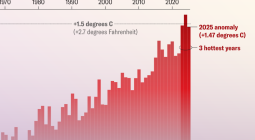


The past 11 years (2015–25) have been the hottest on record, with last year being the third-warmest year since observations began according to most data sets, finds a report released on 23 March by the World Meteorological Organization (WMO)1.
The State of the Global Climate 2025 report, which tracks important climate indicators, found that atmospheric carbon dioxide concentrations and ocean temperatures reached record levels last year. Global surface temperatures were slightly lower in 2025 than the previous year — the hottest on record — but continued a run of exceptionally high temperatures, the report states. Observations of the yearly average area covered by sea ice in the Antarctic and Arctic regions were some of the lowest since 1979.
The speed at which temperatures are rising, the ocean is heating up and glacial ice mass is melting is concerning, says Mandy Freund, a climate scientist at the University of Melbourne in Australia.
“We seem to be entering this new era where temperatures will be significantly higher than what they were ten years ago,” says climate scientist Sarah Perkins-Kirkpatrick at the Australian National University in Canberra. The past three years have seen large changes in temperature that could only be a result of climate change, she adds.
Energy imbalance
For the first time, the report includes a measure of the accumulation of heat on Earth and in the atmosphere. The indicator, called Earth’s energy imbalance (EEI), has been used by climate scientists for at least a decade and measures the difference between the amount of energy that Earth receives from the Sun and the amount radiated back into space. It allows scientists to monitor the rate of global warming. A positive EEI value means that the total amount of heat stored on Earth is increasing.
Last year, the EEI reached its highest level since observations started in 1960, the report states. The increased concentration of greenhouse gases in the atmosphere traps heat on Earth, reducing the amount of warmth that is radiated back into space.
Thomas Mortlock, a climate analyst at the University of New South Wales in Sydney, Australia, says that the inclusion of the EEI in the WMO report is notable. Typically, the rise in surface temperatures is what makes headlines, but the atmosphere absorbs just 1% of the planet’s excess heat, so using it to gauge the severity of global warming is “quite misleading”, he says. More than “91% of all of the excess heat that has been received by the Earth since the 1970s has been absorbed in the oceans”, he adds.
Mortlock suggests that the planet’s energy imbalance is a much better descriptor for understanding the true effect of global warming.
Freund adds that the EEI is also a clearer measure of long-term changes than is comparing average temperatures, which can fluctuate year to year owing to phenomena with short-term effects, such as volcanic eruptions and La Niña events.
Record greenhouse gas levels
Atmospheric CO2 reached a record high of 423.9 parts per million in 2024 — the most recent year for which global figures are available — the highest concentration in two million years. This means that the atmosphere holds about 3,306 gigatonnes of CO2. The concentration of two other greenhouse gases, methane and nitrous oxide, also reached the highest levels on record in 2024.
Ice cores from Antarctica show that atmospheric CO2 has oscillated between 150 and 300 parts per million for the past 800,000 years. “This means we are now far outside the bounds of natural climate variability,” says Mortlock.
Reducing global greenhouse-gas emissions would help to limit global warming, says Perkins-Kirkpatrick. But some warming cannot be undone and communities will need to adapt, she says. For example, houses and infrastructure will need to be built to withstand extreme weather events and health-care systems will need to manage risks related to extreme heat.
The report notes that higher temperatures and changing rainfall patterns caused by climate change have created ideal conditions for mosquito reproduction, which is increasing the transmission of Dengue fever. It is now the world’s fastest-growing mosquito-borne viral disease.