

Tuesday briefing: What polar bear DNA tells us about a warming Arctic
In today’s newsletter: As species across the world struggle to keep pace with global warming, how do we report the rare glimmers of hope without downplaying the accelerating ecological crisis?
Good morning. Amid the constant drumbeat of bleak news about the planet’s environment and the accelerating climate emergency, the occasional bright spot still emerges. One example came last week, when researchers published the first statistical evidence that polar bears are changing their DNA in response to a warming Arctic.
But is it really good news that human activity – the burning of fossil fuels and the destruction of habitats – is forcing animals to alter their genetic makeup? The picture, as ever, is complicated.
For today’s newsletter, I spoke to the Guardian’s environment reporter Helena Horton about what the polar bear study tells us and whether almost a decade spent reporting on biodiversity loss and the climate crisis has left her feeling more or less optimistic about the planet’s future. Here are the headlines.
Five big stories
-
Donald Trump | Donald Trump has filed a lawsuit against the BBC over its editing of a speech he made to supporters in Washington before they stormed the US Capitol in 2021, requesting at least $5bn in damages.
-
Australia | Australia’s national security agency Asio investigated one of the alleged Bondi shooters in 2019 over potential extremist links but decided he was not “a person of interest”, prime minister Anthony Albanese has revealed, despite two of the man’s associates being jailed.
-
International trade | The US has paused its promised multi-billion-pound investment into British tech over trade disagreements, marking a serious setback in US-UK relations.
-
Health | Resident doctors in England will go on strike as planned this Wednesday for five days, after they voted to reject the government’s latest offer to end the long running pay and jobs dispute.
-
Ukraine | Europe is ready to lead a “multinational force” in Ukraine as part of a US proposal for a peace agreement between Russia and Ukraine, European leaders have said.
In depth: What counts as good news in a climate emergency?
For decades, polar bears have been among the most recognisable victims of climate change. Long before charts, models and emission targets entered the public conversation, images of stranded bears offered a stark visual shorthand for what a heating planet looks like.
That is what makes new research suggesting polar bears may be changing their DNA to adapt to warmer climates so striking – and potentially unsettling. “It is a small piece of hopeful news,” Helena Horton says, “that animals are adapting. But this shouldn’t be happening. DNA only changes so rapidly under extreme environmental stress.”
Has reporting on the climate crisis made you more or less optimistic about the future?
“It’s a mix,” Helena tells me. “There are moments of good news,” she says, citing countries working together to reduce emissions, major leaps in renewable technology, and electric cars becoming more popular than expected. But there is a caveat. “You have people elected who might roll back on a lot of those commitments,” she says. “And we see coal use spiking a lot more than we thought it would.”
Over the years, Helena has closely watched biodiversity indicators in the UK, and she says they provide a mixed picture. For every story like a mystery wild beaver turning up in Norfolk, the first sighting of one there for 500 years, or red squirrels thriving again in the Highlands after a decade of a reintroduction programme, there are many more that are less hopeful.
“The indicators came out again last week, – species continue to decline,” she says. “The stats on wild birds in particular are very distressing, and if they keep declining in this way, we’re going to see extinctions in the UK.”
What made this polar bear DNA story stand out?
Scientific studies are published all the time, but some are more meaningful than others. Part of the work of science reporters is deciding which make the publishing cut. “What made this one stand out was that it’s the first time a statistically significant link has been found between rising temperatures and DNA changes in a wild mammal,” Helena says. “That’s genuinely new.”
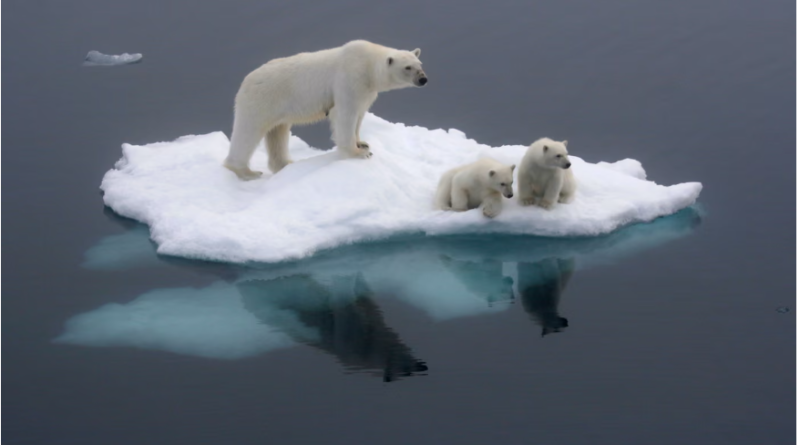
That polar bears are the focus of the research is notable. They have become one of the most powerful symbols of the climate crisis, because they were among the first animals whose habitats were visibly and dramatically destroyed. “The Arctic, where they live, is warming at a higher rate than the rest of the planet. It’s also a habitat that’s more susceptible to visible warming, because it melts. We’ve all seen those horrible images of polar bears stranded on shrinking ice.”
Photographs of polar bears in snow-free environments feel inherently powerful in conveying just how fast their habitat is changing, as the bears filmed living in an abandoned Soviet research station on Kolyuchin Island in the Chukchi Sea (pictured above) demonstrate.
How is the climate crisis changing animals?
Helena says we are already seeing animals move locations, change their behaviour, and even change their bodies. More octopuses in Britain’s seas, tiger moths in Jersey, birds developing larger beaks in Australia or bats developing bigger ears to allow more efficient heat exchange are all examples she lists.
“So we’re making animals move around the planet, we’re forcing them to change their physiology – and now, as this research shows, we’re even pushing them to change their DNA,” Helena says.
Habitat destruction is also a factor in changing animal behaviours, and bringing them into more conflict with humans.
“You see this with elephants in Africa and with the great apes,” Helena says, reminding me that last week the Guardian carried a depressing report on the plight of the rare Tapanuli orangutans. Their Indonesian habitat is under threat from an expansion of gold mining, and the population has suffered a dramatic loss due to recent flooding which was exacerbated by the climate crisis.
How do you balance hope and honesty in climate reporting?
“I try to let the scientists speak for themselves,” Helena says.
“With the polar bears, the lead researcher was very measured. She said it offers some hope, but it’s not a magic bullet – and we still need to stop burning fossil fuels. This isn’t something that should be happening. It’s happening because we’re putting enormous pressure on ecosystems.”
The real question, Helena explains, is whether animals can adapt fast enough to keep up with how quickly humans are changing the planet. At the moment, she says, that seems very unlikely.
Cover photo: Polar bears have been clear victims of the human-made climate crisis. Photograph: Russell Millner/Alamy