

Trump Moves to Repeal Endangerment Finding, Cornerstone of U.S. Climate Regulation
The Trump administration is taking a deregulatory chainsaw to the cornerstone of United States climate policy, launching a long-awaited attack on the 2009 endangerment finding that will almost certainly be appealed right up to the largely Trump-appointed U.S. Supreme Court.
“The repeal would remove the regulatory requirements to measure, report, certify, and comply with federal GHG emission standards for cars,” Reuters reports, citing unnamed administration officials quoted by the Wall Street Journal, “but would not apply to stationary sources such as power plants.”
Environmental Protection Agency (EPA) Administrator Lee Zeldin still called the repeal “the largest act of deregulation in the history of the United States,” Reuters says.
White House press secretary Karoline Leavitt echoed those words almost exactly on Tuesday.
In tandem with the announcement, Trump was preparing an executive order instructing the U.S. Department of Defense to buy its electricity from coal-fired power plants, Inside Climate News reported Tuesday. “It’s expensive, it’s outdated, and it just puts us at risk,” responded Erin Sikorsky, director of the Center for Climate & Security at the Council on Strategic Risks. “Coal is just going backwards, not forwards, for the Department of Defense.”
The endangerment finding repeal “will have taken just over a year to finalize, a remarkably rapid pace for an agency that typically spends at least three years on such efforts,” the New York Times writes. “Legal experts said the speed would be no accident: It could allow the Supreme Court to consider related legal challenges while Mr. Trump is still in office. There, the conservative majority with an anti-regulatory bent could chip away at the federal government’s power to limit the greenhouse gas emissions that are dangerously warming the Earth.”
In that sense, the Times says, Zeldin “appears to be playing to an audience of six: the conservative justices on the Supreme Court.”
Heatmap echoed that overall assessment late last week, reporting that Trump’s EPA was expected to officially rescind the rule “any day now”. But “whether the decision holds up to the inevitable legal challenges and what it all means for [U.S.] climate policy… will hinge on the justification the EPA provides for reversing course.”
“They’re swinging for the fences,” said Jody Freeman, director of Harvard Law School’s Environmental and Energy Law Program, told the Times. “They want to not just do what other Republican administrations have done, which is weaken regulations. They want to take the federal government out of the business of regulation, period.”
“They’ve moved very quickly, especially compared to the first Trump administration, where they didn’t do much of anything in their first year,” added energy attorney Jeffrey Holmstead, who served in the EPA under then-president George W. Bush. “This time they’re much more organized and they have a pretty clear playbook.”
The Times has a profile of the four Trump stalwarts who may be on track to declare “total victory” in obliterating U.S. climate regulation.
A Foundational Ruling
The December, 2009 endangerment finding was an historic and foundational ruling by then-EPA administrator Lisa Jackson that six “key well-mixed greenhouse gases”—including carbon dioxide, methane, and nitrous oxide—“threaten the public health and welfare of current and future generations” when they’re emitted by motor vehicles.
“These findings do not themselves impose any requirements on industry or other entities,” the EPA explains. “However, this action was a prerequisite for implementing greenhouse gas emissions standards for vehicles and other sectors.”
Trump’s advisors first looked into revoking the endangerment finding during his first term of office from 2017 to 2020, but a more concerted attack on the rule has been seen as a stronger possibility since his return in 2025. “Successfully obliterating the 2009 finding that climate pollution endangers public health and welfare—the justification for most climate regulations—would be a massive victory” in Trump’s attack on climate science, Politico Power Switch reported. “The administration’s greatest obstacle, however, may be itself,” after a panel of climate deniers handpicked by Energy Secretary and former fracking CEO Chris Wright backed what Politico called “contrarian” views on climate that have been “rejected by the vast majority of researchers.”
Politico and the Washington Post said Wright ultimately disbanded the group after the U.S. Environmental Defense Fund and others sued for public disclosure of its records. “Scientists say the report is riddled with errors,” the Post wrote, while the lawsuit asserted that the group’s operations violated federal transparency requirements.
A Matter of Law
In August, a Carbon Brief fact check documented more than 100 false or misleading claims in the report. Then late last month, a federal judge ruled that the formation of the panel itself broke U.S. law by failing to hold public meetings or assemble a balance of viewpoints.
“These violations are now established as a matter of law,” wrote Judge William Young of the U.S. District Court for the District of Massachusetts, who was nominated to the bench by former president Ronald Reagan.
“Their work was obliterated,” NRDC senior attorney David Doniger told the Post. “The criticism leaves nothing standing,”
The Post said administration officials had delayed the repeal effort “over concerns the proposal is too weak to withstand a court challenge.” The paper documented a dispute between the White House Office of Information and Regulatory Affairs (OIRA), which questioned the scientific and economic analysis behind the proposal, and EPA officials who wanted it finalized and announced as soon as possible.
Politico said Jeffrey Clark, the former U.S. Justice Department lawyer leading the charge for OIRA, has “his own history of battling climate science.” As of last week, he was still “pushing the administration to strengthen its legal defence without relying on the tainted report.”
The Times says the administration’s pitch for repealing the endangerment finding “is not expected to try to discredit this overwhelming scientific consensus” on the reality of climate science. Rather, it will argue that the U.S. Congress “never explicitly gave the agency authority to regulate greenhouse gases under the Clean Air Act.”
Once the repeal gets under way, “environmental groups are certain to challenge it in federal court. And even if the Trump administration suffers an initial setback there, it is likely to appeal to the Supreme Court.”
Be Careful What You Wish For
While the repeal would be a signature win for the fossil fuel companies that invested lavishly to bring Trump back to the White House, it may not deliver the big boost they’re looking for.
If even one of the Trump EPA’s various legal arguments is uphold in court, “those precedents could restrict future presidential administrations from trying to regulate planet-warming emissions,” write HEATED publisher Emily Atkin and Fieldnotes reporter Julia Kane. “Fossil fuel companies, power plants, and other major emitters could effectively be free to pollute as much as they want—forever.” But you wouldn’t know it from the way the American Petroleum Institute—the alpha lobby group that tried to block the endangerment finding when it was first put forward, then spent years fighting it in court—is responding now.
“It turns out, API isn’t celebrating,” Kane and Atkin write. “Instead, the trade group—one of the most influential and well-organized lobbying forces in the world—is now hedging, backtracking, and sending mixed signals about whether it wants the endangerment finding rescinded.”
That’s because “oil corporations have realized that repealing the endangerment finding could backfire, leaving them more vulnerable to accountability than ever before,” the two climate news veterans explain. Until now, facing a “growing avalanche” of lawsuits and state laws aimed at holding them accountable for their outsized role in the climate crisis, “a critical part of their legal defence has been that, because the federal government already regulates greenhouse gas emissions under the Clean Air Act, any claims under state law are pre-empted.”
But repealing the endangerment finding would undercut that defence. If U.S. courts allow a final rule that says greenhouse gases can’t be controlled under the Clean Air Act, it’ll be “considerably more difficult” for Big Oil to argue that states have no regulatory role to play, the article states.
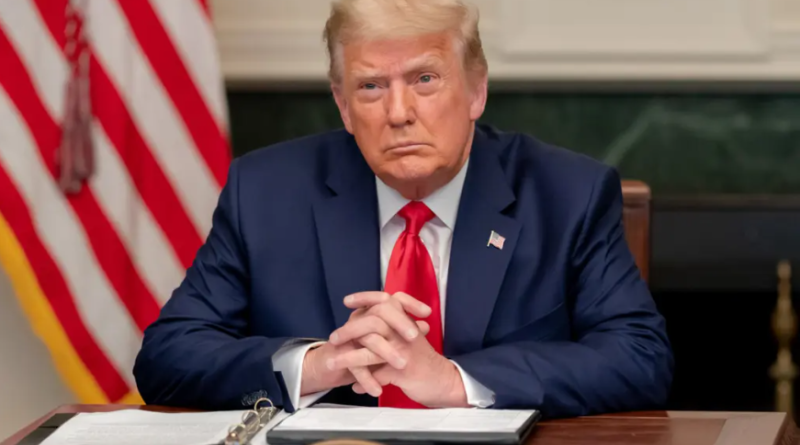
Cover photo: Donald Trump photographed in 2020 (Official White House Photo by Shealah Craighead)