

Policy to projects: Govt, financiers urge delivery at AGES 2026
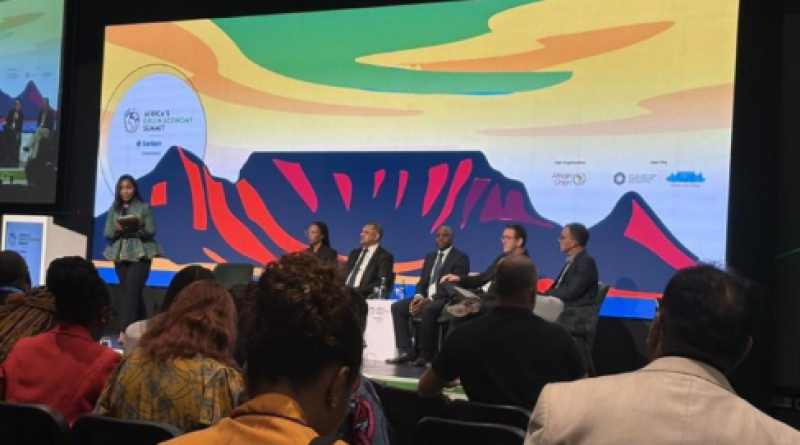
South Africa’s Deputy Minister of Forestry, Fisheries and the Environment, Narend Singh, addressed the AGES event
Translating climate commitments into real investment and jobs dominated keynote addresses at Africa’s Green Economy Summit (AGES) on Wednesday (25 February), where policymakers, financiers and scientists warned the continent would be judged by implementation rather than pledges.
Speaking at the opening plenary, South Africa’s Deputy Minister of Forestry, Fisheries and the Environment, Narend Singh, said the core challenge facing governments was converting strategies into tangible economic activity.
“The difficulty is translating policies, strategies and frameworks into meaningful action. This is where the rubber hits the road,” he told delegates.
From policy frameworks to bankable projects
Singh said achieving sustained action required a wide set of reforms, including shifting from brownfield to greenfield investment, adopting low-carbon business practices, accelerating clean technologies and closing skills gaps.
Access to affordable finance remained a central barrier, particularly for entrepreneurs and small businesses, which he described as critical to an inclusive low-carbon economy.
South Africa’s transition, he said, is being anchored by the Just Energy Transition Partnership (JETP) and the Renewable Energy Independent Power Producer Procurement Programme (REIPPPP), which are reshaping the electricity system while creating industrial and skills opportunities.
The minister added that collaboration between investors, academia, industry and government would be essential as new sectors emerge.
Food-water-energy interconnection
Singh also highlighted food security as a growing priority in a water-scarce region, urging adoption of climate-smart agriculture — including water conservation, soil restoration and climate-resilient crop varieties — while pointing to emerging innovations such as green fertiliser production using hydrogen in Kenya.
Transport decarbonisation and circular economy business models were also identified as major opportunities. Singh cited greener freight logistics, e-cargo bikes and resource-efficient production as examples of small-enterprise innovation already under way.
“We need bankable project pipelines and access to finance for early-stage low-carbon ventures,” he said.
The department is working with the Department of Trade, Industry and Competition and the National Cleaner Production Centre to promote green enterprises in industrial development zones, and is preparing a regional programme with UN agencies to support green industrialisation in six Southern African countries.
Africa seeks a just transition, AGES hears
Harsen Nyambe, Director for Sustainable Environment and Blue Economy at the African Union Commission, said geopolitical change, extreme weather and youth unemployment were reshaping the policy landscape.
Despite challenges ranging from climate impacts to regional conflict, he argued the summit provided a platform to connect investors with innovators and move “ambitions into implementation”.
While global discussions often focus on net-zero targets, Africa’s priority is a just transition, he said, using its natural resources to leapfrog development while creating green jobs.
The continent’s critical minerals endowment places it at the centre of e-mobility and low-carbon industries, while biodiversity, water and sanitation sectors could also attract investment. The African Union is supporting member states to prepare climate-finance pipelines through its Green Recovery Action Plan.
“We are not here to seek charity,” Nyambe said. “We are here to share global solutions for business and humanity.”
Entrepreneurs front and centre
Matsi Modise, Africa Lead at the World Climate Foundation, argued that sustainability has shifted from a niche environmental concern to a core business strategy.
Green and blue economy entrepreneurs – from township solar installers to waste-to-value recyclers and sustainable ocean enterprises – already exist across the continent, she said.
The issue is whether ecosystems are enabling them to scale.
She identified three priorities:
- building entrepreneurial confidence,
- unlocking finance and skills, and
- creating supportive markets that reward impact.
“These are practical businesses with real customers and real impact,” she said, urging investors and policymakers to treat sustainability ventures as mainstream economic activity rather than development projects.
Capital must be unlocked
From the investor perspective, Andrew Johnstone, Chief Executive of Climate Fund Managers, defined the green economy as behaviour change towards low-carbon, climate-resilient and resource-efficient growth.
Unlike industrialised economies that must decarbonise existing systems, Africa has an opportunity to avoid locking in carbon-intensive development, he said.
The continent’s infrastructure deficit, renewable resources and population growth create significant investment potential in water systems, hydrogen, industry and technology.
Crucially, he added, global capital is available, but flows to scalable, risk-adjusted opportunities. “Money flows where risk exists, because with risk comes return,” he said, urging faster project preparation and execution. “No more speeches… just get it done.”
Science, nature and the economy
Closing the keynote session, David Obura, chair of the Intergovernmental Platform on Biodiversity and Ecosystem Services (IPBES) and director of CORDIO East Africa, said sustainable development must be understood as the interaction of nature, society and the economy.
A recent IPBES business and biodiversity assessment found all companies depend on and affect biodiversity, creating risks but also opportunities for positive change.
He warned that enabling regulatory conditions are necessary to shift economies away from environmentally damaging cycles and towards stability and resilience. Africa, he added, could benefit from regional trade and circular economic relationships, particularly in food, energy and water systems. ESI
Cover photo: Africa’s Green Economy Summit is underway in Cape Town, South Africa. Source: ESI Africa