Op-ed: The makings of a nuclear power cell-network
We can develop a vision for interconnected reactors sharing information like a continent-wide cellphone network.
The South African government’s outlook for electricity generation for the coming decades has recently been made public, and nuclear power, a clean energy technology, is making a comeback.
The National Plan contains a notable provision for more nuclear power, which is an excellent strategy. Nuclear is the future of the world, without a doubt.
Furthermore, the National Plan specifically mentions both small and large nuclear reactors.
What is the difference between small and large nuclear power plants?
Large nuclear is like the existing Koeberg nuclear power station near Cape Town. New large ones would be about 25% to 35% larger than Koeberg. But a limitation is that such plants need to be on the coast, because they need seawater for system cooling.
However, South Africa needs to power the inland gold mines, large industrial areas, and remote communities where there are no large water bodies. So you also need Small Modular Reactors (SMRs), which do not require water and can be placed anywhere. These are about 10% the size of Koeberg.
Over 30 years ago, South Africa started developing just such an SMR. Today, we are in a position to build them.
The power plant construction challenge
But now comes another big challenge, for both the government and the industry.
We need the courage and foresight to build a homegrown nuclear construction industry so that South Africa can become a nuclear reactor-exporting country. Such an approach also ensures continued energy independence.
In October, Minister of Electricity and Energy, Kgosientsho Ramokgopa, called for decisiveness. “We are prepared to pay the price and the premium for growing the South African economy… I know industry is ready,” he said.
The simple instinct now is, yet again, to imagine that we will just buy a reactor from another country. But instead, we need to harness national pride and capability and say, ‘Why can’t we be exporters? Why can’t we export to Africa and elsewhere?’
We need to find industrialists with real vision. Sadly, most of them are not real leaders, in the sense of some of the great names of the past. They want to be led, and not be leaders.
South Africa has the expertise to construct power plants
Basically, constructing a nuclear power station is no more complex than building a new Sasol plant, an oil refinery, or a new gold mine. South African leaders have done all of this before.
Such projects consist of assembling multiple teams. There are the civil engineers who create the concrete structures, electrical specialists who develop all the electrical systems, toolmakers who make intricate, accurate parts, and excellent foremen who ensure that site construction unfolds according to plan.
South Africa has all these expert people. So what we need are courageous leaders who are prepared to pull the teams together and to vigorously blow a vuvuzela to draw attention to what our own people can achieve.
There are 300 South Africans working on the giant Barakah nuclear power plant in the UAE.
Our country believes in our road engineers, our cellphone engineers, and our people who build giant shopping malls. So why is there no belief in our nuclear engineers, who South Africa has produced to world-class standards?
Just imagine the size of the industry which can be created by building a nuclear export capability. We need the job creation. We need the income. Where is the courage and leadership?
Right now, 300 South Africans are working on the giant Barakah nuclear power plant in the UAE. It has become a beacon of how a large nuclear plant should be built. There are additional South African nuclear specialists worldwide. South Africa is a world leader in nuclear technology. We certainly can do it.
The notion of a South African nuclear network
We need to develop the vision of a network of South African-built reactors. All over Africa. They can all be interconnected like a giant cellphone network, so they all support each other. I do not mean electrically connected for an electricity supply, but interconnected for information and management purposes, for mutual support.
With the modern Internet, this can be done. We need people from various governments involved in foreign affairs. We need nuclear lawyers involved, and we need them all interacting with the engineering teams.
Let us become leaders in this field, rather than sitting in the queue waiting for some other country to come and help us with the eternal, and usually useless, ‘foreign aid’ because it has to be paid back with interest, and we are also forced to do as the funder instructs.
Foreign aid suppliers usually follow the philosophy of making you a ‘locked-in’ customer, and certainly not an exporter and competitor.
Let us use South African aid for South Africans. It just needs foresight, courage and determination.
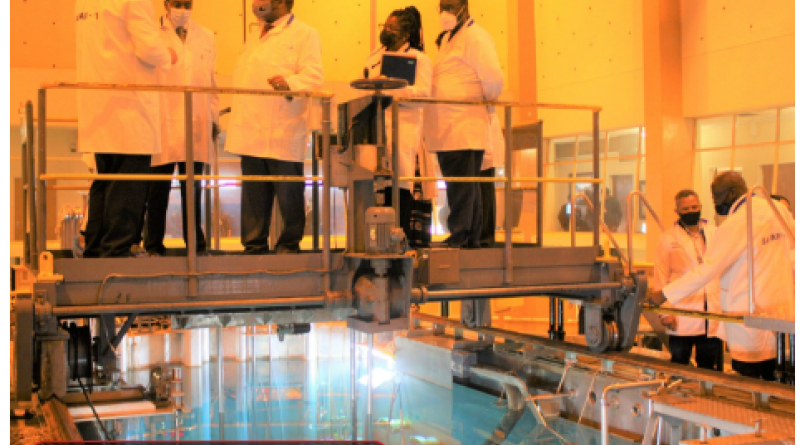
Cover photo: South Africa’s flagship nuclear research reactor, SAFARI-1, is a 20MW light water-moderated reactor commissioned on 18 March 1965. Source: NECSA