

Local Economies Pushed Aside as Newfoundland LNG Megaproject Presses Ahead
“There appears to be a lot of misunderstanding” around FEL’s latest news, Kenny wrote, in a notice posted on the town’s Facebook page. But “while Hanwha and Fermeuse Energy may have entered into some MOU, Council has not seen, or have been made aware of, the contents of the MOU. There have been no formal agreements…between the Town and FEL or Hanwha or any other business concerning an LNG or major project for Fermeuse.”
Kenny added: “Before any major project is to be considered there will be environmental assessments involving all levels of Government.”
The arrival of a deep-pocketed industrial conglomerate from South Korea may be improving the odds for a $10- to $15-billion liquefied natural gas (LNG) megaproject off the Newfoundland coast that was considered unlikely to proceed as recently as last fall.
But an energy justice specialist at Memorial University of Newfoundland says discussions so far around the Fermeuse LNG project give no indication that the venture will be designed to help build or diversify the economy in the small town of 600, rather than extracting local resources and handing the proceeds over to foreign owners.
As The Energy Mix reported last month, a memorandum of understanding (MOU) between St. John’s-based Fermeuse Energy Ltd. (FEL) and Seoul, South Korea-based Hanwha Group established Hanwha “as a long-term strategic partner to Fermeuse Energy, supporting the project’s development, engineering, financing, shipbuilding, and LNG logistics across the full LNG value chain,” FEL said in a Jan. 19 release. At the time, Sung-chul Eo, president of Hanwha Ocean’s Naval Ship Division, said the company was approaching the project “not merely as a service provider, but as a trusted partner committed to supporting the project from concept through execution and commercialization.”
It was a far cry from an announcement last September in which Swapan Kataria, CEO of both FEL and its partner company Crown LNG, touted the prospects for a 380-kilometre pipeline to carry 9.7 trillion cubic feet of offshore gas, about three times the initial estimate for Nova Scotia’s Sable Island development, from the Jeanne d’Arc Basin east of St. John’s to a liquefaction facility in Fermeuse.
At the time, Kataria acknowledged that project financing and logistics were still very much a work in progress. By October, the Town of Fermeuse was declining to answer questions about the project, stating that there was no project to talk about.
“Council cannot participate in an interview as there is no LNG project proposed for our community,” Town Clerk Marsha Kenny told Angela Carter, Canada Research Chair in Equitable Energy Governance and Public Policy at Memorial University, in an email seen by The Mix. “FEL has informed Council that they will not be pursuing their announced plans.”
Kenny referred further questions to Kataria or FEL director John Allan.
‘Market Access’ Is Lining Up
But momentum may have shifted with the MOU announcement in mid-January.
FEL Strategic Counsel Stephen Tessier, partner in the St. John’s-based WaterWerks advertising agency, said Hanwha “has been qualified” as a provider of the floating LNG (FLNG) technology that FEL would require to build its extraction site off the coast. And despite persistent concerns about future global demand for LNG, “FEL has built market access through its project licences in India and UK; and other markets,” Tessier told The Mix in an email. “Hanwha has qualified FEL due to its unique positioning with market access through its sister companies.”
Sungsu Ahn, head of marketing planning and business development for Hanwha’s FLNG business, said the market potential for the project is about to receive careful attention. “The MOU is intended to jointly assess the technical and commercial feasibility of potential LNG solutions including market considerations, as part of early-stage due diligence,” he wrote in an email. “Any specific assessment of market potential or time horizon will be developed collaboratively with Fermeuse Energy as studies progress and remain subject to regulatory and market conditions.”
Ahn added Hanwha is prepared to cut FEL some slack as it works to assemble the investment it will need to fund the project. “We consider financing to be a key success factor for the project,” he wrote. But “given that an offtake/volume placement plan for the LNG product is already being established, there is some flexibility in the near-term timeline for financing discussions.”
No Regulations in Place
There’s also some question about the regulatory assessments the project will require. The Fermeuse Marine Base, the proposed endpoint for the gas pipeline, has been through environmental approvals—but as a type of supply depot, not as a gas liquefaction terminal.
“There is no legislation about the gas offshore,” said Valerie Walsh, a St. John’s college instructor whose family has been in Fermeuse for generations, based on conversations with two provincial cabinet ministers. “There are no regulations about extracting the gas, laying the pipeline, etc. If the proposal moves on beyond the stage it is at, all new assessments and regulations have to be done.”
But one of the big selling points in FEL’s original project announcement was the contention that the Marine Base would require no further review. At the time, Kataria said the prior approvals would save 12 to 18 months of development time on environmental approvals that are already in place.
“Give or take, 54 to 60 months, we should be able to export if we do not get delayed with the regulatory process,” he told The Mix.
In their emails over the last week, Tessier and Ahn both cited Kataria’s original project timeline, with Ahn projecting construction beginning in 2027 and first gas produced in 2031.
‘Rewriting the Community’
Walsh said the MOU announcement marked the second time she’d received major news about her community through the media, rather than the company or the town administration. Neither Town Clerk Kenny nor Mayor Jerome Kenny responded to an email asking how they intended to inform and consult the community about the project, what other plans they had to build and diversify the local economy, and whether they would hold out for community benefits or revenue-sharing if the LNG project gets off the ground.
But with or without the town’s active participation, Carter said projects like Fermeuse LNG have a profound effect on local communities.
“This project seems to take all the air out of the room,” she said. “It becomes very stressful for the community, or the other way, there are people in the community who get really excited about the project and start to believe it’s going to be their future,” she said. “When in reality, what might be more constructive for the community is to be thinking about more viable options for diversification and for a different kind of energy future.”
But “rather than this being a project that was developed with lots of community engagement, coming from the community itself, coming from a vision the community had for itself in the future, community members felt blindsided by this,” she added. “Surely it’s not appropriate for people to be blindsided by $15-billion projects that would rewrite the community.”
Carter cast Fermeuse LNG as the latest in a string of megaprojects that promised great results for small towns in Newfoundland and Labrador, but delivered little or no lasting value—notwithstanding past efforts in the province to support strong local communities. “It’s megaprojects that are always for export, and they are triggered or created by outside wealth and outside control,” she said, whether the product is oil or gas, hydroelectricity or green hydrogen.
“Ultimately, all of these projects are being welcomed because we’re seeking economic diversification as a province,” Carter explained. “We’re trying to create an economy that is sustainable for people. Because the root, which is very powerful, is that we want to be able to stay here. We want jobs for our kids, and we want our communities to be strong.”
But “unfortunately, the way that gets pursued is by welcoming these extreme extractive projects for export that in the end serve more for the enrichment of people from away,” she said. “The megaproject path hasn’t worked for us, and it hasn’t worked again and again and again. So at a certain point we’ve got to choose a different way,” with outside investment targeted to build on communities’ assets and their own vision of the future.
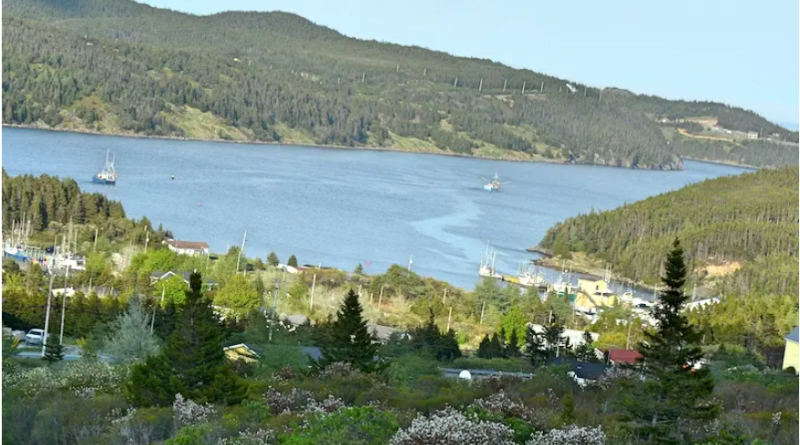
Cover photo: Linda Cutler Kenny/Facebook