

China Could Reach Peak Greenhouse Gas Emissions Sooner Than Beijing Planned, New Report Suggests
Falling emissions from the world’s biggest greenhouse gas emitter could mean a global turning point.
Planet-warming emissions from China, currently the world’s largest greenhouse gas polluter, have continued to flatline or fall as cleaner forms of energy outpace coal and gas generation, according to a new analysis published Wednesday.
If the trend continues, China’s emissions from energy production could peak in the next two years, representing a major structural change in global fossil fuel use and a critical milestone in the effort to slow atmospheric warming.
The study, from Finland’s Centre for Research on Energy and Clean Air, says that China’s emissions from major emitting sectors have dropped over the last year, continuing a slowdown that began in May 2024.
“What we’re seeing broadly is a plateau in emissions, which is in itself a huge step forward from the preceding decade when China single-handedly had the majority of global emissions growth,” said Lauri Myllyvirta, the lead author of the analysis and co-founder of the center.
That dynamic could mean that China achieves its goal of reaching peak emissions before 2030, Beijing’s target date, announced by President Xi Jinping in 2021. Emissions from oil and gas could potentially peak this year, and emissions from coal could peak in 2027.
“That means there’s a very good chance that if this plateau continues, this is the peak,” Myllyvirta added. “Which year ends up being the eventual peak will depend on rains and temperatures and business cycles.”
China has been projected to reach its emissions peak in the past, including in the 2010s when fossil fuel use declined, but soon saw an uptick in response to a series of economic stimulus measures.
Since then, China has strategically focused on developing renewable energy technologies while acknowledging its responsibility for the climate crisis—and the need for it to set emissions reductions targets.
“This is an important piece of work,” said Jackson Ewing, the director of energy and climate policy at the Nicholas Institute of Energy, Environment and Sustainability at Duke University. “Given that we’re looking at close to a two-year plateau and slight decline, it’s more likely than ever that this is here to stay and that the overall emissions trajectory for China is likely to be relatively flat for the next couple of years, at which point it will likely begin to decline and, in fact, decline quite precipitously.”
Among the reasons for that, Ewing explained, is China “reaching exit velocity on its deployment of renewable energy infrastructure—solar, wind and storage, primarily solar, where it’s exceeding growth rates consistently and exceeding growth rates on storage, alongside continuing to build out nuclear.”
The study, produced for Carbon Brief, found that emissions in 2025 declined from nearly all of China’s major polluting sectors. Emissions from transportation fell by 3 percent, power by 1.5 percent and construction by 7 percent. The 7 percent drop from the building sector came mostly from a decline in the production of cement, which accounts for about 8 percent of total greenhouse gas emissions globally.
China produces more than half of the world’s cement, accounting for up to 15 percent of its overall emissions. In 2020, Beijing imposed new rules on real estate developers, requiring them to reduce their debt, which significantly slowed construction and, ultimately, demand for concrete.
At the same time, power generation from solar, wind and nuclear grew over the same period— by 43, 14 and 8 percent respectively—continuing a trend that started in 2023 and driving the country’s flat or falling emissions.
President Donald Trump’s trade war with China is likely the cause behind one of the dark spots in the center’s analysis, which finds that emissions from the chemical industry in China rose 12 percent in 2025, driven by rising coal and oil use for the production of plastics.
China is the biggest importer of U.S.-produced ethane and ethylene, key feedstocks for plastic. But amid the trade tensions in 2025, China began ramping up its own production, even as it continued to import ethane.
“China was the biggest importer [of ethylene] and they have already been building a domestic industry to reduce reliance on the U.S.,” Myllyvirta said. “But that really got fired into high gear by the tariffs.”
The study also notes that, even as China’s emissions slow, the reductions are likely not sufficient to meet the country’s own targets for cutting emissions, including one of its central commitments under the Paris Agreement.
“Emissions are not growing the way they did up to 2023,” Myllyvirta said. “And they’re also not coming down the way they need to.”
China overtook the U.S. as the world’s largest greenhouse gas emitter in 2006, but historically has emitted only about 11 percent of global emissions from 1850 to 2021, while its per-capita emissions are roughly half of those in the U.S.
Beijing continues to make clear commitments to reduce China’s emissions, most recently announcing it would cut its economy-wide emissions 10 percent to meet its Paris targets.
Wednesday’s analysis comes the same week that the Trump administration prepared to repeal the bedrock legal basis that allowed the U.S. to regulate and limit greenhouse gas emissions. Also on Wednesday, the Washington Coal Club was scheduled to bestow the inaugural “Undisputed Champion of Coal” award to Trump, one day after the president ordered the Department of Defense to buy more electricity from coal-fired plants.
“China’s made a strategic decision, that’s over a decade old at this point, to try to electrify their economy to as great an extent as possible, in a way that remains consistent with their economic growth targets,” Ewing said. “In the U.S., we’ve just had a much less consistent set of approaches and policies … to an energy and industrial transition. There’s been real wide vacillations between administrations, I think, particularly between these last two, the Biden and second Trump administration.”
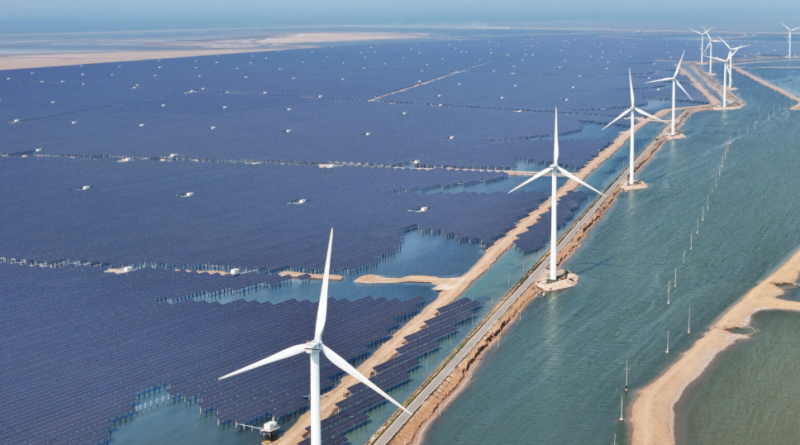
Cover photo: Solar panels and wind turbines are seen at the Huaneng Binzhou new energy power generation project in Binzhou, China, on June 11, 2025. Credit: STR/AFP via Getty Images