AGES 2026: Green economy – the new operating system of the modern world
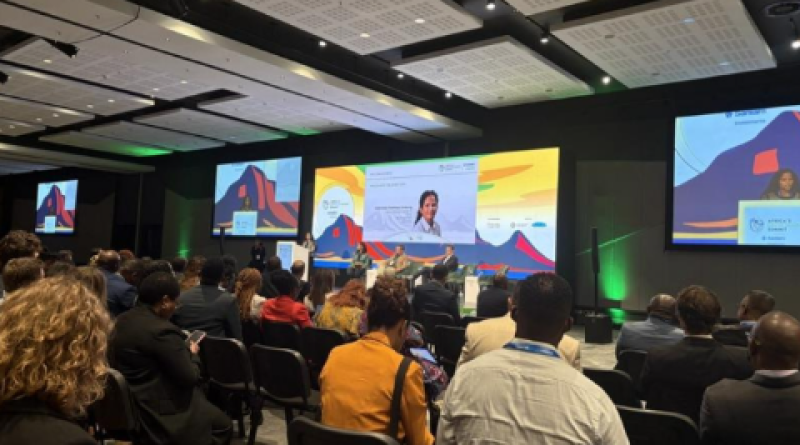
AGES organisers say the summit is structured to move beyond dialogue, offering both open and closed-door sessions to accelerate transactions
Calls to move “from ambition to action” and mobilise capital at scale set the tone on Wednesday as the Africa’s Green Economy Summit (AGES) opened at the Century City Conference Centre.
The four-day dealmaking platform, held under the theme “From Ambition to Action: Scaling Investment in Africa’s Green and Blue Solutions”, aims to connect global capital with investment-ready projects across:
- renewable energy
- green transport
- water
- waste
- sustainable agriculture
- green buildings, the blue economy, and
- climate technology.
Organisers say the summit is structured to move beyond dialogue, offering both open and closed-door sessions to accelerate transactions, from early-stage innovations to large-scale infrastructure.
AGES 2026: ‘Action and scale’
In his opening address to the summit, Carl Roothman, CEO of Sanlam Investment Group, the event’s key sponsor, said two words should guide the continent’s green transition: “action” and “scale”.
“Africa is one of the fastest growing population centres in the world,” he said, noting that the continent’s urban population is expected to double to around 1.4 billion over the next two to three decades.
That growth, he argued, would require vast investment in infrastructure – particularly green infrastructure. “The opportunity is incredibly vast,” Roothman said, while cautioning that Africa must compete aggressively for capital.
“We compete with Asia. We compete with Eastern Europe. It is not Africa’s right to receive capital… we have to work incredibly hard for it.”
He urged policymakers and regulators to simplify investment frameworks and strengthen capital markets to crowd in private finance at scale.
Billions upon billions needed, AGES hears
While climate-focused asset managers are beginning to raise multi-billion-dollar funds, he said far more vehicles are needed to meet Africa’s infrastructure and climate finance requirements.
“We need billions and billions… of dollars into Africa,” he said. “It’s great to dream, but we must act, and we must do it at scale, with international returns and meaningful impact on the planet.”
Roothman pointed to recent initiatives by Sanlam, including new impact-linked investment products and climate-focused funds targeting projects in oceans, sanitation, water and green hydrogen in South Africa and Namibia.
He said mobilising capital from listed markets into private infrastructure and equity investments would be central to accelerating delivery.
Cape Town pitches infrastructure drive
Xanthea Limberg, Mayoral Committee Member for Energy for the City of Cape Town, said the summit’s theme was a “call to collective action”.
“Africa’s green transition will not be achieved through competition alone. It requires practical collaboration, stronger partnerships and scaled investment,” she said.
Limberg highlighted the paradox facing the continent: widespread energy insecurity despite abundant renewable and marine resources. What Africa must strengthen, she said, are stable policy frameworks, infrastructure and investor confidence.
She outlined Cape Town’s own plans, including more than R4 billion in grid upgrades over three years to 2027 to support renewable integration.
The city is finalising South Africa’s first municipal-owned, utility-scale ground-mounted hybrid solar PV plant in Atlantis, expected to generate up to 7MW, with battery storage expansion already under way.
A larger 70MW solar PV project is being prepared for procurement in the coming months, while additional clean energy will be sought through waste-to-energy and energy trading tenders.
Through its “Cash for Power” scheme, the city is also incentivising households to feed rooftop solar electricity back into the grid in exchange for municipal credits redeemable as cash. Energy wheeling is now offered as a municipal service, with plans to expand to multilateral trading arrangements.
Limberg said roughly 40% of the city’s long-term infrastructure pipeline is directed at climate resilience and utility upgrades, as part of efforts to diversify supply and liberalise the local energy market.
Green and blue ‘new operating systems’
Go Green Arica and AGES co-founder Iain Banner described the green and blue economies as “the new operating systems of the modern world”.
He said climate change impacts were being felt globally and called for a renewed balance between economic development and environmental stewardship, arguing that modern societies must restore a more symbiotic relationship between people and nature. ESI
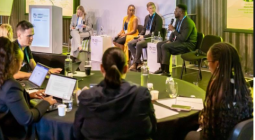
Cover photo: Africa’s Green Economy Summit has opened in Cape Town. Source: ESI Africa