


White roofs and screens cut indoor heat and slash mosquitoes in Kenya
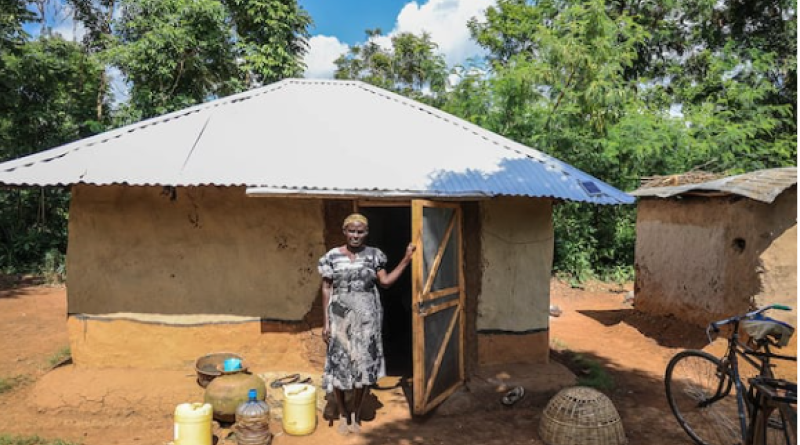
In kenya, painting corrugated roofs white enables insect screens without overheating homes
There is a way to prevent deadly malaria at low expense: change the house. A medical researcher in Africa has developed a two-birds-with-one-stone technology that lowers indoor temperatures and blocks mosquitoes that spread malaria through home remodeling.
Entomologist Bernard Abong'o of the Kenya Medical Research Institute and the team said on the 5th (local time) in the journal Nature Medicine that they had "demonstrated the effectiveness of sustainable dwelling renovation techniques that can lower indoor temperatures and block mosquitoes in rural areas." Low-income Africans are reluctant to install screens because they raise indoor temperatures, but the team solved that problem with inexpensive cooling technology.
◇Screens once shunned for heat, possible by lowering indoor temperatures
According to the World Health Organization (WHO), 610,000 people died from malaria in 2024. Most victims are children in underdeveloped African countries. Abong'o turned to dwelling renovations to prevent malaria infections.
Roofs on rural houses in Kenya, as Korea once had, are made of corrugated iron. Corrugated iron is a material that coats thin steel plates with zinc to prevent corrosion. It is thin and easy to work with, so it is widely used for dwellings. But it absorbs heat well, so indoor temperatures do not drop even at night.
A hot interior invites malaria. People end up keeping doors and windows open, exposing themselves to mosquitoes that carry malaria. You could install screens on the open doors, but many are reluctant because they block airflow and make interiors hotter.
The team tested three cooling strategies in a village in western Kenya. Ten households added more windows to improve ventilation. Another 10 households installed traditional plant-based mats on the ceiling to keep heat from the roof from entering the interior. The remaining 10 households painted the roof white to reflect heat. The team installed screens on windows, doors, and eaves of each house to block mosquito entry.
The results showed that the strategy of painting the roof white was most effective at lowering indoor temperatures. Compared with other houses, indoor temperatures were 3.3 C lower during the day and 2.4 C lower at night. At the same time, screens reduced the number of female Anopheles funestus mosquitoes, which transmit malaria, by 77%. Culex mosquitoes, which transmit Japanese encephalitis, fell by 58%.
With enough money, houses with air conditioning can be built in Africa too. The problem is money. The team said the expense of the dwelling improvement work tested this time was $189 (about 280,000 won) per household. Abong'o said, "In rural Africa, the only ways to keep mosquitoes out were nets and insecticides," adding, "Dwelling renovation is a sustainable and effective method to lower indoor temperatures and block mosquito entry."
In fact, 85% of the households participating in this experiment said they were willing to spend money on dwelling renovations. The team said it plans to expand the dwelling renovation experiment to 300 households with support from Wellcome Trust, a U.K. nonprofit research funding foundation.
The cooling effect of white roofs has long been known. In hot places, homes are often painted white. White reflects all light and appears bright, which helps block heat. Steven Chu, who won the 1997 Nobel Prize in physics and served as U.S. secretary of energy, argued that to curb warming, all roofs worldwide should be painted white.
Scientists are boosting cooling effects by developing paints that achieve a perfect white. In 2021, a team led by Purdue University professor Xiulin Ruan reported in ACS Applied Materials & Interfaces that white paint significantly reduced indoor temperatures.
White paints currently on the market reflect only about 80% to 90% of sunlight. The Purdue team used barium sulfate, a substance that makes chemicals and cosmetics white, and varied particle sizes to develop a paint that reflects 98.1% of sunlight. Outdoor tests found that areas painted with the new white paint were 13.3 C cooler than their surroundings at noon and stayed 7.2 C cooler at night.
The cooling effect of white paint comes from blocking light while emitting heat as infrared radiation. Heat from outdoor AC units remains on Earth and causes urban heat island effects. By contrast, the new paint emitted more than 95% of its infrared radiation in wavelengths that are not absorbed by the atmosphere and can escape directly into space.
In 2018, Columbia University's Yuan Yang reported in Science a white paint that reflects up to 99.6% of sunlight. Applied to buildings, it reflected almost all wavelengths of sunlight and lowered the surface temperature by up to 6 C.
The team said air bubbles embedded in the paint make it appear even whiter. Ice is transparent because light passes through, but when shaved to make a slush, air enters and reflects light, turning it white—the same principle applies. The air bubbles in cooling paint reflect not only visible light but also ultraviolet and infrared, the team said.
Cover photo: Dwellings in rural western Kenya feature white roofs and insect screens. The low-cost retrofits lower indoor temperatures and block mosquitoes./Courtesy of Habitat International