Is Venezuela a “War For Oil”?
It’s an overused cliche, but there is one way in which oil might figure in the recent illegal war: go to Africa to see it
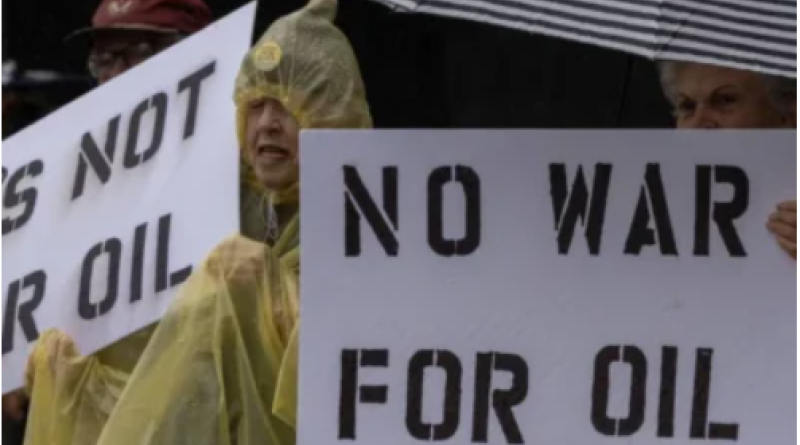
One of the more annoying phrases in the political chant lexicon is “No War For Oil!!” Oil is the mainstay of the world, and the American, economy: blocking supplies of it could be a perfectly legitimate casus belli. In addition, many times when protestors attack a war as being “for oil” they are actually wrong: the phrase rang through marches in the runup to the Iraq War, which wasn’t about oil at all, but rather about…well…no one really knows exactly, but it wasn’t about oil
And unsurprisingly, we are hearing it again now, after Tump’s clearly illegal attack Venezuela yesterday. Venezuela holds vast oil reserves, which Trump is now claiming somehow that it “stole” from the United States.
I am actually somewhat skeptical the oil plays the primary role here: as The Atlantic noted in an article nearly eight years ago, the Trump Doctrine is “We’re American, Bitch.” He wants to do what he wants wherever he wants whenever he wants and no can stop him. It’s about his narcissism and sociopathy, not his wallet.
As Politico reports this morning, US oil companies have little interest in developing Venezuelan oil: the infrastructure is in a shambles, the country’s oil is heavy, sticky stuff that is relatively difficult to refine, and the United States is actually a net exporter of petroleum. The hoary and simplistic notion of American imperialism, driven by US corporations, does not apply here. America does not need this oil.
But you know who does? Donald Trump.
One gravamen of Trump’s entire second term – aside from retribution against his political enemies – has been personal enrichment. He is easily the most corrupt President in US history by orders of magnitude, and in terms of actual billions gained, he might be in the top two or three most corrupt in history. But that is the thing about avarice: it is never satisfied.
Trump has no ownership of major petroleum assets. And his record indicates that he wants it to change.
That might very well be the sense in which this is a War For Oil: not so that the United States can get more oil, but so its aspiring monarch can. And interestingly enough, there is a precedent here:
Meet Leopold II of Belgium (1835-1909; reigned from 1865 until his death). Leopold shares many characteristics with Trump. He was avaricious, arrogant, corrupt, and unfaithful: in 1899, he took a 16-year-old French prostitute as a mistress. (no doubt arranged by some 19th century Jeffrey Epstein).
And relevant to our story, he also loved to seize other countries for himself. Literally.
In 1884, the European powers carved up Africa at the Congress of Berlin. Or at least the European powers and Leopold: mainly because none of them wanted any other country to possess what in now called the Congo (and for many decades was known as Zaire), they agreed to create the “Congo Free State” not as a Belgian colony but as the personal fief of Leopold himself. For close to the next quarter century, Leopold ruled it with an iron fist as his personal property.
The Congo Free State was corrupt, brutal, malicious, and horrid even by the unexalted standard of European colonialism. Leopold tried to strip the vast territory of everything he could, and oversaw mass atrocities that even disgusted the public in the late 19th century. Adam Hochschild’s book King Leopold’s Ghost: A Story of Greed, Terrorism, and Heroism in Central Africa (1998), which won several awards detailed the horrors. The area served as a massive rubber plantation, where natives were enslaved to toil for the king. Women and children were imprisoned as hostages to force husbands and fathers to work. Flogging, starvation and torture were routine. Murder was common—tribes resisting enslavement were wiped out; administration officials expected to receive back a severed human hand for every bullet issued. Rape and sexual slavery were rampant. Workers failing to secure assigned quotas of rubber were routinely mutilated or tortured. Administration officials so completely dehumanized local peoples that at least one decorated his flower garden with a border of severed human heads. News of these atrocities brought slow, but powerful, international condemnation of Leopold’s administration leading, eventually, to his assignment of the country to Belgian administration in 1908.
Unsurprisingly, even after it became the Belgian Congo, conditions hardly changed. The Congo has been a gaping wound in the heart of Africa since then – when it finally achieved its independence in 1960, the United States arranged for the murder of its young, charismatic Prime Minister Patrice Lumumba and for the handover of power to Colonel Joseph Mobutu, who became the country’s dictator, changed his name to Mobutu Sese Seko Nkuku Ngbendu Wa Za Banga (meaning “The all-powerful warrior who, because of his endurance and inflexible will to win, goes from conquest to conquest, leaving fire in his wake.”). Mobutu also stripped the country, slaughtered thousands, and was finally overthrown in 1997 – generating nearly three more decades of violence and brutality.
But to the extent that this is a War For Oil, it seems to me that this is the most likely scenario. Senator Chris van Hollen says that Trump is trying to make money for his “billionaire friends.” This is wrong: Trump has no friends. Trump isn’t trying to make American oil companies rich: he is trying to make himself rich, like Leopold did. And it is worse because Leopold did not use Belgian state assets to do it. Trump does: he is looting the Federal treasury and risking American servicemembers’ lives in order to personally enrich himself.
Perhaps a more homely comparison is from Illinois, specifically former Illinois Governor Rod Blagojevich, who when he realized that he alone had the power to replace Barack Obama in the Senate, told an associate, “I’ve got this thing, and it’s f*cking golden.” That’s Trump’s view of the Presidency: he sees the United States as his personal possession.
None of this would happen, of course, if Congress and the Supreme Court still existed. But they don’t.
Cover photo: By Legal Planet