

Too Much Rain: The Climate Disaster That Ended an Ancient Chinese Society
Ancient floods, not war, drove the fall of the Shijiahe culture.
Around 4,000 years ago, a sophisticated society in the middle reaches of China’s Yangtze River, known for its palaces, water management systems, and finely crafted jade, suddenly emptied out.
Was it invaders or climate change that caused the collapse of the Shijiahe culture? Now, a new high-resolution climate record points to a relentless, yet unexpected force: decades of unusually heavy rainfall.
Researchers reconstructed ancient rainfall year by year using the oxygen isotopes and trace elements in a cave stalagmite. The record shows that prolonged flooding drove people from one of Neolithic China’s most advanced urban centers.
The Great Flooding
Stalagmites grow slowly as mineral-rich water drips from cave ceilings, leaving behind thin layers of calcium carbonate. Each layer preserves a chemical trace of the climate above ground.
By drilling hundreds of microscopic samples from a stalagmite in Heshang Cave, researchers created a thousand-year “rainfall yearbook” for the middle Yangtze Valley. They performed 925 measurements to estimate relative annual rainfall between about 4,600 and 3,500 years ago.
The record reveals dramatic swings. Three dry intervals brought less than 700 millimeters of rain per year, while two wet periods exceeded 1,000 millimeters annually and lasted for decades. The most severe shift began around 3,950 years ago, when the longest wet period took hold.
Those wet decades coincided with signs of crisis: expanding wetlands, repeated floods, and a sharp drop in signs of population across the region. As lakes spread and lowlands became waterlogged, farmland and settlements shrank. The agricultural base of the Shijiahe heartland must have been severely undermined.
Too Much Water Not Too Much War
Dry spells, by contrast, proved less destructive. During earlier low-rainfall periods, residents shifted crops from water-hungry rice to drought-tolerant millet and maintained stable populations. Too little water can strain a society, but too much can make the land uninhabitable.
“[The data] enabled us to demonstrate, for one of the first times, that high rain can cause problems for past societies, as well as drought conditions,” said Professor Gideon M. Henderson, a professor in the Department of Earth Sciences at the University of Oxford and a co-author of the study.
The Shijiahe collapse occurred during the so-called 4.2-kiloyear event, a period of global climate disruption often linked to drought-driven collapses elsewhere. Here, however, the record indicates that long-lasting floods and not drought played the central role.
Implications for Today’s Changing Climate
The ancient rainfall reconstructed from the stalagmite reached about 1,200 millimeters per year at its peak—intense, but still lower than some extremes measured in the region during the past century.
Modern engineering, irrigation, and governance now allow the middle Yangtze to produce a large share of China’s rice. Ancient farmers had no such defenses.
“This not only reflects the limited adaptive capacity of ancient societies, but also highlights the critical importance of modern-day water management infrastructure, agricultural innovations, and governance systems in mitigating climate risks and safeguarding food security,” said lead author Jin Liao of the China University of Geosciences.
As global temperatures rise, extreme rainfall is expected to intensify in many regions. The fate of Shijiahe suggests that the slow accumulation of water across seasons and generations is just as dangerous as drought.
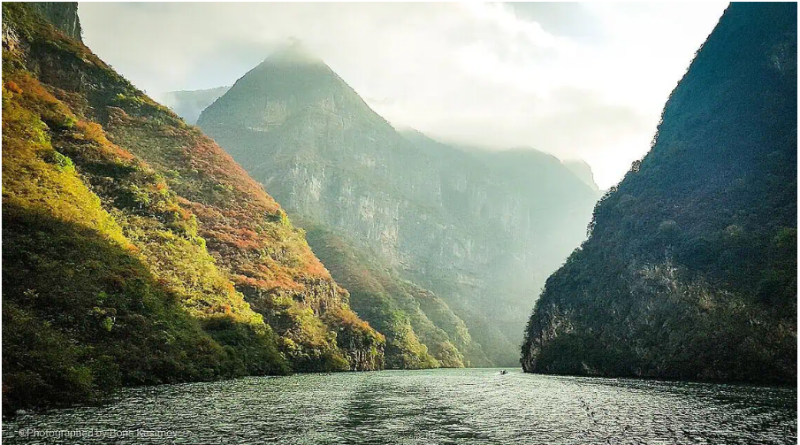
Cover photo: Yangtze river today