

Life on the edge and the villages lost to the sea
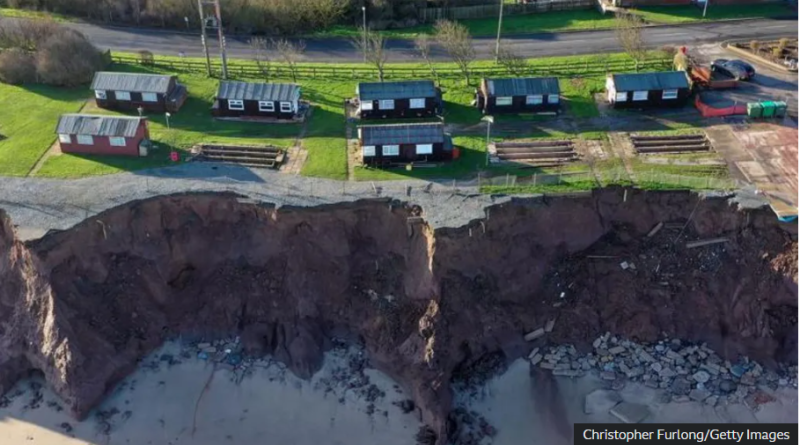
East Yorkshire has one of the fastest eroding coastlines in the UK. Dozens of towns and villages have been lost over the years, but there is one tale that has stood the test of time.
"It was just a story you talked about as children, sort of a fairy tale," recalls 90-year-old Shirley, who grew up in Withernsea in the 1940s.
"The story was that there'd been a village or a settlement out there, and that it had eroded into the sea, and you could hear the church bells. I'd like to think I believed it, but I'm not sure.
"Quite a lot of villages have been lost on that coast, so it's possibly true."
Shirley moved to Withernsea from Hull in 1939 at the age of four. She lived there until she got married at St Nicholas Church in 1958.
She believes the tale of the bells may have originated from St Peter's Church in Owthorne, just north of Withernsea, where large parts of the town were washed away in the early 19th Century.
Shirley says she would often see "lumps falling off the cliffs" as she walked along the coast, and even at the end of her road, Princes Avenue.
Maps stored at East Riding Archives show the impact of erosion on the East Yorkshire coast dating as far back as the 16th Century.
A map created by Christopher Saxton in 1577 shows a number of hamlets and villages that went on to succumb to the sea, including places such as Dimlington, Owthorne and Waxholme.
By 1786, a map produced by John Tuke shows Hornsea Beck had completely disappeared.
Dr Caitlin Green, who specialises in history, archaeology and place names, said 38 houses had been destroyed in Hornsea Beck since 1547. By 1695, all but one or two houses had washed away.
Fast-forward to 1912 and a map showing the lost towns of East Yorkshire, by Thomas Sheppard, shows locations that used to be inland, such as Old Kilnsea, Ravenspurn and Out Newton.
As a whole, the maps are visual evidence of more than 30 locations disappearing from the East Yorkshire coast in the past 400 years.
Hannah Stamp, who works at the archives, said: "It is very worrying to see, in particular for communities living along the coast who are directly impacted by this every day."
David Whitaker, landlord of The Crown and Anchor in Kilnsea, knows only too well what life is like living with the elements.
The 59-year-old's pub is just a stone's throw from the North Sea, which he says can be "pretty bad" at times.
"When I take the dogs down there it can be a cliff one day and the next I can walk straight on to the beach, it's shifting that much," he says.
"You don't really know year to year what your customer base is going to be, you just keep going."
With power cuts and wi-fi issues also causing a nuisance, what makes living on the edge of a coast worthwhile?
"It's so peaceful. The beauty and the charm just trump everything," he says.
"In winter, it can be very bleak and the weather can be atrocious. On the other side of it, we get some of the best sunsets in the country."
Despite having flood defences installed nearby in 2013, sea still sprays on to the pub during storms.
"When you open the curtains in the morning, it's like being at sea," he adds.
"You need to be a certain type of person to enjoy that, it could be daunting otherwise."
And what about the church bells?
David says it's a story that continues to be told more than 80 years on from when Shirley first heard it.
"For many years you could still see the spire on a clear day above the water," he says.
"At certain tides, you can hear the bells chiming. I haven't heard them personally, but that's the tale."
The Environment Agency says the risk of eroding coastline along the East Yorkshire Coast is "likely to increase in the coming years due to climate change, sea level rise and increased storminess".
A spokesperson adds: "The Changing Coasts East Riding Project is part of the government's £200m Flood and Coastal Innovation Programme, which is driving forward flood and coastal resilience to support adaptation to an ever-changing climate."
Cover photo: Holiday chalets on the edge of the coast at Withernsea in 2020