

Global renewables soared in 2024, but 2030 target remains elusive
The report highlights the need for investment to increase to support better planning for climate risks and long-term system resilience
Global renewable power capacity surged by a record 584 gigawatts in 2024, pushing total installed capacity to 4,448GW, new data from the International Renewable Energy Agency (IRENA) report shows.
The report indicates that the 15.1% jump marks the fastest annual growth on record, but it still falls short of what is needed to triple renewables by 2030, highlighting the urgent need for grid infrastructure, market reforms and a sharp increase in investment.
The report highlights the need for investment to increase to support better planning for climate risks and long-term system resilience.
Renewables as a shield against price shocks amid geopolitical instability and volatile fossil fuel markets
The WMO–IRENA 2024 Year in Review: Climate-driven Global Renewable Energy Resources and Energy Demand, report emphasises that decarbonisation pathways aligned with the Paris Agreement must also deliver a just energy transition.
“To this end, energy security, affordability and resilience are emerging as interdependent priorities. Amid geopolitical instability and volatile fossil fuel markets, many countries are turning to renewables not only for emissions reduction but also as a strategy to strengthen domestic supply and mitigate future price shocks.”
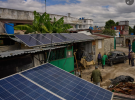
The report also highlights stark spatial disparities in how renewable energy is deployed. Looking into Africa, IRENA reminds that the continent possesses some of the world’s highest potential for solar, wind and hydropower – yet remains underdeveloped, accounting for just 1.5% of global renewable energy capacity.
“Unlocking this potential, particularly through distributed systems, could drive industrialisation and energy access across the continent. Detailed climate-informed resource assessments are essential to support this ambition,” says IRENA.
The report points to widening regional disparities driven by climate stress on energy systems.
- Southern Africa experienced strong positive anomalies for both solar (+2%–6%) and wind (+8%–16%) capacity factors in 2024, driven by high solar irradiance and intensified synoptic pressure gradients. However, hydropower remained below average for the third year running, and energy demand reached record highs in most countries except South Africa.
- Eastern Africa saw positive hydropower anomalies from surplus rainfall, while solar and wind CFs were generally near or below average.
- Central and Western Africa recorded some of the highest Energy Degree Days anomalies globally exceeding +20%, with limited installed solar or hydro capacity to buffer the increase.
The report notes that rising awareness of climate change, energy security and supply chain diversity has led to a record deployment of renewable electricity capacity in 2024. However, it warns, despite this progress, the current pace remains far too slow to meet the global commitment to triple capacity by 2030
Cover photo: wingwings©123rf