Donald Trump vs. The World
How far will Trump have to overplay his hand before the rest of us can get back to the real emergencies on the agenda, beginning with climate change? This past week, it hasn't been going well for him.
With his oil-soaked adventures in Venezuela and his dangerous threats against Greenland (and Colombia, and Cuba, and Canada), the evidence is mounting that Donald Trump may finally be overplaying his hand.
And for the failed real estate speculator and wannabe reality TV star who pledged to “Drill, Baby, Drill” his way to an era of American prosperity, the sweet irony is that global oil markets and the energy transition may be essential ingredients helping to bring him down.
For the first time since Trump pulled us all into this era of disruption, corruption, and chaos with his ridiculous escalator ride in 2015, after countless moments when we all thought he had stepped too far (we were wrong), this may be the year when he finally picks a series of fights he can’t win. Countries that spent 2025 mollifying him, then working around him, are declaring a line in the sand around Venezuela and Greenland. A few Republicans in Congress, anxious about his plummeting poll numbers and their own, are finding their spines and occasionally voting against him. The oil executives who invested hundreds of millions in donations to put him back in office are now second-guessing his plan to take over and expand Venezuelan oil production or, in the case of fracking CEOs in Texas, declaring themselves “pissed” that he’s trying
Decline and Fall of the United States
The other shoe will take a while to fully drop, but it’s beginning to land with a thud. With “Drill, Baby, Drill” at the centre of White House strategy, Trump’s power grab is all built on the assumption that he can dominate the globe by controlling an oil and gas market that is entering its sunset. Meanwhile, China is emerging as the world’s first electrostate—not only because low-carbon, renewable electricity and storage are cleaner, cheaper, more reliable, and quicker to scale, but because in the 21st century, clean energy deals with dozens of other countries will be the key to global influence.
It’s a measure of how preoccupying Trump’s wave of international gangsterism has been that this post isn’t mostly about the militarized violence he has also unleashed in the U.S., culminating in the murder of unarmed civilian Renée Nicole Good by an Immigration and Customs Enforcement (ICE) officer in Minneapolis.
But even if his domestic terrorism, polarization, and cascading misinformation don’t fully break the country he claims to want to make great, the climate impacts Trump refuses to acknowledge may well finish the job. In 2025, the U.S. saw a billion-dollar climate disaster every 10 days, our friends at Grist report, while a year of ham-fisted budget cuts have produced a “dangerous erosion” in the country’s emergency response capacity, The Guardian writes.
It’s hard to see how this doesn’t end very badly for the United States—and for any politicians trying to carry on Trump’s legacy after he leaves office.
Mocking the Schoolyard Bully
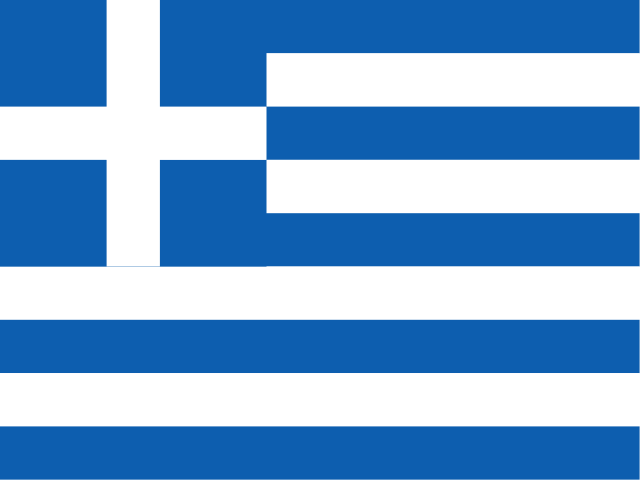
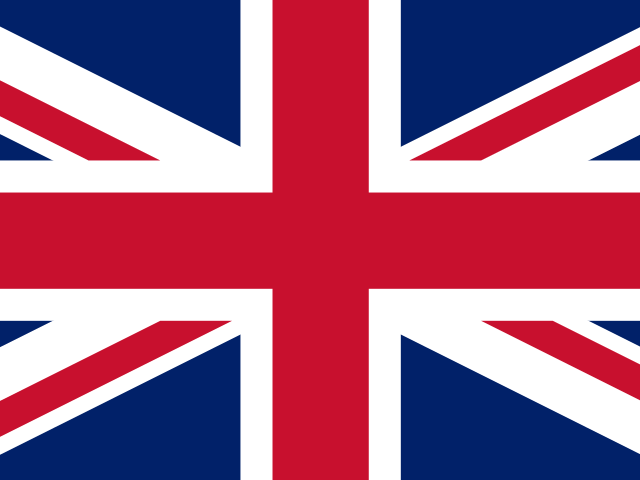
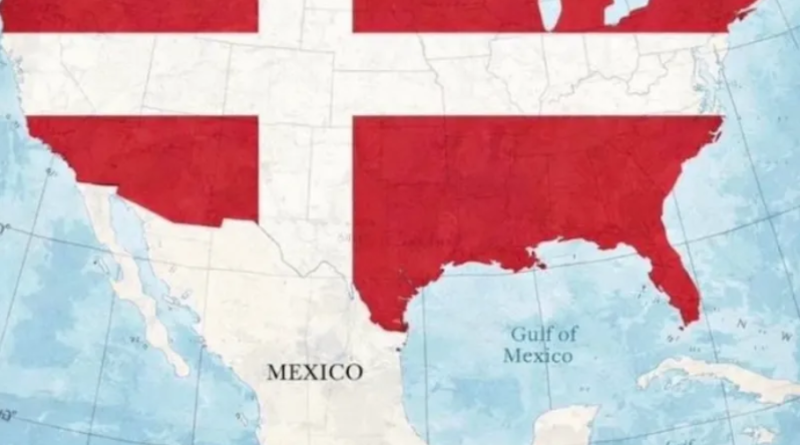
The international reaction is something the U.S. hasn’t seen before, and that Trump may not have bargained on. The image at the top of this post is edgy. But Christian Thalacker-Heldenstein of Denmark’s Folketing Committee for Geopolitical Hygge, who posted it online, wasn’t the one who started it.
The original provocation came from Katie Miller, whose husband Stephen is the White House deputy chief of staff behind many of Trump’s most toxic policies, a confirmed fascist so odious that members of his extended family have reportedly “mostly disowned him” as the “face of evil”.
“Nobody’s going to fight the United States militarily over the future of Greenland,” Miller told CNN’s Jake Tapper last week. “We live in a world, in the real world, Jake, that is governed by strength, that is governed by force, that is governed by power. These are the iron laws of the world since the beginning of time.”
Like any schoolyard bully, Trump hasn’t reacted well when people at home or abroad have tried to accommodate him, pacify him, or wait him out. Now, the tide is turning, and with Thalacker-Heldenstein’s post, it’s beginning to descend into open mockery. He writes:
In light of recent global events, and in the spirit of offering constructive solutions, the Bicycling Kingdom of Denmark proposes bold, compassionate, and frankly, hyggelig action.
We are formally announcing our intention to annex the territory formerly known as the United States of America. Why? Because every human deserves clean water, trustworthy government, and happiness.
Our proposal is simple. Upon peaceful integration, all American residents will be offered:
• Seamless Path to Danish (and EU) Citizenship: No complicated paperwork. Just a pleasant 50-kilomertre scenic bike ride and a short oral exam on proper bicycling hand signals.
• $150/Month Universal Health Care: Includes preventive care, mental well-being, and a complimentary handmade candle and wool blanket at every visit (HyggeCare™).
• Scandinavian-Style Education: Forest kindergartens, where iPhone-screens are replaced with pinecones, and critical thinking is honed by building shelters from the rain.
• Western Europe-Style Hate-Free Speech and Governance: Council meetings are live-streamed with free wienerbrød. Hate speech and corruption convictions lead to 100 hours of community kayak sessions.
For anyone who’s ever faced down a bully—at school, in adult life, or in the international arena—looking out for signs of weakness is a survival skill, and mockery is the ultimate revenge. For Trump, the assumption that oil is a viable path to strength may be the biggest weakness of all.
The Illusion Begins to Pop
Since the U.S. bombing and kidnapping raid on Caracas, Trump has been going all-out to assert control over Venezuelan oil production. It hasn’t been going well for him, partly because the illusion that oil still runs the world is popping faster and falling farther than you might have expected.
The days after the raid were filled with the kind of bombast and spin we we’ve come to expect from Trump: that Venezuela “will be turning over” 30 to 50 million barrels of oil to the U.S., that Trump will personally control the revenue from selling that oil, and that the U.S. fossil industry will pile in to Venezuela to restore its decrepit, poorly-maintained production infrastructure.
As usual with the U.S. huckster-in-chief, it didn’t take long for the illusion to shatter.
We heard that Trump would have no constitutional authority to take control of the funds.
That it would take years and cost $100 billion to increase Venezuelan production by a scant million barrels per day.
That oil execs aren’t keen on Trump’s demand that they pitch in, with ExxonMobil warning that Venezuelan oilfields will be “uninvestable” as things now stand, and an industry source admitting that the fossil companies most keen on getting involved “are among the least prepared and least sophisticated.”
That all of the discussion is swirling around a country that produces the dirtiest of heavy oil, with climate pollution so flagrant that its methane emissions are visible from space.
And that the loudest objections to Trump’s latest brainstem-storming exercise are coming from some of his most avid financial supporters, shale oil executives in Texas who invested heavily to get their guy re-elected and are now worried that a flood of Venezuelan oil—in the unlikely event that it happens—will drive down prices and sink their companies.
“We’re talking about this administration screwing us over again,” one top executive told the Financial Times. “If the U.S. government starts providing guarantees to oil companies to produce or grow production in Venezuela I’m going to be…pissed.”
Oil Markets Are Stumbling
The root of the problem, and the key to the opportunity, is that oil demand ain’t what it used to be. The world is still extracting vast quantities oil, gas, and coal, far beyond the available carbon budget in a cascading, global climate emergency. But they’re drilling so much that they’ve produced a surplus generally estimated at about 2.5 million barrels per day. In the mindset of the commodity traders who set the global price of oil, that’s enough to drive down prices—possibly as low as $15 or $20 per barrel, when fracking operations, for example, need $60 to break even. That creates severe headaches for producers, and for petrostates like Alberta whose budgets depend on them.
Oil prices have always been volatile—early in the pandemic, they fell to -$37.63 per barrel, prompting one friend of The Energy Mix to leap into action. “I’d like to order one billion barrels, please,” he snarked. “Below is my bank account for deposit of the $37,630,000,000.00 as my rebate for buying this stuff.”
The difference this time is that more analysts and pundits are noticing. “On Monday, the market said—loud and clear—we are heading into an oil glut,” Globe and Mail business columnist Andrew Willis wrote last week. “The market did not say—in any way, shape, or form—it is time to build another pipeline to get more Alberta bitumen to the British Columbia coast.”
That view is by no means unanimous. Alberta Premier Danielle Smith is predictably treating the Venezuela raid as a pretext to speed up the already accelerated approval of a West Coast pipeline to just six months, and federal Conservative leader Pierre Poilievre is predictably singing from the same songbook. They’re supported by a Globe and Mail editorial and a Toronto Sun columnist—and by one of the country’s most aggressive oil execs, Strathcona Resources executive chair Adam Waterous.
“BREAKING: Oil CEO says Canada should abolish all laws, Indigenous consultation, to get a B.C. coastal pipeline started in three months,” climate communicator Jason Mogus responded on LinkedIn. “Or else the poor oil sands will, gasp, shrink. Guess bro missed the whole point of the Paris Agreement: unless fossil fuels shrink, we all cook.”
“I challenge you to name a single geopolitical event of significance from the last two years that the Canadian oilpatch hasn’t claimed provides a rationale for building a new western oil pipeline,” added climate analyst Aaron Cosbey, president of Small World Sustainability Consulting.
But the overall tone of the news coverage and analysis is beginning to shift. “It’s basically coming across through most of the more reflective media we’re seeing,” Mark Campanale, CEO of the UK’s Carbon Tracker think tank, told The Weekender in an email. “‘We can’t get the stuff out without loads of infrastructure investment’ is the most repeated line we’re seeing—as is correct. Less of ‘the world won’t need this stuff by the time it gets to market’, which is what we’d want to see more of.”
Even so, 15 years after Carbon Tracker coined the term “carbon bubble”, more and more investors “are getting it,” Campanale wrote. “Our job is to undermine investor confidence in the future of fossil fuels/new production, that it’s not needed,” and slowly but surely, “I think we’re winning there.”
Global Cooperation for the Win
For the Mark Carney government, job one is still to protect Canada’s economy and sovereignty from a rampaging U.S. president with no restraint. There is some worry that even the faint hope of expanded heavy oil production from Venezuela will influence Canada-U.S. trade negotiations in the course of this year. And Smith is gleefully acting as a fifth column for U.S. annexation by actively supporting an Alberta separation referendum, prompting Carney to deliver a “sobering wake-up call to his Liberal caucus last month,” Politico Canada Playbook reported last week. “It was a clear sign from the PM to Liberal MPs that Alberta’s separatism movement is shaping his thinking—and federal policy.”
Politico writes:
To the surprise of those in the room, Carney opened his remarks by addressing the spectre of Alberta separatism, framing the pipeline deal not just as an economic win, but as a strategic necessity to keep the country together.
“He was talking about how [the separatist movement] is very difficult to understand. But he said make no mistake, it’s there,” a Liberal MP told Playbook….
“He was emotional,” the MP said. “You could hear a pin drop.”
But those fears are emerging at a moment when “strong pressures on multilateral institutions are causing global cooperation to evolve rather than retreat,” the World Economic Forum reports, with “smaller and more agile coalitions of countries—and, at times, companies” keeping the lines of communication open.
From the news coverage in the week since Trump’s Venezuela bombing raid, Carney has been at the centre of that activity, announcing:
• A new consulate in Greenland, due to open in February;
• A new partnership with Mexico on trade, energy, and security;
• A trip to electrostate China this coming week, the first by a Canadian prime minister in more than eight years;
• Side visits to Qatar and to the World Economic Forum in Davos, Switzerland while he’s on the road.
Canada’s economic dependence on the United States has taken decades to build up, it’s been enabled by successive federal governments, and it won’t be solved overnight. But with Trump threatening to annex our country while he systematically dismantles his own, there’s no other time to get on with correcting the problem. With the climate crisis always in the foreground, it doesn’t hurt that failing oil markets will sap the U.S. regime’s clout and credibility, while increasingly giving way to the energy sources at the heart of the inevitable shift off carbon.
Mitchell Beer traces his background in renewable energy and energy efficiency back to 1977, in climate change to 1997. Now he and the rest of the Energy Mix team scan 1,200 news headlines a week to pull together The Energy Mix, The Energy Mix Weekender, and our weekly feature digests, Cities & Communities and Heat & Power.
Cover photo: Christian Thalacker-Heldenstein/LinkedIn