

Toward Climate Resilience with a Focus on Adaptation: Lessons from Communities
Abstract: This article reflects on the role of communities in climate change adaptation, highlighting Tajikistan’s experience with the Early Warnings for All initiative. It illustrates how global commitments, when combined with inclusive local action, strengthen resilience and protect communities from climate risks.
Public authorities and civil society organisations are key to bridging gaps and building community resilience against climate change. This article reflects on their roles and the role of communities, including local public authorities, in adaptation, drawing from the experience of support from the Red Crescent Society of Tajikistan and the Government of Tajikistan in the rolling out of the Early Warnings for All (EW4All) initiative. It argues that global frameworks such as the Paris Agreement and the Sendai Framework gain real meaning when translated into action at the community level.
The Paris Agreement, adopted in 2015 and ratified by 194 state Parties, sets a global framework for climate action.[1] Its success in implementation requires a whole-of-society approach, engaging governments, businesses, civil society, and communities. Its Article 12 and the UNFCCC framework of Action for Climate Empowerment (ACE) highlight six elements—education, awareness, training, participation, information access, and international cooperation—to empower people to engage in climate action.[2]
Launched by the UN Secretary-General in 2022, the EW4All initiative aims to ensure that by 2027 every person is protected by early warning systems for hazardous weather, water, and climate events.[3] Its four pillars—risk understanding, hazard monitoring, warning dissemination, and preparedness to respond—form an end-to-end system. EW4All complements the Paris Agreement, supports the Sendai Framework’s global target on multi-hazard early warnings,[4] and contributes to the Sustainable Development Goals by reducing vulnerability and protecting livelihoods.
Tajikistan was among the first 30 countries selected to implement EW4All. Preparations began in June 2023, led by the Committee of Emergency Situations and Civil Defense (CoES) of its government with strong support from the UN system and the International Federation of Red Cross and Red Crescent Societies (IFRC).[5] The national launch in August 2023 was backed by high-level political leadership, including the appointment of a Deputy Prime Minister as the focal point. Coordination was anchored in the existing National Platform for Disaster Risk Reduction.
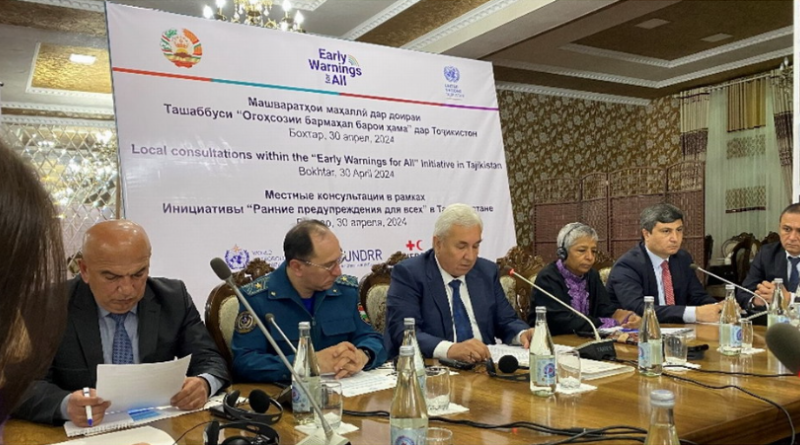
A major achievement was devolving EW4All from national to the local level, particularly in developing capacity for preparedness to respond (Pillar 4). Under the leadership of CoES, the Red Crescent Society of Tajikistan supported by IFRC worked together with local public authorities and communities.[6] National and provincial workshops in 2023–2024 discussed draft roadmaps that identified gaps in coverage of warnings and made action plans for the four pillars, particularly in areas prone to avalanches, floods, mudflows, and landslides. By July 2024, an integrated national roadmap was endorsed, setting time-bound actions for strengthening early warning systems nationwide.
Tajikistan’s approach illustrates how global commitments can translate into local resilience. Success factors included: high-level political leadership; inclusive coordination across government, UN agencies, and civil society; active participation of stakeholders at all levels; time-bound, adaptable planning; and empowerment of communities to act effectively on warnings. This multi-level cooperation is an example of how to embed climate action into national and local systems.
Based on Tajikistan’s experience, several recommendations emerge for other countries implementing EW4All or similar programs:
- Ensure strong government leadership at the highest political level to drive progress.
- Strengthen coordination across sectors and levels, with a clear role for each stakeholder.
- Invest in local capacity building so communities are not only recipients of warnings but active participants in preparedness.
- Develop time-bound roadmaps with monitoring to track progress and adapt when needed.
- Empower communities through education, awareness, and participation, ensuring early warning systems are people-centred and action-oriented. The EW4All initiative in Tajikistan shows how governments, civil society, business and international partners can collaborate to localise global climate goals. Its inclusive and devolved approach provides a model for other countries seeking to protect communities from climate-related risks, including through EW4All, and move toward a more resilient future.
Cover photo: By IFRC