

But monitoring PFAS in penguins has traditionally required drawing blood, pulling feathers, or collecting samples of guano from remote breeding colonies. Besides being stressful for the animals, “a blood sample only tells you what the penguin ate and metabolized, not what it comes into contact with in its environment,” Uhart says.
Seeking both better samples and a more humane detection method, Uhart’s team fitted penguins with soft silicone bands loosely placed around one of their ankles. Silicone acts as a passive sampler that absorbs chemicals present in the surrounding environment, allowing the bands to record the contaminants penguins encounter in their daily lives. Similar bands have already been used in experiments with firefighters to detect chemicals they are exposed to during fires. “It’s a useful, accessible, and inexpensive technology that was already within reach,” Uhart says.
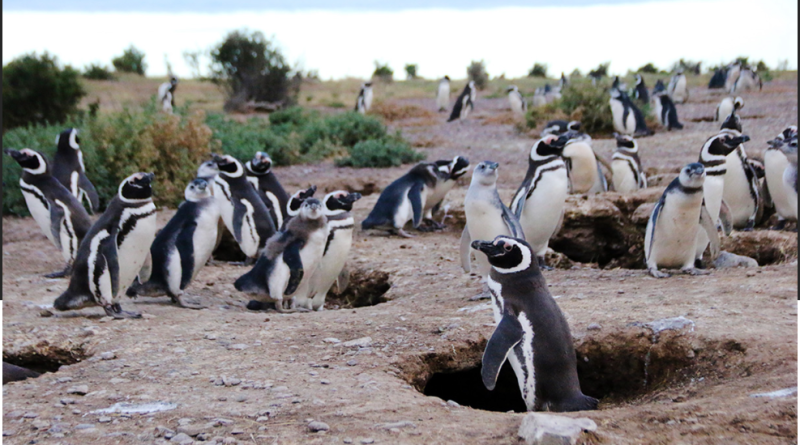
The team placed the bands on 55 penguins in two colonies along the Patagonian coast of Argentina during three breeding seasons between 2022 and ’24. The devices remained on the birds for between 2 and 9 days before the team retrieved them and analyzed them in the laboratory. The researchers screened the bands for 40 different PFAS compounds.
The results showed that most of the penguins had been exposed to these contaminants. The scientists detected PFAS in about 91% of the bands and identified nine different compounds, including both highly toxic legacy PFAS used before 2000 and newer replacement chemicals, which are less likely to accumulate in tissues but are still highly persistent and in widespread use today. Exposure also varied between colonies, seasons, and the length of time the bands remained on the birds, suggesting marine PFAS levels change across space and time.
Penguins are particularly suited for this work because they forage across large areas of the ocean but reliably return to the same breeding colonies, making it possible to deploy and retrieve monitoring devices. But Uhart and her colleagues hope to expand their network by placing the samplers on other species. Next on the list: cormorants, birds capable of diving more than 50 meters below the surface, deeper than penguins can go.
But Uhart emphasizes that the penguin study was only a pilot, with a small sample size and study period. Even so, the technique’s low cost means it could be replicated in larger penguin populations and across more regions, Frere says. “Not all of the Argentine sea is the same.”
Despite the pilot’s small size, Dee Boersma of the University of Washington sees promise in the idea. She notes that penguins are more than mere monitors for their habitats. They’re also charismatic species that can quickly capture human attention and deliver an urgent message. “We don’t really know what these chemicals are doing—but penguins are in trouble,” she says. “We’re losing our sentinels.”
doi: 10.1126/science.z7009y4
Cover photo: During the breeding season, Magellanic penguin colonies along the coast of southern Argentina’s Chubut province can reach up to 640,000 pairs