
Kawasaki signs contract to build world’s largest liquefied hydrogen carrier
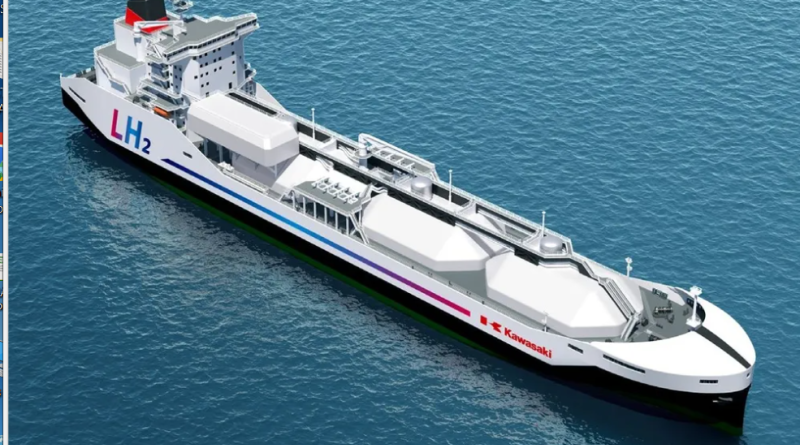
The new vessel will have 32 times as much storage capacity as the only previous LH2 carrier, the Suiso Frontier
The as-yet-unnamed ship will have 32 times as much storage capacity as the world’s first — and so far only — LH2 carrier KHI’s Suiso Frontier, which first hit the water in 2019 and subsequently shipped 1,250 cubic metres of liquid hydrogen from Australia to Japan in early 2022 (see panel below).
KHI and JSE said in a joint statement that the vessel has been designed “to respond to the global demand for hydrogen anticipated in the 2030s” and to “provide the foundation for the future hydrogen supply chain”.
The ship, which will be built by KHI in the southern Japanese city of Sakaide, will use a diesel/hydrogen electric propulsion system powered by one “hydrogen/oil-based dual-fuel generator engine” and one “conventional oil-based generator engine”.
However, both ammonia and methanol would require energy-intensive cracking at their destination if the end user intends to use hydrogen, rather than the derivatives directly.
“By providing a stable supply of large volumes of hydrogen and supporting the decarbonisation of electricity generation, mobility, and industry, the new vessel will help to realise a hydrogen-based society,” KHI and JSE said.
“Kawasaki and JSE will continue to cooperate with diverse businesses to construct a commercial-scale, international supply chain for liquefied hydrogen and realise a carbon neutral society by 2050.”
JSE is a consortium of businesses established originally as a joint venture between KHI and Japanese energy firm Iwatani. It now also includes Ebara Corporation, Obayashi Corporation, Tokyo Century Corporation, the Development Bank of Japan, Mizuho Bank, and Mitsubishi Kakoki Kaisha.
Cover photo: A rendering of the planned liquid-hydrogen carrier