

Geoengineering On the Table, and Under Fire, As Scientists Race to Save Melting Thwaites Glacier
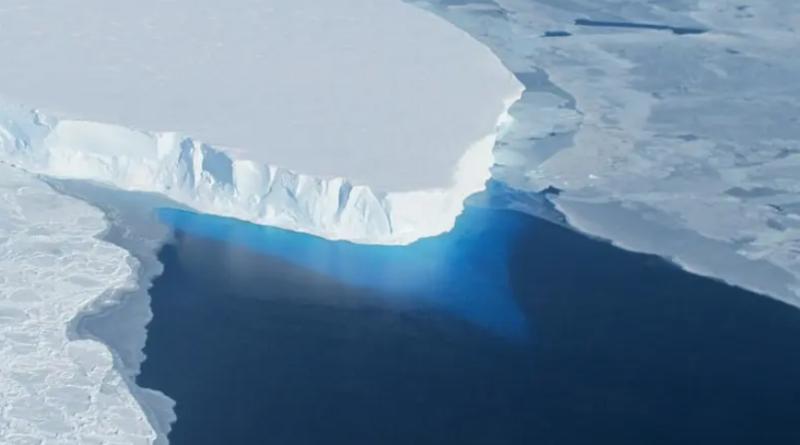
As the Thwaites glacier loses its grip on Antarctica’s western edge, a small group of scientists is proposing radical interventions like drilling heat-exchanging devices into the ice and creating artificial “speed bumps” on its bed to slow its collapse. Other glaciologists say the schemes are infeasible and a dangerous distraction from cutting emissions.
But there is wide consensus that the clock is ticking on the mighty glacier responsible for around 4% of current sea-level rise—a melting piece of our planet’s story.
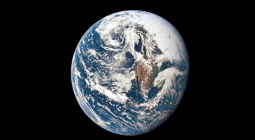
On December 7, 1972, an Apollo 17 astronaut took the Blue Marble photograph. Captured four years after Earthrise, the photo credited with launching the global environmental movement, this breathtaking image marked the first time earthbound humans had ever seen their planet in the round. It was also the first time humanity had seen Antarctica from space, a whorl of brilliant white ice and clouds, out of which the otherwise blue, green, and umber planet seemed to rise.
The atmospheric concentration of carbon dioxide that year was 328 parts per million (ppm), meaning 328 out of every million air molecules were a greenhouse gas that traps heat close to Earth’s surface. This was already up from a pre-industrial baseline of roughly 285 ppm in 1850.
Fifty-four years on, that number has climbed to 431 ppm, and glaciers of the West Antarctic are receding, none faster than the mammoth Thwaites.
A Marine Glacier Melting Down
Thwaites is the widest glacier on Earth—120 kilometres across at its front edge and up to four kilometres thick in places. Should it melt completely, Thwaites alone contains enough ice to raise sea levels by 65 centimetres.
Even in the absence of other drivers of sea level rise, such an event would force millions of people to relocate, with Asian countries especially vulnerable. A sudden collapse of Thwaites is unlikely in the next few decades, but the glacier is shedding ice five times faster than in the 1990s, by one recent estimate.
Some researchers fear that Thwaites cannot be saved—that no amount of emissions reductions will stop it from melting away into the Southern Ocean. Thwaites is particularly vulnerable because it is a marine ice sheet. Like the much larger West Antarctic ice sheet of which it is a part, Thwaites rests on bedrock deep below sea level. It is especially exposed to warming ocean waters that are steadily eating away at its underbelly.
A ‘Grim’ Outlook
In February 2026, researchers at the Potsdam Institute for Climate Impact Research identified +1°C as the temperature threshold beyond which Thwaites and its neighbour, Pine Island Glacier, will inevitably lose ice mass sufficient to generate 90 centimetres of long-term sea level rise.
With global heating now standing at roughly 1.3°C, Thwaites may already be in a state of irreversible collapse, wrote the Potsdam team. Three years ago, a team of United Kingdom scientists warned of “unavoidable future increase in West Antarctic ice-shelf melting over the twenty-first century.”
“Substantial ocean warming and ice-shelf melting [is] projected in all future climate scenarios,” including “the most ambitious targets of the Paris Agreement,” wrote lead author Kaitlin Naughten, a climate modeller with the British Antarctic Survey’s Polar Ocean Team. Rapid decarbonization can do little now to stop Thwaites’ substantial disintegration.
The glacier’s future is “grim,” wrote the International Thwaites Glacier Collaboration (ITGC) in a September 2025 briefing about findings from a seven-year effort by more than 100 scientists to learn as much as possible about the glacier’s response to global heating, and what it means for sea-level rise.
“Warm water at depth from the Amundsen Sea continues to melt the front and underside of the glacier and ocean models show the temperature of this water will continue to increase through this century,” warned the ITGC.
The timeline for Thwaites’ demise remains highly uncertain, however, because so many of the complex interactions that will determine its fate—between ice and ocean, between ice and bedrock—remain hidden from view, thousands of metres beneath the surface..
Thanks in part to a first-time deployment of underwater robots, ITGC’s now completed research effort has yielded many critical insights—and many more questions.
“One of the main things that has come out of all the research we’ve done in Antarctica, is that a lot of things are much more complicated than anybody realized,” geophysicist Robert Larter, UK Lead Scientist in the ITGC Science Coordination Office, told The Energy Mix in an interview.
Could We Geoengineer A Fix?
Some 150 years ago, an ice stream flowing under the Ross Ice Shelf—more than 1,000 kilometres to the east of Thwaites—suddenly stopped moving. A widely accepted theory is that the Kamb Ice Stream (formerly Ice Stream C) stagnated when an adjacent ice stream (known as B) robbed it of the water that was lubricating its steady flow into the Ross Sea. Thwarted by this act of “water piracy,” the ice stream was effectively frozen in its tracks, and has remained so, ever since.
For Brent Minchew, Caltech professor of geophysics, this event provides a natural analogue for a geoengineering feat that could save Thwaites. Briefly, passive heat exchange devices called thermosyphons drilled down into the glacier could be used to draw heat up and away from its melting undercarriage, thereby refreezing Thwaites to its bed. Some 120,000 such devices have been keeping the permafrost around the Trans-Alaska pipeline frozen since it was built in 1974.
A decade-long deployment of some 10,000 such thermosyphons might well be enough to do the trick, Minchew told Sally Kornbluth, president of Massachusetts Institute of Technology (MIT), during a podcast in February 2025. Co-founder and chief scientist at the emerging Arête Glacier Initiative, Minchew is one of a small group of scientists who believe that it’s time for geoengineering solutions to halt the meltdown of the world’s glaciers.
The thermosyphon proposals “are only ideas at this stage,” Minchew and his co-founder Colin Meyer wrote in a January 2026 op-ed in the Guardian. Other ideas include building “speed bumps” into the base of Thwaites to stymie its seaward slide.
“It will take years of research and development to understand if and how we might stabilize ice sheets,” Minchew and Meyer wrote, stressing the need for “scientific discipline and environmental responsibility” alongside “innovation and speed.”
“We cannot ‘move fast and break things’—but we also cannot afford to debate until the tide is at our door.”
The Thwaites Will Be Gone
Rising tides and ticking clocks are precisely why glaciologists should be united against polar geoengineering, say its critics. Minchew and Meyer’s Guardian op-ed appeared five months after a group of more than 40 top glaciologists from around the world, including Larter, published an exhaustive rebuttal of polar geoengineering in Frontiers in Science.
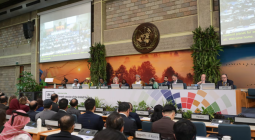
Led by Martin Siegert, a glaciologist at the University of Exeter, the authors “felt the need to push back after polar geoengineering was discussed by panels at the annual United Nations climate summit in Dubai in 2023,” reports Scientific American.
Evaluating five polar-geoengineering ideas currently under development, including giant “sea curtains” deployed to keep warm ocean waters back from the edge of Thwaites, the scientists rejected them all as technically and/or logistically infeasible, environmentally damaging, prohibitively expensive, unethical, and illegal under the international laws that govern Antarctica.
The glaciologists warned that promoting geoengineering fixes for a problem caused by global heating risks encouraging complacency or false hope in ordinary people, and “predatory delay” in those whose interest lies in maintaining the fossil-fueled status quo.
And sure enough, opportunities for “ice-washing” are beginning to germinate: a proposal for “ice-credits” based on Arctic ice thickening has been submitted to controversial carbon credit review agency Verra. The project has been put on hold, but another review is promised in 2027.
Humanity’s efforts to keep Antarctica frozen must concentrate on deep and rapid decarbonization using mitigation strategies that have been proven to work, rather than “speculative solutions with uncertain outcomes,” Siegert and his team write.
While Thwaites, and even the West Antarctic Ice Sheet in the longer term, are likely now past saving, “other regions of Antarctica are unlikely to lose substantial mass if current emissions targets are met,” wrote UK climate modeller Naughten in her 2023 study.
“It may be too late for Thwaites, but if we carry on what we’re doing, we’re going to destabilize marine-based sectors of the East Antarctic in the same way, and so mitigation is absolutely essential,” Larter told The Mix. “We may have created a big problem for ourselves, but if we carry on in this way, we’re going to make it a lot worse.”
Cover photo: Thwaites Glacier James Yungel NASA ICE CC BY 2.0/wikimedia commons