

Financing water: Investors urged to embrace risk, AGES 2026 hears
Water may appear to be a daunting proposition for investors – it is poorly structured, underprepared and trapped in weak partnerships – but it is about understanding the risk (perceived or otherwise) and how it is placed and ultimately addressed.
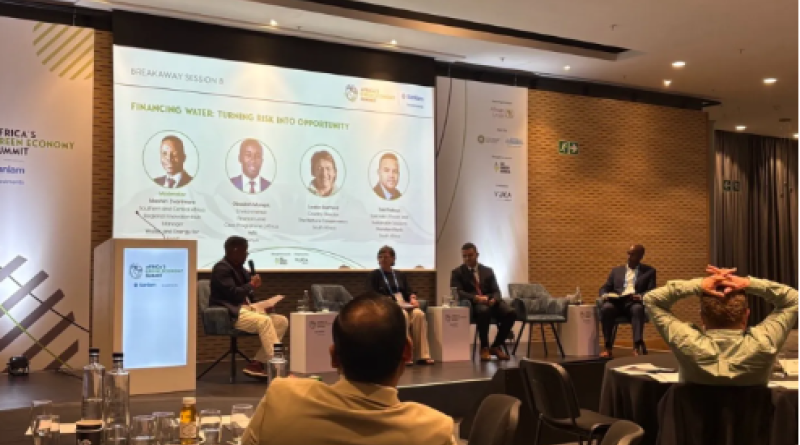
That was the key message from an expert panel at Africa’s Green Economy Summit 2026 (AGES) in Cape Town on Thursday (26 February), where they tackled the topic Financing Water: Turning Risk into Opportunity and argued that Africa’s water crisis could become its next green asset class – if governance, data and financial design are fixed.
The session brought together Obadiah Mungai, Environmental Finance Lead for Cities at World Resources Institute Africa (Kenya); Zaid Railoun, Specialist for Energy and Infrastructure at Standard Bank South Africa’ and Louise Stafford, South Africa Country Director at The Nature Conservancy.
Risk is misunderstood, not insurmountable
Mungai rejected the idea that hydrology alone makes water un-bankable.
“Yes, there are droughts and floods. But the investability problem is one of translation… how do you convert water outcomes into bankable outputs?”
He pointed to structural weaknesses rather than climate volatility. In South Africa, non-revenue water—estimated at more than 40%—reflects failures in billing, metering and collection rather than rainfall patterns.
There is a bigger risk in business as usual than in investing in water
Elsewhere, tariffs may exist on paper but cash flow enforcement is weak.
Cape Town’s “Day Zero” (projected to occur on 12 April 2018) crisis exposed another vulnerability: utilities dependent on volume-based revenue models suffered financially when demand management reduced consumption.
The crisis officially passed as winter rains arrived in 2018, filling dams and pushing back the, then eventually cancelling, “Day Zero” deadline.
For Mungai, the issue is risk and value allocation. “Water is not too risky. It is about where the risk is placed… and whether revenues, beneficiaries and partnerships are clearly defined.”
Infrastructure and governance gaps
Railoun said investors must distinguish between physical climate risk, infrastructure risk and governance risk. Burst pipes and ageing systems present bankability concerns just as serious as drought.
He pointed out that governance fragmentation – where responsibilities for bulk supply, distribution and regulation are split across agencies – further complicates due diligence.
“We need to unpack perceived risk. Once we understand it properly, the financial metrics begin to make sense.”
Railoun added that commercial banks are increasingly approaching water as a service opportunity, particularly for clients in agriculture, manufacturing and mining seeking reuse, reclamation and efficiency solutions.
For banks, he said, bankability hinges on:
- capable sponsors,
- credible technical partners, and
- a clear supply-demand matrix at facility level.
“A good client understands where they are going… not just on water, but on the sustainability journey,” said Railoun.
Nature-based finance gains traction
Stafford argued the greater risk lies in inaction: “There is a bigger risk in business as usual than in investing in water.”
She warned that South Africa’s water demand is projected to outstrip supply by 17% within the next two decades.
The Nature Conservancy SA Director cited Cape Town’s response to the 2018 crisis as evidence that water resilience can be commercially viable.
After conducting hydrological and economic studies, nature-based catchment restoration was shown to cost a fraction of large-scale infrastructure alternatives such as desalination, while delivering significantly higher long-term returns.
The City invested R125million—about 46% of total programme funding—acting as a catalytic anchor to crowd in private capital through a blended finance structure.
An outcomes-based water bond is now being developed to close a funding shortfall and scale restoration efforts. “The private sector wants to see action. They want transparency. They want to follow the money,” saiid Stafford.
‘Valley of death’ in project preparation
Across the panel, preparation emerged as the critical weak point.
Mungai identified three recurring failure stages:
- poor problem definition at concept stage,
- weak data and delivery models during preparation, and
- financial structuring that magnifies unresolved uncertainties.
Too often, projects begin with a preferred technology rather than a defined problem or buyer. During preparation – the so-called “valley of death” – inadequate baseline data, unclear offtake arrangements and unresolved land or water rights stall progress.
Research suggests three to five percent of total project cost should be dedicated to robust preparation, he said.
““”Financial structuring only magnifies what the fundamentals allow. If the preparation is weak, you will not reach financial close,” said Mungai
Quantifying resilience
Asked how to value water resilience, Mungai said the answer lies in modelling avoided losses and reduced volatility.
Investors should compare intervention scenarios with a “do nothing” baseline, quantifying avoided industrial disruptions, productivity losses and future capital expenditure. Reduced insurance premiums and lower risk pricing can also be incorporated.
“It is a technical process that ends with a dollar value. But it must be robust and grounded in real data.”
Partnerships under strain
The speakers agreed that partnerships frequently fail due to misaligned objectives and rigid institutional frameworks.
Stafford said private sector partners require clear value propositions, measurable outcomes and transparent governance. However, public institutions are often not structured for innovation.
“Public–private partnerships are powerful. But without enabling mechanisms, they remain a paper exercise,” she said.
Railoun stressed the need for layered financing models. Development finance institutions and concessional capital often need to de-risk projects before commercial lenders can step in.
Mungai highlighted procedural bottlenecks. Public procurement and PPP frameworks are designed to protect the public interest but can slow private sector onboarding. Without political will or regulatory clarity, projects risk stalling indefinitely, the panel warned.
From crisis to asset class
The panellists agreed that Africa’s water challenge is less a question of scarcity than of structure.
Catchment-level thinking, blended finance, credible data and clear revenue models could reposition water from perceived liability to investable infrastructure and resilience asset.
As pressure mounts from climate change, urbanisation and industrial demand, the choice for governments and investors is narrowing.
The speakers suggested that the cost of inaction may ultimately prove far higher than the perceived risk of investing. ESI
Cover photo: An expert panel at Africa’s Green Economy Summit 2026 (AGES) in Cape Town tackled how to turn risk into opportunity when it comes to financing water projects. Source: ESI Africa