

Energy security: The pillar of sustainability, the passport to independence
What are the components of energy security for a nation?
The Iran war, more than any other war previously, has brought home clearly how invaluable energy security is. In a few days the uncertainty created by the combination of the war being waged in one of the biggest fossil fuel hubs – production and transport – and the contradicting, unclear messages from the leading actors of the war, caused havoc in the stock markets and consequently all the markets.
As always is the case, some people who “knew”, made a lot of money, while the rest of the world is bleeding ever since.
Practically everything in our life depends on energy. But this dependence is not simply defined as having enough “fuel”, but rather securing a continuous, reliable, environmentally friendly and affordable availability of energy for all.
And this is the definition of the benefits of energy security, because it satisfies three fundamental cornerstones of sustainability, the environmental, the social and the economic.
But how can one nation or the whole planet for that matter, ensure energy security? What are the components of energy security for a nation?
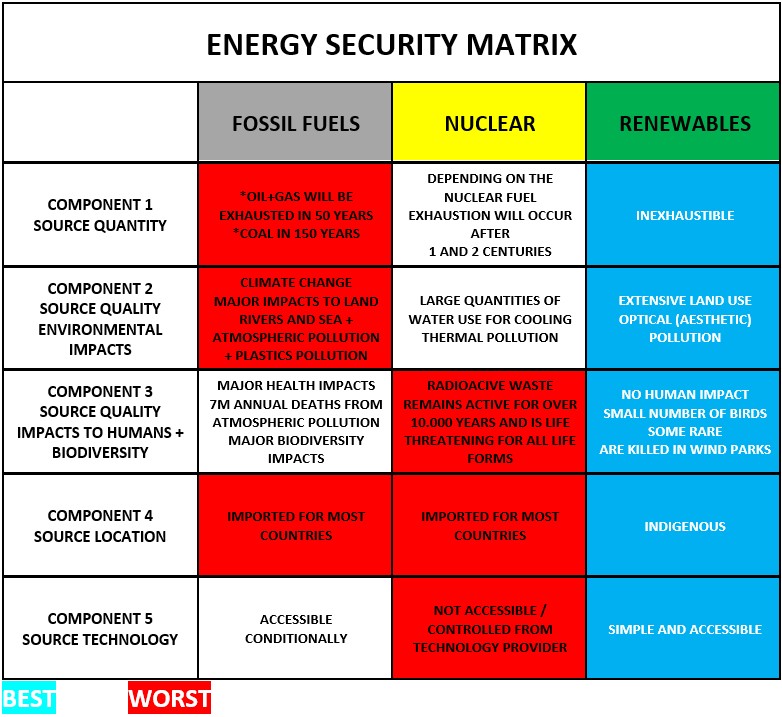
- The energy source, quantitively will provide the answer to the abundance of energy supply question, at any given time as well as perennially.
- The energy source, qualitatively will define its environmental impacts.
- The energy source, qualitatively will define its impacts on humans and biodiversity.
- The energy source, geographically will define the dependence or independence of energy supply.
- The technology needed for its exploitation, will define the degrees of freedom of exercising national energy policy.
The table below presents a summary of the best and worst energy source for each component:
The role of renewables in energy security
Renewables are the obvious and impulsive choice because they can help all nations establish their independence and develop their national economies independent of imported fuel and imported technology. This alone should be enough to make that choice, without venturing down the lane of destructive human and environmental impacts associated with the other 2 energy sources.
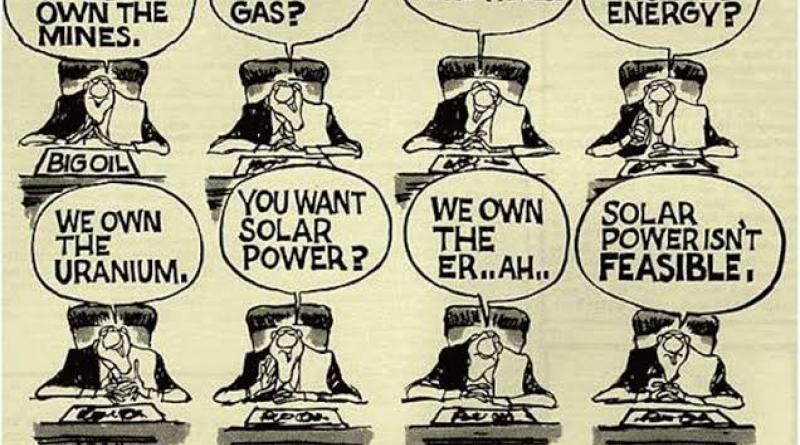
And this is precisely the reason that renewables are being fought so hard, by the energy establishment and its controlled media.
For the energy establishment, the dominant selection criterion for an energy source is the ability to control it.
Fossil fuels fit that description quite well, even for countries, who have their own fossil fuel reserves, as history has shown. Venezuela and Iran are painful examples.
But if fossil fuels fit the bill, nuclear energy seems “godsent”, way better than fossil fuels, because both the fuel and the technology are controlled. Ideal! But it is definitely not ideal for the nations which fall into the marketing and political trap and make this fatal choice. It can develop easily into neo-colonialism.
Energy independence for all
Energy independence, through the use of abundant, inexhaustible, environmentally and biodiversity friendly, available to all nations, cheap and simple renewable energy sources, does not only provide energy security and sustainability, but it opens the way for national independence.
Or as UN Secretary General said in a video message for the State of Global Climate 2025 report, which is yet another emergency call: “…renewables deliver climate security, energy security and national security…”
And one final thought: No one will ever wage a war to secure the wind, the sun or other renewables, because all nations have more than enough renewables available to last them for ever.
Makes you think. Doesn’t it?
About the author
Prof Dr Ioannis Tsipouridis, a Senior Research Fellow at Strathmore University in Kenya. He is a Renewable Energy Consultant Engineer and Climate Action Advocate, Director at RECCReC (Renewable Energy & Climate Change Research Center at TUM) and Visiting Professor at the Technical University of Mombasa (TUM), Visiting Professor at Kisii University, Editor of the “Energy Matters to Climate Change” Emc2 portal, Member of Fossil Fuel Non Proliferation Treaty and Member of Loss and Damage Collaboration Group