


Does Taking Oil Money Disqualify You from Being Governor?
The Drain is a weekly roundup of environmental and climate news from Legal Planet.
The race to be California’s next governor has managed to be both wild and underwhelming, with a wide field of candidates who are competent but not exactly captivating. Exciting or not, voters are starting to tune in.
If the environment and climate change rank among your top concerns, who should you vote for? My Legal Planet colleagues from UC Berkeley have an ongoing series examining the climate issues in the race and while we don’t do endorsements, I have some observations.
Tom Steyer and Katie Porter received a dual endorsement from the California Environmental Voters and the endorsement of The Climate Center Action Fund. Why? Because according to The Climate Center they are the two candidates who won’t take oil money, will stand up to corporate power, will invest in nature, and won’t prolong the fossil fuel era.
Tom Steyer of course is a longtime climate activist and anti-billionaire billionaire. After building a hedge fund empire and making a fortune (off fossil fuels among other industries), you could say he’s seen the light. He’s credited his religious faith for bringing him to a spiritual form of environmentalism. Observant reporters have noticed that Steyer draws a Jerusalem cross on his hand to remind himself to be truthful. He has supported candidates as a donor, backed several successful ballot measures taking aim at corporate power, and unsuccessfully run for president. He says California is “uniquely positioned to continue to lead, further cementing itself at the forefront of clean energy, innovation, climate mitigation, and adaptation.”
Katie Porter is the consumer lawyer and former whiteboard warrior in Congress representing Orange County. She has taught at UC Irvine School of Law. She was appointed by then-Attorney General Kamala Harris to be California’s independent monitor of banks in a nationwide $25 billion mortgage settlement. She famously flipped her congressional seat from red to blue and wielded said whiteboard to take on corporate interests—and polluters—during congressional hearings. She says that “preparing for and responding to disasters that strike California will be one of the most important roles of our next Governor.” She lost a previous run for a U.S. senate seat but had an eight-point plan for fighting polluters and climate change.
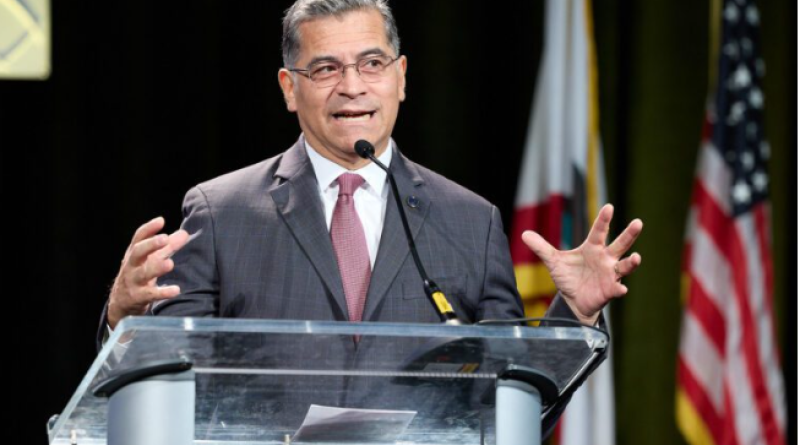
A few weeks ago, I started thinking about Xavier Becerra. He’s one of the only candidates who has actually held statewide office or run a big government agency. As state Attorney General, he has a record of taking on polluters and protecting the environment. He sued the Trump administration more than 100 times. More recently as the head of the U.S. Department of Health and Human Services, Becerra connected public health and the environment by launching a new government office to address the health threats of climate change. Becerra has climbed in the polls this month, and snuck into the feeds of Instagram influencers, but he’s not high on any environmental voter guides.
Earlier this month I posed a question on social media: Why isn’t Becerra scoring more points with climate activists? I quickly got my answer on Bluesky. “Problem is he’s still taking money from the fossil fuels industry, so I don’t feel like I can trust him,” replied David Sacerdote. “Lots of other candidates refuse that money.” Although I’d seen California Environmental Voters cheer Steyer and Porter for saying “no” to Big Oil contributions, I hadn’t yet noticed Becerra failing to do so. “Chevron maxed out to Becerra,” RL Miller, the Political Director of Climate Hawks Vote, pointed out. “He’s a non-starter among climate folks.” (Search the campaign finance records at CalAccess.) By Monday of this week, the issue had fully entered the discourse.
So, should taking Big Oil contributions disqualify you from being governor of California?
Becerra supporters might argue that it’s easy to reject Big Oil money when you’re a self-funded billionaire like Steyer, while their guy had to fight for every donation at the start of the campaign. Fair enough, but Katie Porter also swore off oil money, and she’s done alright. Becerra backers might also argue that he has a track record as Attorney General and HHS Secretary of holding corporations accountable even if they donate to his campaigns. Twenty years ago, you might be able to make that argument with a straight face. But knowing what we know now about the fossil fuel industry’s decades-long campaign to undermine the consensus on climate change, it’s hard to take that argument seriously. Each legislative session, we witness the oil industry’s continued stranglehold on political power in Sacramento. Chevron is not just the second-largest oil company in the U.S., it is a firm with California history that recently moved its headquarters from Northern California to Texas and that is constantly threatening to leave the state entirely if it doesn’t get what it wants (fewer taxes and emissions rules). Chevron and its lawyers are in many ways leading the charge against climate lawsuits, which includes the lawsuit by the state of California against Chevron. All of this points toward the benefits of a governor not having any fresh financial ties to Chevron, even if political litmus tests are less than ideal. Part of me wondered if Becerra, seeing his new surge in the polls, regretted having taken oil money.
At a recent candidate forum, Becerra got that question. KQED’s Scott Shafer asked Becerra why he took money from Chevron and Southern California Edison. “Why do they support you?” Shafer asked.
“It’s a free country,” Becerra replied. “Chevron — that’s the problem with politics — they’re not the bad guy. Does everybody here drive an electric vehicle? You need Chevron, I need Chevron, my people of the state of California need Chevron,” Becerra said. “It’s unfortunate that we use these tags and paint with these broad brushes. Chevron wants to give me a check, that’s their prerogative… Some of these candidates are saying ‘He took a check from Chevron, so he’s gotta be bad on the environment.’ I say look at my record and compare to their record.”
Luckily, someone has done just that. Last week, the Center for Biological Diversity Action Fund evaluated the five highest-polling candidates for governor of California) and gave them an overall environmental grade. Here’s how the democrats in the race did:
Tom Steyer: A
Katie Porter: B+
Xavier Becerra: C+
Steyer is the most climate forward. He’s airing a new ad touting his experience taking on Big Oil. He designated himself a “climate advocate” on the ballot and describes himself as the “#1 climate candidate” in mailers. He’s endorsed by Our Revolution. He has sat for multiple longform interviews with climate journalists, like Dave Roberts and Emily Atkin, demonstrating that he can go deep on electricity, grid utilization, retail competition and answer tough questions. In last night’s debate, Steyer tried to drive home that Big Tech, Big Oil, and investor-owned utilities are spending big bucks to defeat him. “If you want change, there is only one person on this stage they are afraid of,” he said.
Given his place in the polls, other candidates (Porter included) have slammed him for profiting off past investments in polluting industries. But when it comes to the subject of making polluters pay now? The Center for Biological Diversity Action Fund gave Steyer, and him alone, an A+.
Cover photo: U.S. Health and Human Services