

Climate and Prosperity Vision Counters Trump’s Energy Dominance ‘Bombast’ in Davos
With a tight, persuasive message, advocates for a sustainable global economy rooted in planetary stewardship offered a sharp contrast in Davos yesterday to the rambling bombast of a United States president trumpeting oil and gas as the cornerstones of economic strength.
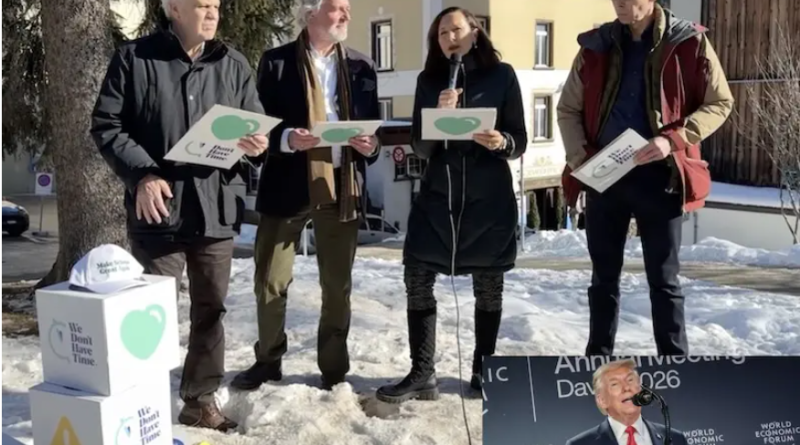
As nearly 2,000 politicians and business leaders gathered behind closed doors at the invitation-only World Economic Forum, a group of climate, social justice, and business leaders assembled by the We Don’t Have Time climate action platform stood outside in bright winter sunshine to present an “alternative” vision of human prosperity: one deliberately set against the message soon to be delivered by Donald Trump.
“We are here today to present a vision of prosperity that is grounded in well-being, for a safe planet,” said Sandrine Dixson-Declève, executive chair of Earth4All. She contrasted it with Trump’s vision, which she said is “grounded in a fossil-fuel driven expansion and deregulation.”
“It hoards prosperity for the few and is contributing to a world that is less safe and less stable for the majority.”
An hour later, when Trump addressed Davos, Dixson-Declève’s description of his vision would be justified. Introduced by billionaire Laurence Fink, CEO of investment behemoth Blackrock, Trump delivered a hectoring speech, insulting Europe’s military capabilities and bragging about the United States navy—though he also backed away from using “excessive strength” to invade Greenland. Trump revelled in the “grow, baby, grow” narrative that his treasury secretary Scott Bessent had just touted at Davos, boasting about U.S. oil supplies.
“Under my leadership, U.S. natural gas production is at an all-time high, by far,” Trump said. That same production boom drove down the prices fossil companies could charge on international markets while also contributing to a spike in energy costs for U.S. consumers.
“U.S. oil production is up by 730,000 barrels a day,” Trump told the Davos audience, “and last week we picked up 50 million barrels from Venezuela alone.” That’s oil lifted from what Politico calls “decayed oil fields in a still socialist-led country amid a global oil glut.” Nevertheless, Trump re-asserted American economic hegemony: “When America booms, the entire world booms. That’s been the history.”
“You all follow us down and you follow us up.”
He went on to deride “the new green scam,” slagging wind turbines while falsely claiming that China’s globe-leading deployment of the technology is a marketing ploy. He ridiculed the United Kingdom’s efforts to regulate drilling in the North Sea and described Greenland as America’s “big piece of ice.”
Outside, Earth4All’s Dixson-Declève urged “the importance of planetary stewardship.”
“In one lifetime, we have become powerful enough to alter the Earth system,” she said. “Every year, the damage to climate and nature continues to draw trillions from the global economy, money that could instead lift millions out of poverty and make a safer and fairer world.”
This widening gyre of harms is accelerating despite “a solid evidence base that investing just one to 2% of global GDP in climate and nature restoration could yield 10 times that value in economic and social returns,” Dixson-Declève added.
The World Economic Forum itself reinforced the point with a July, 2024 report on the US$10 trillion in “nature-positive transitions” that could be “unlocked” worldwide by 2030, with China “poised to capture” 20% of this potential.
Contrary to Trump, whose speech was larded with threats like “Canada lives because of the United States. Remember that next time, Mark [Carney],” Dixson-Declève urged Davos leaders to embrace a vision that “regards a stable planet as our only choice for survival, but also as a lasting opportunity for security and for peace and for prosperity for all.”
Standing alongside Dixson-Declève, Johan Rockström, director of the Potsdam Institute for Climate Impact Research, warned that the burning of fossil fuels is pushing humanity ever closer to “no return tipping points” like melting ice sheets. Such changes will “expose people across the entire world everywhere to profound risk, which will go in many cases beyond adaptation.”
“Staggering” economic costs will mount, he added, as coastal cities are lost to rising seas and health systems are “overwhelmed.” But there still remains an open window, namely, “the full scale phase out of fossil fuels now to a zero-carbon economy within the next 25 years.”
Far from being a path to prosperity, expanding fossil fuels “is a path towards planetary collapse,” Rockström added. “The leaders gathered here in Davos have both the power and the responsibility to change course and to lead the transformation that the world so urgently needs.”
Paul Polman, a former Unilever CEO who was once himself a denizen of the WEF plenary hall and its podiums, now spoke outside. Addressing his business peers, Polman urged them to abandon the beliefs that “protecting nature comes at the expense of economic growth, that destruction and extraction are simply the price we have to pay for capitalism, and that safeguarding ecosystems is therefore bad for business.”
“Nature is not separate from the economy. It sits at its heart,” Polman said.
Carlos Nobre, renowned climate ecologist and senior scientist at the University of São Paulo Institute for Advanced Studies, said the planetary emergency is also a justice crisis.
“Those least responsible for ecological breakdown are being hit first and hardest, facing crop failure, displacement, deadly heat, and rising poverty, [with] Indigenous and marginalized communities on the front lines,” Nobre said.
Cover photo: We Don't Have Time/YouTube. Inset: Heute/CC 4.0