

Chinese Scientists Are Turning Desert Dunes into Soil Using Ancient Microbes
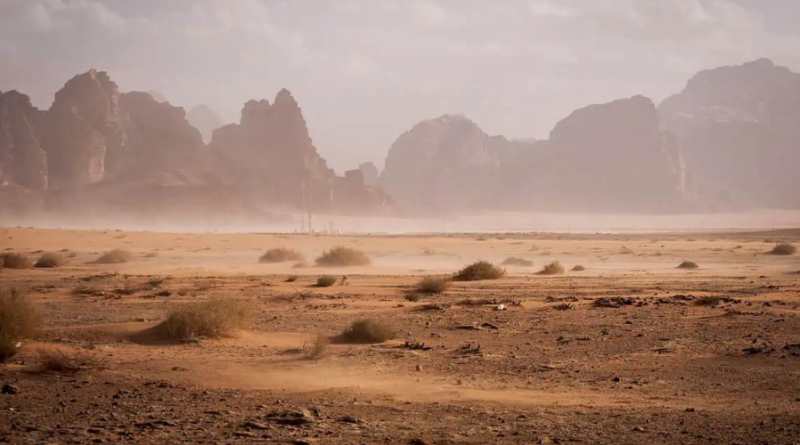
Researchers analyzed 59 years of data to show that adding bacteria to desert sand can rapidly create new soil.
For decades, we’ve been fighting a losing battle against the sand. As temperatures climb and we drain our water reserves, deserts continue their slow, relentless expansion. But a landmark 59-year study from China suggests we’ve been looking at the problem all wrong. Instead of planting trees, we should be planting “seeds” of ancient microbes.
According to the research, these microbes can compress 15 years of natural recovery into a single season. The secret is a strategy called Induced Biological Soil Crusts (IBSCs).
The Original Terraformers
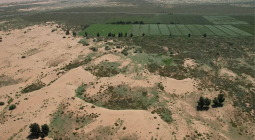
When we try to stop a desert, we usually reach for shovels and saplings. China has done this for years along the edges of the Taklamakan desert with impressive results. But long before trees existed, the Earth already had its own terraformers: cyanobacteria.
These sunlight-powered bacteria are the true pioneers of the desert. When they find even a hint of moisture, they ooze sticky sugars called polysaccharides. These sugars act like a biological glue, binding loose sand grains into a cohesive, living web. They are incredibly resilient, thriving in blistering heat and direct sunlight where most plants would simply wither.
The logic is simple: fix the soil first. By creating a stable crust, you stop the wind from ripping the ground apart. This creates a safe harbor where native grasses and shrubs can eventually take root on their own terms.
But does it work?
The 59-Year Proof
In a study published in Soil Biology and Biochemistry, researchers analyzed samples from a 59-year-long field experiment — the longest of its kind. They compared Natural Biological Soil Crusts (NBSCs), which form on their own over decades, with Induced Biological Soil Crusts (IBSCs) created by seeding the sand with bacteria.
The differences were striking. Under natural conditions, it can take 15 years for a stable crust to form. With “induced” seeding, that window shrinks to 1 or 2 years. But the advantages didn’t stop there. The induced crusts also functioned better. Carbon and nitrogen accumulation increased significantly, correlating directly with the age of the crust.
The most recent breakthrough, however, happened in the Shapotou Desert Research and Experiment Station. Researchers developed “solid seeds” of cyanobacteria that can be used to transform the desert into soil. Initially, scientists tried spraying liquid cultures of cyanobacteria, but that required heavy machinery and electricity — two things rarely found in the middle of a remote dune field.
Now, they’ve turned these microbes into a dry, portable “seed” mixed with organic matter. These can be carried to inaccessible areas and scattered by hand or drone. When it rains, the seeds “activate,” and the glue begins to set.
These crusts are very resilient in some ways. They tend to merge with the natural environment and stabilize to become a permanent, sustainable part of the microbial community. But they’re also fragile: a single tire track or a herd of livestock can shatter a decade of microbial work in seconds.
The Future Is Seed
Desertification currently threatens 40% of the Earth’s land surface. The Chinese approach offers a rare win-win: it restores the ecosystem without the massive water footprint of traditional tree planting.
And this approach could work in many places around the world. It could work in various types of regions and isn’t restricted to only one type of ecosystem. The study showed that these artificial crusts don’t just stay as a monoculture of bacteria. They actually invite “friends.” The induced crusts quickly accumulated nutrients — carbon and nitrogen levels spiked — which acted as a beacon for other species. It turns out that if you give the soil a firm foundation, the rest of the ecosystem knows exactly what to do.
In the next five years, China plans to rehabilitate nearly 100,000 mu (approx. 6,600 hectares) of desert using these solid seeds. It’s not a huge swath of land, but it could be a paradigm shift in fighting the desert. With this approach, we’re not just stopping the sand; we’re helping it live again.
Cover photo: Juli Kosolapova.