For blighted Niger Delta communities, oil spill clean-ups are another broken promise
Many local people are disappointed by efforts to repair the devastation left by foreign oil firms even as the Nigerian government plans to restart drilling
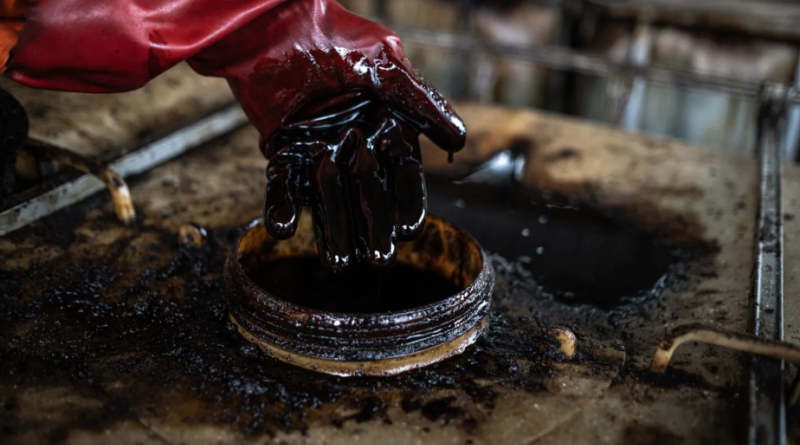
A thick, black liquid bubbles to the surface as Anthony Aalo pokes a stick into the muddy ground just outside Bodo, a fishing and farming community at the heart of Nigeria’s oil-drilling belt.
“You see? That’s oil,” the environmental activist said as he examined the sticky residue. “You can see the level of contamination, it’s still in the ground.”
Bodo, like other parts of Ogoniland in southern Nigeria’s Niger Delta region, still bears the scars of repeated oil spills spanning decades – despite being involved in two major clean-up operations over the last 10 years that promised to restore land and repair environmental damage.
Local fishermen say their catches have still not recovered from a massive 2008 oil spill that polluted the community’s water supplies and farmland, and decimated a nearby mangrove forest.
“Before you would have seen a lot of fish,” said Monday Saka, a 50-year-old fisherman, throwing a fishing net into the water from a traditional pirogue. “[Now], as you throw the net, nothing comes out.”
Big Oil’s environmental destruction
Bodo’s plight has become a symbol of the environmental destruction wrought by foreign oil companies in Nigeria, Africa’s largest oil producer, and the community continues to fight in the courts for adequate compensation to make up for lost livelihoods, health costs and environmental damage.
Shell agreed to pay the community compensation over the 2008 spill, and funded an environmental clean-up that ended last year.
Several sites in Bodo have also been earmarked for remediation as part of a $1-billion government-led clean-up for Ogoniland, billed by the United Nations as the world’s “most wide-ranging and long-term oil clean-up exercise” before work started six years ago.
The site in Bodo where Aalo, the activist, examined the oily ground was included in the first clean-up, but has yet to be reached by the ongoing Ogoniland-wide operation, known as the Hydrocarbon Pollution Remediation Project (HYPREP).
HYPREP, which is funded by a group of foreign oil companies and the Nigerian government, followed a damning 2011 assessment of oil-related damage by the UN Environment Programme (UNEP). The report said it could take 35 years to clean up Ogoniland.
But even as Nigerian President Bola Tinubu and some local leaders push for oil drilling to resume in Ogoniland for the first time in three decades, residents and environmental experts told Climate Home News and IrpiMedia that the government-led clean-up has fallen short of their expectations.
In line with the UNEP report, 65 sites were earmarked for the first phase of HYPREP’s soil and groundwater clean-up operations.
So far, 17 of them have been completed, the project’s leaders said in an update in June, detailing other achievements including the provision of drinking water distribution hubs, a power plant, a university centre of excellence for environmental restoration, and two new hospitals.
It also launched a coastal clean-up – not part of its original remit, which was over two-thirds done by October – as well as mangrove restoration that was 94% finished, according to a more recent statement. In addition, it notes 7,000 jobs have been created and 5,000 local people trained in a range of skills.
Nonetheless, some local activists and residents said HYPREP’s progress has been disappointing, with many blighted communities in Ogoniland not included in the initial list of sites to be remediated.
Others told this investigation that the project has strayed beyond its original remit into high-impact PR activities – such as the new hospitals and university centre, diverting focus from the laborious clean-up work. It takes about two years to clean each of the sites identified in the project’s first phase.
Funding shortfall
At the same time, there has been criticism over the disruption caused by frequent leadership changes.
A lack of money, however, is the biggest problem facing HYPREP today, said Evidence Ep-Aabari Enoch-Zorgbara, an oil and gas development expert and consultant who has previously worked for Shell and the Nigerian government. “Have we done enough? I will say no. Have we used the money well? I will say no. Have we done something? Yes. Are we at ground zero? No,” he said.
The initial $1 billion in funding was meant to cover the first five years of work, but has not been topped up as planned, he said.
A 2025 UNEP assessment of the project said HYPREP’s long-term impacts depend on the replenishment of the trust fund underpinning the process, calling for the Nigerian government to work towards securing lasting funding for the ongoing implementation of HYPREP.
HYPREP and Nigeria’s Environment Ministry did not respond to repeated requests for comment on the project’s finances, but a senior HYPREP official told local media earlier this year that funding was not a problem – without addressing the issue of its future resources.
Doubts over efficacy of clean-up methods
Meanwhile, the labour-intensive work of cleaning contaminated water and farmland inches forward.
At a site near the settlement of K-Dere, contaminated water is pooled in basins, while polluted soil is excavated for treatment. Once the water and soil are cleaned and the pollutants fall below a certain threshold, it can be used again for traditional activities such as farming and fishing.
“We have a lot of work to do and we are trying to do it to the best of our abilities,” said team lead Israel Siglo, walking around the site in orange overalls and a protective helmet.
UNEP has rated such work positively, but independent monitors such as the NGO Stakeholder Development Network (SDN) have questioned some of the clean-up methods and their effectiveness.
Paul Samuel, from the SDN, said the group’s monitoring had found that treating soil with cleaning chemicals before transplanting it back does not tackle groundwater pollution nor make the land fit for agricultural use.
Without tackling contamination deeper in the ground, some experts fear progress made in the first phase could end up going to waste.
“We are about 20-30% of the way through the project, because groundwater remediation is still completely missing,” Enoch-Zorgbara said.
President: “Put this dark chapter behind us”
Last September, when announcing the push to resume oil production in Ogoniland for the first time since protests led by environmental activist Ken Saro-Wiwa in the 1990s, President Tinubu urged the Ogoni people to “put this dark chapter behind us and move forward as a united community”.
In a reminder of the persistent tensions between local people and government authorities 30 years since the execution of Saro-Wiwa by Nigeria’s then-military junta, security personnel with rifles slung over their shoulders keep guard at HYPREP’s headquarters in Port Harcourt.
In June, Tinubu’s government granted a posthumous pardon to Saro-Wiwa, whose killing sparked international outrage.
But for many Ogoni activists, such gestures are a government ploy to access the territory’s hydrocarbon reserves, as oil continues to leak from the aging pipelines criss-crossing the region.
“If there is anyone who needs a pardon, it is the federal government, not the Ogoni people who committed no offence,” said Celestine AkpoBari, a veteran environmental campaigner and coordinator of the Ogoni Solidarity Forum.
Not everyone in Ogoniland is opposed to new oil drilling, seeing it as a source of potential wealth for the region – as long as the lessons of the past are heeded.
Speaking to reporters from his palace in Port Harcourt, King Godwin Bebe Okpabi, the ruler of the Ogale community, said leaving the region’s oil riches in the ground “makes no sense” – even as the world strives to transition away from fossil fuels.
At the same time, King Okpabi is representing his community in a UK lawsuit against London-headquartered Shell and its former Nigerian subsidiary, which was taken over by Renaissance Africa Energy Company.
Having extracted oil in the area for decades, fossil fuel giants including Shell and Italy’s Eni are now accused by the local community of washing their hands of the responsibility for its aftermath by divesting from the region without adequately compensating for the pollution their activities caused.
Shell has denied this, saying Renaissance will remain accountable for any clean-up and remediation work, while Eni has said that, at the time of the sale of its onshore operations, it had remediated “100% of the spills” on its joint venture assets.
TotalEnergies said it had fully met its financial obligations on remediation funding for environmental clean-up and site restoration purposes, including by contributing to HYPREP.
Oil firms blame spills on thieves
Energy companies have often blamed the frequent oil spills in Ogoniland on local oil thieves who drill holes in pipelines.
“This criminality is the cause of the majority of spills in the Bille and Ogale claims, and we maintain that Shell is not liable for the criminal acts of third parties or illegal refining,” a Shell spokesperson said.
But Enoch-Zorgbara and environmental activists say that the spills in Ogoniland were primarily caused by corrosion of aging oil infrastructure.
UNEP’s 2011 environmental assessment came in the wake of the devastating 2008 spill in Bodo, which took place when a decades-old pipeline, then operated by Shell, ruptured and leaked 3,900 barrels of oil for 72 consecutive days.
Black waves of crude swept through the fishing village and the surrounding areas, polluting rivers – a primary source of livelihood – contaminating fields, and destroying natural habitats.
After a group of Bodo residents took Shell to court, it acknowledged the environmental disaster had been caused by the erosion of the pipeline. Shell also agreed to restore the mangrove forest, which had shrunk by two-thirds as a result of the spill, and to pay £55 million ($72 million) in compensation to the community.
The 15,600 people behind the lawsuit received £2,200 each, with £20 million earmarked for community benefits, including a medical centre.
But for Saka, the fisherman in Bodo, the money does not make up for what the community has lost.
“Compared to what the oil destroyed in our river, the compensation is small – it cannot help us,” he said.
Cover photo: By CLIMATE CHANGE NEWS