

AI in Mining: Separating hype from reality
AI in the mining industry includes technologies such as machine learning, computer vision or robotics
Artificial intelligence (AI) is spoken of as a challenge, opportunity, problem, solution, mystery, transformative mindshift and/or next gen miracle for the mining sector to grapple with, sometimes all in one go, and conversations at the Investing in African Mining Indaba conference were no exception.
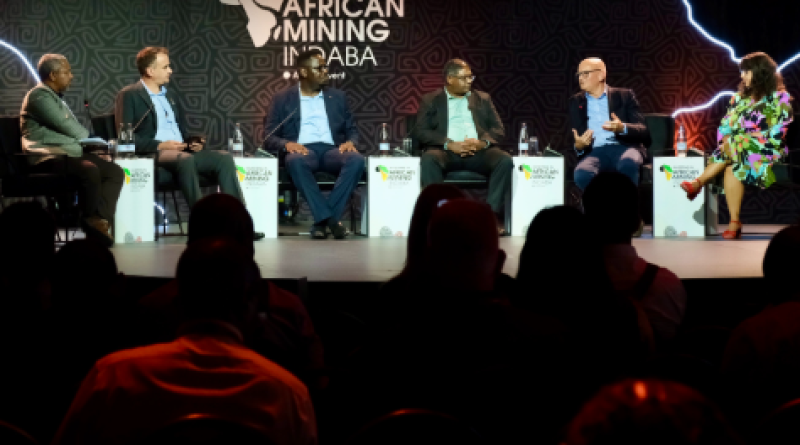
A specific panel discussion on AI in mining – separating the hype from reality, turned out to be a rapid-fire exchange of what is already happening on the ground at various mines around Africa.
Jon Stanton, CEO of Scottish multi-national Weir Group spoke about how the engineering solutions company has added software technology to their ambit, to the point where “AI is becoming embedded in everything we do.”
His view on the energy transition is that if the mining industry is to deliver the “terrific volumes of more metals” required, from existing and new mines, then the pressure is on and the whole industry has to deploy all of the technologies at its disposal.
“That applies to hardware and software and AI has a massive role to play in it. We’re not going to get there by doing the things we’ve always done,” said Stanton.
Weir Group are already applying AI in software such as geological mapping, mine control and dispatch, especially in apps where multiple scenarios need to be explored concurrently, or repetitive tasks need to be finished faster.
“It’s all about how we drive efficiency and sustainability. So, we are doing it, it’s real. We’re just scratching the surface,” said Stanton.
A mine is for mining, it is not a research lab
Prof Glen Nwaila, Director of the African Research Centre for Ore Systems Science (CORE) at Wits University was at pains to point out that mines should never be the test bed for new technologies, that according to him is a job for a university, which should come up with the concept and then build the protocol to allow the technology to meet the mine’s need.
Secondly, the university should act as a buffer between a mining company and a technology. “It’s a sandbox. When looking at AI, the university is the buffer for creating the research and the use case,” he explained.
Nwaila also expects the university to customise the necessary algorithms that will underpin the technology and then teach the students to understand how to use them.
Nwaila said the issue of Intellection Property must be addressed at the beginning, when a mining concern approaches a university to come up with a technological solution. Too often he sees mines being sold a proof of concept when they need proof of value, and he believes the former should be done on the university campus or at a technology lab.
He reminded that mines need technology applications that are not simply isolated to one type of mining situation, but are flexible and adaptable.
Using AI to design from scratch creates a different kind of mine
Mervin Govender, executive head: technical services at Exxaro Resources warned that it is critical get AI applications right before they are implemented on the frontline.
The mining concern was in the fortunate position to build a digital twin of a future mine they wanted to construct. When designing a mine you have to use many different kinds of systems, incorporating geoscience, mobile equipment, fixed equipment, power plants, logistics and supply chain management, all of which come with their own processes and requirements.
One of the early learnings was to be very clear on strategy, and to ask “where does the value sit” about all operations.
Data security was a paramount concern from the get-go, as was physical safety on site, and Govender pointed out that humans are always going to have to be part of the equation.
“We use the AI tool for insights, but not to actually drive the process,” said Govender. “You can’t just apply AI all over. Call it a geofence. Box it, try it and see if it works. If it works, then you apply it elsewhere.”
Interoperability of mining systems
Siemens Sub-Saharan Africa CEO Sabine Dall’Omo says interoperability is not a challenge for them because the technology conglomerate works on applications for automation and process control across the mining sector as well as various industrial sectors.
She pointed out that more than 100 years in the business means they understand mine operations and have helped clients gather massive amounts of data over the years. So cybersecurity has inadvertently become a watchword.
“Data security is all-important. If you cannot trust that the data is secure, it creates risk to human life and production cost,” said Dall’Omo.
Specific to artificial intelligence, she reminded that AI would only be profitable “if you can scale it up”.
Going smart
David Phillpotts, Executive Manager: Measurement & Control at Mintek specialises in advanced process control and he explained that most of the work they do deals with some form of measurement of data and thus potential application of AI. They are looking into the use of digital twins for various processes, for virtual process optimisation and predictive insights.
Phillpotts cautioned smaller operations who want to upgrade to smart technologies that simply tacking equipments and software onto what is already being done is not a solution. “Take a step back and start with the data. Data is the new oil. What you need is clean, contextual, unbiased data,” said Phillpotts.
He pointed out that accessing and integrating data from different networks – such as IT, operational and the internet – creates a configuration management problem and varying ownership of systems comes with its own risks.
When do you want to turn to AI?
One example Phillpotts used is that a power plant operator may not be aware of what a partial shutdown would do to the mining operations. A different example is that ending a relationship with a particular vendor might create a problem when a new vendor tries to access existing data on site.
Phillpotts struck a cautious note when interrogating why a company adopts AI: “We stand the risk of missing the point completely. A lot of these technologies are borrowed from the tech world and with some exceptions, they are not led by the process or automation industries.
“So, kudos and fair play to the tech industry, but they’ve managed to largely outmanoeuvre and outsell the process automation industry. Well done to them but it comes with a few risks. The fundamental physics of the process and economic drivers are not appreciated – they ignore robustness in favour of performance.
“So, what that creates is a risk of ignoring the fundamental problem – solving to unlock value. It’s supposed to be about unlocking smart processes. Taking a tool-first strategy creates AI doing for AI’s sake,” said Phillpotts.
Keep the human in the loop
Govender reiterated the need to keep the human in the loop. “You can’t explain a fatality when you have AI making the decision.
“You can use AI for insight, but you have to have the human make the final decision… For ethical oversight, an AI policy is key to a mining operation.
“You have read about mines getting hacked and losing their process data, so security by design is key and one of the guardrails you need to put in,” said Govender.
Stanton supported the data clarity idea from another point of view. “It’s about the data and you have to have clear standards, common core data,” reinforced Stanton. “Garbage in, then garbage out, so it’s about the quality of the data.” ESI
Cover photo: l-r: Session moderator Dr Quentin Williams, Partner: AI & data, Deloitte; David Phillpotts; Prof Glen Nwaila, Director of the African Research Centre for Ore Systems Science, Wits; Mervin Govender executive head: technical services at Exxaro Resources; Jon Stanton, Weir Group CEO; Sabine Dall’Omo, Siemens SSA CEO, at Investing in Mining Indaba 2026. Source: Hyve Group.