

Africa: Storage drives solar energy growth as costs fall
Africa’s energy transformation is happening fast! In just 12 months, the continent imported 15GW of solar panels, a 60% increase from the previous year
The findings form part of AFSIA’s Africa Solar Outlook 2026 report that argues that the scale of solar energy in Africa has been underestimated, with global manufacturers increasingly viewing the continent as the next major growth market.
In last year’s report, AFSIA identified storage as experiencing a hockey-stick growth curve across the continent, with annual increases of three-, 10- and 11-fold.
The growth was attributed mainly to sustained cost reductions, alongside technology improvements that have made storage solutions more flexible and longer-lasting.
Impact of lower storage costs for solar energy in Africa
The 2026 report notes that continued decline in storage prices has major implications for Africa.
“This ever-decreasing price of storage has game-changing implications for a region like Africa with a dire need for stable and baseload power.
“Indeed, solar has for long been one of the cheapest and most versatile sources of power, but its intermittency and the fact that it is produced only during the day have limited its use in the African energy mix,” says the report. At lower costs, storage can help address these limitations and enable solar to play a larger role in power generation.
The report highlights a study by energy think-tank Ember which demonstrated this potential by analysing the latest storage costs and assessing what it would take to convert “daytime solar” into “fully dispatchable solar.”
Solar becoming more competitive
The Enber analysis found it costs $33/MWh to transform daytime solar into dispatchable solar.
Although the scenario examined focused on Rajasthan in India, a region with high solar irradiation, many African countries enjoy similar solar conditions.
The analysis shows that storing excess solar electricity and releasing it later in the evening, night or early morning costs $33/MWh. When combined with the cost of solar generation in Rajasthan, estimated at $43/MWh, the total cost of around-the-clock solar reaches $76/MWh.
The AFSIA report says this level is already competitive with other forms of firm generation in many markets and is, for example, cheaper than a new gas power plant, particularly where countries rely on costly LNG imports.
Storage unlocking increased solar potential in Africa
The Ember study also states that cheap batteries do more than complement solar – they unlock its full potential.
With storage, solar moves from being cheap daytime electricity to dispatchable, anytime power. Together, solar and batteries are projected to meet a significant share of global energy demand growth over the next decade.
The AFSIA report says, grid tariffs in Africa had not fundamentally changed in US dollar terms by 2025, and in some cases have increased, while the cost of solar generation combined with storage has fallen significantly.
Incorporating lower storage costs, the price range has shifted to between $0.07 and $0.20, accounting for imperfect load curves and solar electricity consumption, it notes.
At these levels, PV combined with battery energy storage systems (PV+BESS) has become highly competitive with commercial and industrial grid prices, and more so with diesel generation.
“In reality, PV+BESS may already be more competitive than the grid in almost all African countries. And there all reason to believe that this trend and the adoption of PV+BESS is going to accelerate over the next few years, as grid prices are invariably increasing over time, while PV+BESS continues its downward slope.”
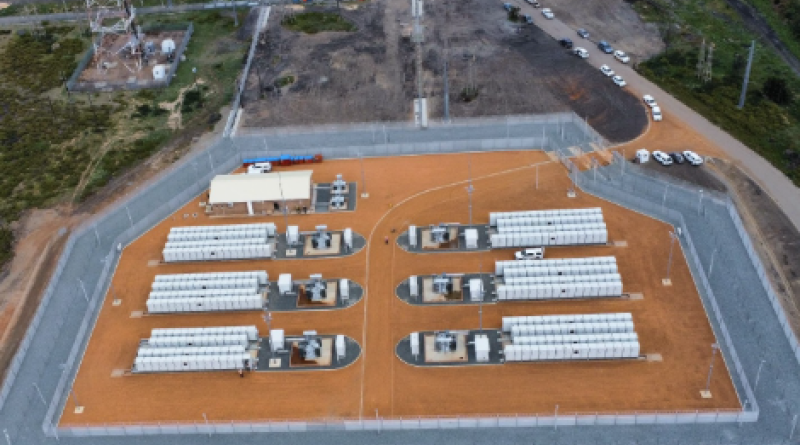
Cover photo: Eskom’s HEX BESS project is the first of the utility’s own-build battery storage projects.