

Africa: Solar market surges as distributed power reshapes energy transition
The report shows that Africa installed approximately 4.5 GW of new solar PV capacity in 2025, representing a 54% year-on-year increase
The renewable energy transition in Africa is entering a faster and more complex phase, with solar PV emerging as a central pillar of the continent’s development, competitiveness and energy security agenda
This is according to the Global Solar Council’s Africa Market Outlook for Solar PV: 2026–2029 report.
“Distributed solar is now growing as fast as utility-scale capacity, driven by low-cost modules, improving battery economics, and emerging local manufacturing ecosystems in countries such as South Africa and Nigeria,” say the Global Solar Council in their latest report.
Supported by stronger economic momentum, falling technology costs and rising demand for reliable electricity, governments across Africa are accelerating renewable deployment as both an energy access solution and a driver of economic resilience.
Economic growth across the continent reached around 3.9% in 2025, with more than 20 countries recording growth rates above 5%, intensifying pressure on already constrained power systems.
Renewable energy commitment across Africa
Against this backdrop, African countries have committed to large-scale renewable expansion, including a continental target of 300GW of renewable capacity by 2030 and initiatives such as Mission 300, which aims to connect 300 million people to electricity.
Solar PV sits at the core of this trajectory, increasingly positioned as the fastest and most scalable solution to meet surging demand.
The report shows that Africa installed approximately 4.5 GW of new solar PV capacity in 2025, representing a 54% year-on-year increase and marking a sharp acceleration in annual deployment across regions. However, growth remains highly concentrated.
- The top 10 solar markets accounted for around 90% of new capacity additions, led by
- South Africa (1.6GW),
- Nigeria (803MW),
- Egypt (500MW) and
- Algeria (400MW),
underlining the continued dominance of established markets.
While Africa’s solar expansion has historically been driven by large, utility-scale projects, the Global Solar Council notes a decisive shift towards distributed and on-site generation across commercial, industrial, residential, mini-grid and off-grid segments.
Ramping up distributed solar capacity
Distributed solar capacity is now growing at a pace comparable to utility-scale installations, driven by lower module prices, improving battery economics and the emergence of local manufacturing ecosystems in countries such as South Africa and Nigeria.
Rising electricity demand, unreliable grids and higher tariffs are pushing households and businesses to generate their own power. This shift is clearly reflected in trade data: Africa imported a record 15GW of solar panels in the year to mid-2025 – far more than utility-scale projects alone can absorb.
On average, utility-scale projects accounted for only about 15% of these imports, pointing to rapid, and often underreported, growth in distributed commercial and rooftop solar installations.
The expansion of distributed solar is increasingly enabling productive and economic uses, ranging from irrigation and agro-processing to refrigeration, small-scale manufacturing and electric mobility charging.
The CBAM effect
Corporate decarbonisation pressures – particularly in response to the EU’s Carbon Border Adjustment Mechanism (CBAM) – are further accelerating uptake, as exporters seek lower-carbon and lower-cost power sources.
Bilateral corporate power purchase agreements, micro-generation subsidies and national electrification strategies, including Mission 300, are improving bankability across residential, commercial and community-level markets.
Mini-grids and off-grid solar are also becoming primary electrification tools for rural and underserved communities, offering the fastest and most affordable pathway to expand access while reducing reliance on costly diesel generation.
Financing challenges continue
Despite falling technology costs and the growing competitiveness of solar-plus-storage, the report identifies finance as the binding constraint on scaling solar across Africa.
Access to capital remains expensive, fragmented and poorly aligned with distributed energy markets. High perceived risk, limited local-currency financing and underdeveloped consumer and SME lending channels continue to slow deployment.
Africa is undergoing what the Global Solar Council describes as a dual energy transition: a state-led expansion of grids and utility-scale projects alongside a rapidly accelerating, privately financed shift by households and firms towards distributed solar and storage.
Yet climate and green finance continue to prioritise sovereign and large infrastructure pathways, leaving the consumer and trade-finance “plumbing” of distributed solar significantly undercapitalised.
Public and development finance still accounts for around 82% of total green finance, although its contribution to energy projects has declined by roughly one-third over the past decade. By contrast, private clean energy investment nearly tripled from $17 billion in 2019 to almost $40 billion in 2024.
Even so, financing costs in Africa remain three to five times higher than in developed markets, suppressing otherwise viable projects.
Addressing risk perceptions for projects in Africa
Structural constraints continue to weigh on deployment. Sub-Saharan Africa mobilises only around $8 billion per year for energy investment, well below the estimated $20 billion annually required to achieve universal access under SDG7.
Grid congestion, underinvestment in transmission and distribution, lengthy permitting processes and off-taker risk – particularly from financially stressed state utilities – further undermine project bankability and concentrate deployment in a handful of mature markets.
The report also flags skills shortages, fragmented regulation, limited transparency and emerging challenges around future PV recycling as risks that could slow scale-up if left unaddressed.
To unlock faster, more inclusive growth, the Global Solar Council calls for a recalibration of risk perceptions to:
- reduce the cost of capital,
- streamlined permitting and licensing,
- improved grid planning transparency, and
- the adoption of portfolio-level procurement approaches.
It also urges governments to embed distributed solar and off-grid solutions at the core of national electrification strategies, modernise results-based financing frameworks and strengthen skills development and local manufacturing ecosystems.
Overall, the 2026 outlook positions solar-plus-storage as a cornerstone of Africa’s leap towards a resilient, decentralised and investment-grade energy system – one capable of supporting access, competitiveness and decarbonisation at scale, if financing and structural barriers can be addressed.
.
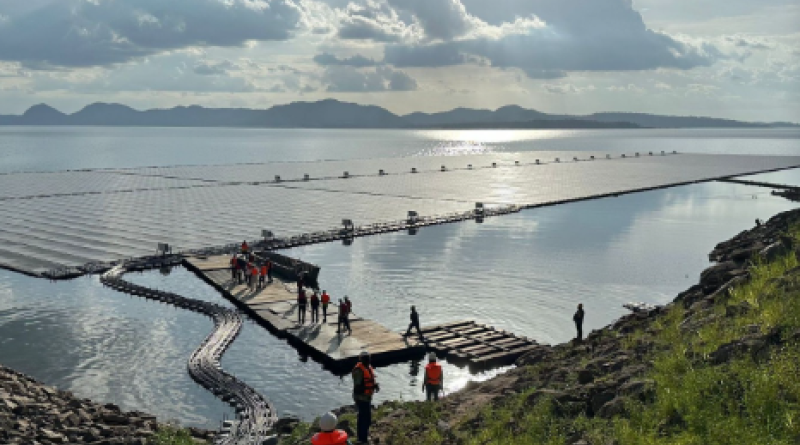
Cover photo: Floating solar panels on the reservoir at Bui Power Station. Image Source: ESI Africa.